

How to win friends and influence Google rankings
Why Off Site SEO Factors Determine Who Actually Wins in Search
The off site SEO factors that shape your search rankings have nothing to do with your website itself — and that’s exactly what makes them so hard to ignore.
Here’s a quick answer if you need it fast:
The core off-site SEO factors are:
- Backlinks – Editorial links from authoritative, relevant websites
- Brand mentions – Linked and unlinked references to your brand across the web
- Digital PR and earned media – Coverage in publications and news sites
- Online reviews and ratings – Signals from Google, Yelp, and industry directories
- Google Business Profile and local citations – NAP consistency across directories
- Social signals – Indirect visibility through shares and community engagement
- AI engine citations – Being referenced by ChatGPT, Perplexity, and Google AI Overviews
Every one of these happens outside your site. You can’t edit them directly. You have to earn them.
That’s the uncomfortable truth most marketers discover too late. You can have a perfectly structured website, fast load speeds, and flawless on-page content — and still sit on page three while a scrappier competitor outranks you. Why? Because they’ve built more external authority.
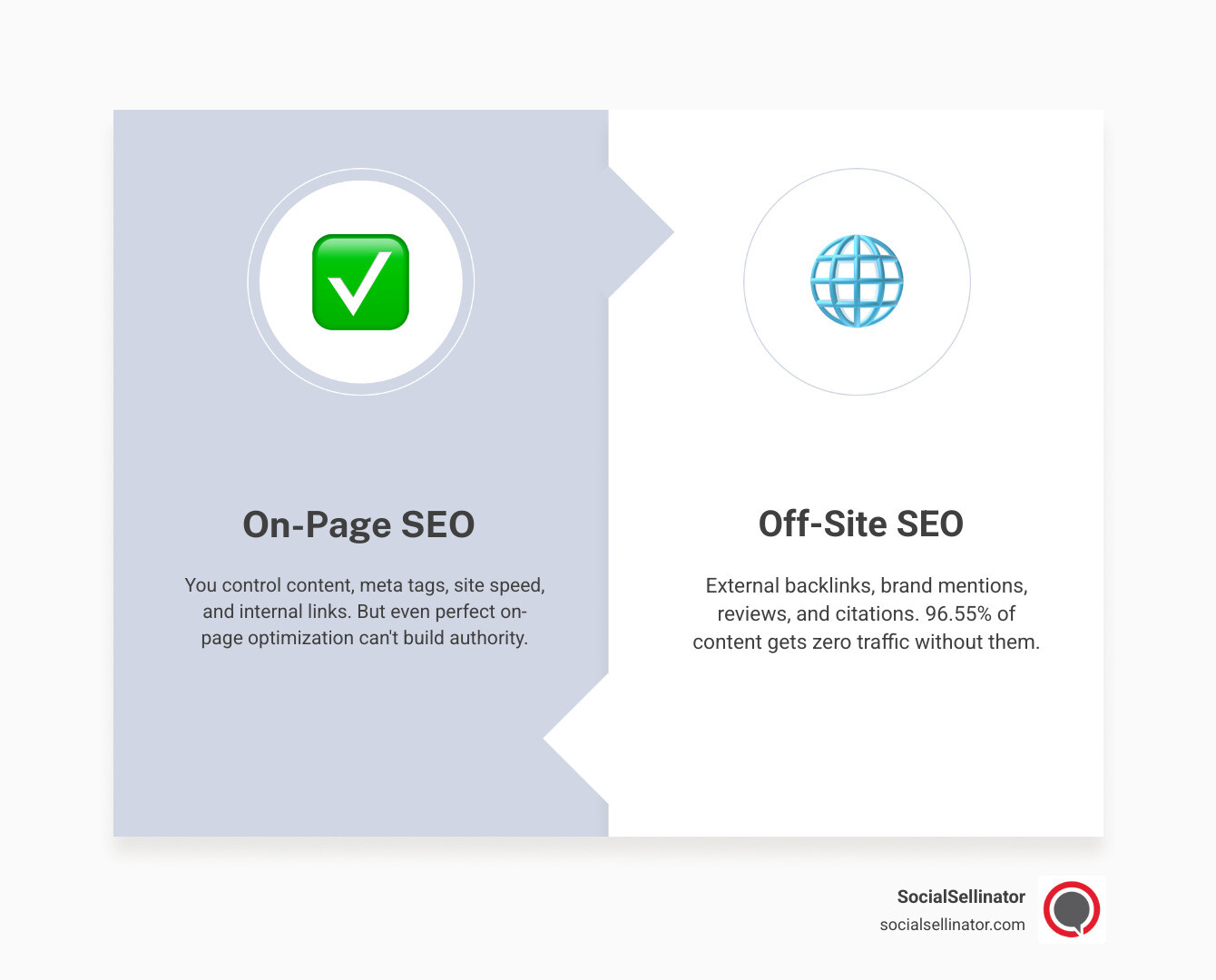
An analysis of 14 billion pages found that 96.55% of content gets zero organic traffic from Google — and a lack of backlinks is one of the three most common reasons. Off-site signals aren’t a bonus feature of SEO. They’re the deciding vote in competitive rankings.
And in 2026, the stakes are even higher. Off-page signals now feed two systems: traditional Google search results and AI answer engines like ChatGPT and Google’s AI Overviews. Your brand’s external footprint determines whether you rank and whether you get cited.
I’m Jock Breitwieser, and in this guide I’ll walk you through every major off-site SEO factor — what it is, why it matters, and how to build it systematically.
Off site seo factors glossary:
- google’s algorithm for ranking web pages
- google site speed ranking factor
- google top 10 seo ranking factors
Demystifying Off Site SEO Factors: The Core Pillars of Authority
To win the search engine game, we must understand that Google does not view our websites in a vacuum. If search algorithms only looked at what we said about ourselves, the web would be a chaotic mess of self-proclaimed experts and low-quality spam.
This is why search engines rely heavily on external validation. When we look at how search algorithms evaluate quality, we find that a significant portion of their ranking calculations is directly tied to off-site signals. If on-page optimization makes your site eligible to rank, it is your off-site footprint that actually determines how far up the search results page you climb.
At its core, off-page optimization is about building digital trust. Think of it as a virtual reputation. When authoritative third-party platforms talk about us, link to us, or recommend our services, they are passing a vote of confidence to search engines. Understanding why seo is important for your business means recognizing that these external votes of confidence are what bridge the gap between being an invisible website and becoming an industry leader.
On-Page SEO vs. Off-Page SEO: Understanding the Divide
While both disciplines are essential components of a unified digital strategy, they operate on completely different levels. On-page SEO is entirely under our internal control. We decide which keywords to target, how to structure headings, how to optimize images, and how fast our pages load. It is a technical science of making our content readable and structured for search engine crawlers.
Off-page SEO, on the other hand, represents our external reputation. It is about what the rest of the internet says about us. While on-page optimization focuses on making your content relevant, off-page optimization focuses on making your brand authoritative.
| SEO Element | On-Page SEO | Off-Page SEO |
|---|---|---|
| Primary Focus | Content relevance, HTML structure, page speed | Authority, brand trust, external validation |
| Control Level | 100% internal control | Indirect control (earned through outreach and quality) |
| Key Activities | Keyword optimization, internal linking, meta tags | Link building, digital PR, local citations, reviews |
| Core Metric | Click-through rate, dwell time, crawlability | Referring domains, brand search volume, citations |
| Target Audience | Search engine bots and direct page visitors | The broader digital ecosystem (publishers, communities) |
Without a balanced approach, even the most beautifully designed, lightning-fast website will struggle to gain traction in highly competitive niches. If your competitors have optimized both their on-page content and their off-page authority, you simply cannot outrank them by focusing on content alone.
The Psychological Shift: From Manipulation to Digital Footprint
Years ago, some marketers treated off-page optimization as a numbers game. They bought bulk link packages, participated in shady link schemes, and spammed blog comment sections to inflate their link counts. But search engines have spent decades refining how they read off-page signals. Today, those old-school manipulation tactics will, at best, be completely ignored and, at worst, trigger severe manual penalties that wipe out your organic visibility.
In 2026, successful off-site optimization requires a major psychological shift. We must stop thinking about how to manipulate search engine crawlers and start thinking about how to build a genuine, cohesive digital footprint.
When we focus on building a real brand reputation, search engine trust follows naturally. This means creating valuable content that people actually want to share, engaging authentically in online communities, and earning coverage in respected industry publications. When real people discover, discuss, and recommend our brand, they generate the precise natural signals that search engines use to measure true authority.
The Power of Backlinks: Why Editorial Votes Still Rule Search
Even as search algorithms evolve to understand brand context and user behavior, backlinks remain the single most influential off-site ranking factor. A high-quality backlink profile acts as an undeniable signal of trustworthiness.
Figure 3: A conceptual map showing how high-authority editorial backlinks distribute equity to a central website. Metadata: Width 800px, Height 450px, Format PNG
But not all links are created equal. In the modern search landscape, the quality of your referring domains matters infinitely more than the sheer quantity of links pointing to your site. Ten links from ten distinct, highly respected industry publications represent ten unique votes of confidence. Conversely, one hundred links from low-quality, irrelevant directories or link farms carry zero weight and can actively harm your brand’s digital standing.
How Backlinks Function as Primary Off Site SEO Factors
To understand why search engines place such a high premium on backlinks, we have to look back at the foundational logic of the web. Links were designed as citations. Just as an academic paper gains credibility when it is cited by other respected researchers, a webpage gains authority when it is cited by other trusted websites.
When a high-authority site links to our content, it passes what we call “link equity” or “authority.” This flow of equity tells search engines that our content is valuable enough to be recommended to their own audience.
Another critical signal within this process is anchor text—the clickable text that houses the hyperlink. When external websites use descriptive, natural anchor text to link to us, it helps search engines understand the exact context of our pages. However, we must ensure our anchor text profile remains natural. Over-optimizing with exact-match commercial keywords can signal automated manipulation, whereas a healthy mix of branded, generic, and partial-match anchors demonstrates organic, earned growth.
Additionally, we must monitor our link velocity—the speed at which our site acquires new backlinks. A sudden, artificial spike of thousands of low-quality links on a brand-new domain is a classic spam signal. A steady, consistent acquisition of high-quality links over time indicates natural, healthy brand growth.
Modern Link Building Strategies for 2026
Earning high-quality backlinks in 2026 requires creative, relationship-driven strategies rather than transactional outreach. Here are the most effective techniques we use to build sustainable authority:
- Being a Data Source: Bloggers, journalists, and industry writers are constantly looking for statistics and data points to back up their claims. By conducting original research, publishing data-driven surveys, or creating comprehensive industry reports, we can position our brand as a primary source. When other creators cite our data, they naturally link back to our site as the original creator.
- Broken Link Building: This classic tactic remains highly effective when executed with a helpful, personalized approach. By identifying dead or broken links on high-authority resource pages within our niche, we can reach out to the site editors, politely notify them of the broken experience, and suggest our own relevant, up-to-date content as a seamless replacement.
- Podcast Guesting: This is one of the most underrated and highly accessible link-building strategies available today. When our team members appear as guests on respected industry podcasts, the hosts almost always include a high-quality, contextual backlink to our website in the show notes. Furthermore, because search engines now transcribe and index audio content, spoken brand mentions on these episodes act as additional authority signals.
- Digital PR and Earned Media: Instead of pitching dry product updates or funding announcements, we focus on pitching journalists with surprising, counterintuitive findings or expert commentary on trending industry news. Earning a feature in a major regional or national publication can secure a high-authority editorial link that drives massive referral traffic and search equity.
By combining these tactics, we can build a diverse, resilient link profile that naturally elevates our rankings. Integrating a smart outreach plan with our broader digital marketing seo social media efforts ensures that every piece of content we create has the opportunity to earn the visibility it deserves.
Beyond Links: Brand Mentions, Digital PR, and E-E-A-T
While clickable links are the easiest off-site signal to measure, search engines have become incredibly sophisticated at reading the unlinked web. Today, a brand mention on a highly authoritative site carries significant weight, even if it does not contain a direct hyperlink.
This shift is closely tied to Google’s Search Quality Rater Guidelines, which place a massive emphasis on E-E-A-T (Experience, Expertise, Authoritativeness, and Trustworthiness). Search algorithms are designed to perform “reputation research” across the web, looking at what independent third parties say about a brand rather than just what the brand claims on its own website.
The Rise of Unlinked Brand Mentions and Entity Mapping
Search engines use advanced entity recognition and natural language processing to build a conceptual map of the digital world. An “entity” can be a person, a place, a business, or a concept. By analyzing news articles, forum discussions, podcasts, and social media, search engines learn to associate our business entity with specific industries, keywords, and geographic locations.
When a respected journalist mentions our brand name in an article about digital marketing, search engines recognize that association. They treat that unlinked mention as an implied link, using it to verify our real-world authority and expertise.
To capitalize on this, we must actively monitor our brand across the web. When we identify unlinked brand mentions on high-quality sites, we can run a polite link reclamation campaign. Reaching out to the author to thank them for the mention and asking if they would mind making it clickable for their readers’ convenience is an easy, highly effective way to convert existing brand equity into powerful backlinks.
Leveraging Social Signals and Community Engagement
There has been plenty of debate in the marketing world about whether social media shares, likes, and retweets directly impact search engine rankings. The reality is that social signals are not direct, algorithmic ranking factors. Because social media engagement is relatively easy to game or automate, search engines do not treat a viral post as a direct measure of website authority.
However, social media plays an invaluable, indirect role in our broader social media and seo strategy. Social platforms act as powerful amplification and distribution channels. When we share high-value content on social media, we get it in front of a massive audience of creators, journalists, and industry professionals.
This exposure drives real-world actions that directly influence our SEO:
- It sparks branded search demand, as users head to search engines to look up our brand name directly.
- It leads to natural link acquisition when bloggers and journalists discover our content on social channels and cite it in their own articles.
- It fosters community discussions on platforms like Reddit and Quora, which search engines increasingly index and surface in search results.
By building an active, authentic presence on social media and engaging genuinely in niche communities, we create a ripple effect that strengthens our overall digital footprint.
Local Authority and the Modern AI Search Landscape
For businesses serving specific geographic markets, off-site optimization is the lifeblood of local customer acquisition. Whether you are looking to capture high-intent search traffic in Austin, Boston, Charlotte, Chicago, Dallas, Denver, Kansas City, Los Angeles, New York, Portland, San Diego, San Francisco, San Jose, or Washington, D.C., your local off-site footprint determines whether you show up in the coveted local Map Pack.
At the same time, we must look ahead to how off-site signals impact modern AI search engines. With AI Overviews and conversational tools like ChatGPT and Perplexity changing how users discover information, the way we optimize our off-site presence must evolve to secure visibility in these generative environments.
Optimizing Off Site SEO Factors for AI Overviews and ChatGPT
AI search engines do not generate answers out of thin air. They rely on the exact same off-page reputation, entity associations, and third-party citations that traditional search engines use to determine which brands are trustworthy.
To ensure our brands are cited in AI-generated answers, we must practice Generative Engine Optimization (GEO). This involves structuring our off-site content and digital PR efforts so that large language models (LLMs) can easily reference and cite our brand.
For AI engines, the primary currency is third-party mention volume in trusted, authoritative sources. Being included in a high-traffic “best of” roundup or featured in an industry-specific publication is incredibly valuable. When an AI search engine synthesizes an answer for a user query, it looks at the prevailing consensus across these trusted sources. If our brand is consistently mentioned alongside top competitors in our space, the AI model is far more likely to recommend us as a trusted solution.
Local Citations, Reviews, and Map Pack Dominance
When it comes to local search, Google’s algorithm relies on three fundamental pillars: relevance, distance, and prominence. While relevance and distance are largely determined by our location and on-page content, prominence is built entirely through our local off-site signals.
To dominate the local Map Pack, we must focus on three core areas:
- Google Business Profile (GBP) Optimization: This is the single most important local off-site asset. We must claim, complete, and actively manage our GBP listing. This means selecting the correct business categories, uploading high-quality photos, posting regular updates, and keeping our operating hours accurate.
- NAP Consistency and Citations: A local citation is any online mention of our business Name, Address, and Phone number (NAP). We must ensure our NAP data is 100% consistent across all major directories, local business listings, and niche industry platforms. Inconsistencies or conflicting details can confuse search engines and damage our local search prominence.
- Customer Reviews and Ratings: Online reviews are a massive ranking factor for local search. Search engines use the frequency, recency, and overall sentiment of our customer reviews to evaluate our real-world quality and trustworthiness. We must actively encourage our satisfied clients to leave honest feedback on our profiles, and we must make it a priority to respond professionally to every review we receive—both positive and negative.
By building a flawless local footprint, we can capture a massive share of local search traffic. If you are looking to elevate your local presence, implementing a comprehensive local seo program is the most reliable way to build lasting regional authority.
Frequently Asked Questions About Off-Site Optimization
We know that off-page optimization can feel incredibly complex, especially with the rapid evolution of search algorithms and AI technology. Here are clear, direct answers to the most common questions we hear from business owners and marketers.
Are backlinks still the most important off-site ranking factor in 2026?
Yes. Despite the rise of brand mentions, entity mapping, and AI search engines, backlinks remain the most powerful off-site ranking factor for traditional search. Search engines still rely on foundational link-based ranking logic, which views high-quality editorial links as the ultimate vote of confidence.
However, the algorithm’s ability to filter out low-quality, manipulative links has never been stronger. Today, a single link from a highly relevant, topically authoritative site in your niche carries more weight than hundreds of generic, low-quality directory links. Focus on earning contextual links from real publications with genuine readership, and your organic rankings will grow steadily.
Do social media shares directly improve Google rankings?
No, social media shares, likes, and comments do not act as direct algorithmic ranking factors. Because social signals are relatively easy to manipulate, search engines do not use them to directly calculate website authority. Most links shared on social media platforms also contain “nofollow” attributes, meaning they do not pass direct link equity to your site.
However, social media is an incredibly powerful distribution tool that indirectly drives SEO success. Sharing high-value content on social channels increases brand visibility, drives high-quality referral traffic, sparks direct branded searches, and gets your content in front of bloggers and journalists who may ultimately write about and link to your business.
How long does it take to see results from off-page SEO?
Off-page SEO is a long-term, compounding investment. Unlike minor on-page technical tweaks that can show immediate results, building external authority takes time. Typically, you can expect to see initial ranking improvements within 3 to 6 months of launching a consistent off-site optimization campaign.
The full, compounding effects of high-quality link acquisition and digital PR generally become most visible after 6 to 12 months. While this timeline requires patience, the authority you build is incredibly durable. Unlike paid advertising, which stops delivering leads the moment you turn off your budget, a strong off-site footprint continues to drive organic traffic, brand trust, and customer conversions for years to come.
Conclusion
Building a powerful online presence requires looking far beyond the borders of your own website. By focusing on the critical off site SEO factors—from earning high-quality editorial backlinks and generating authoritative brand mentions to managing local directory prominence and optimizing for modern AI search engines—you can convince both search engines and real-world users that your business deserves to be recommended.
At SocialSellinator, we understand that busy business owners don’t have the time to manage complex outreach campaigns, monitor brand mentions, or negotiate with publishers. That is why our team of experienced professionals handles the heavy lifting for you. Whether you need to dominate local search results with our specialized seo services in san jose or build a comprehensive digital marketing strategy that spans search and social media, we are here to help your company grow and thrive.
Are you ready to elevate your brand’s digital authority, outrank your competitors, and drive measurable business growth? Get in touch with our team today to find out how we can tailor our digital marketing solutions to your unique business goals.
Headquartered in San Jose, in the heart of Silicon Valley and the San Francisco Bay Area, SocialSellinator proudly provides top-tier digital marketing, SEO, PPC, social media management, and content creation services to B2B and B2C SMB companies. While serving businesses across the U.S., SocialSellinator specializes in supporting clients in key cities, including Austin, Boston, Charlotte, Chicago, Dallas, Denver, Kansas City, Los Angeles, New York, Portland, San Diego, San Francisco, and Washington, D.C.