

Turn Casual Visitors into a Highly Engaged Online Tribe
How to Build an Engaged Online Community
Header image | Subject: Online community interaction | Style: Photorealistic
When organizations set out to build engaged online community platforms, they must give members a clear reason to join and an easy way to take part. Start with a small group of customers, welcome each person, and ask a question they can answer from experience. Keep the conversation going with useful prompts and quick replies. Then track whether members return, help one another, and become advocates.
A social media audience can watch your brand. A community gives people a reason to connect with each other. That shift matters more than a large member count.

Inline image | Subject: Peer-to-peer discussion | Style: Photorealistic
I’m Jock Breitwieser, and I’ll walk you through how to turn that first conversation into a community people want to revisit.
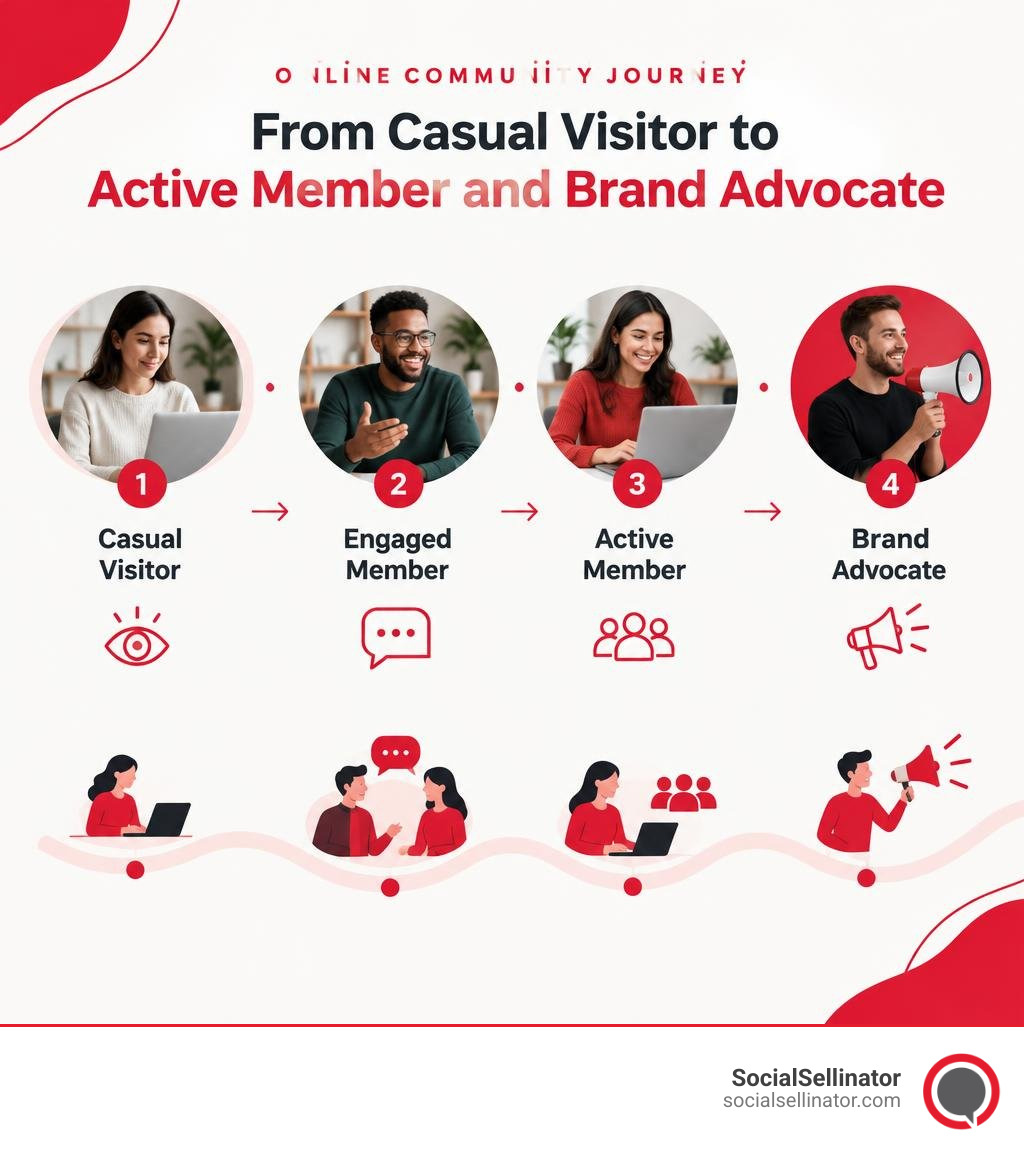
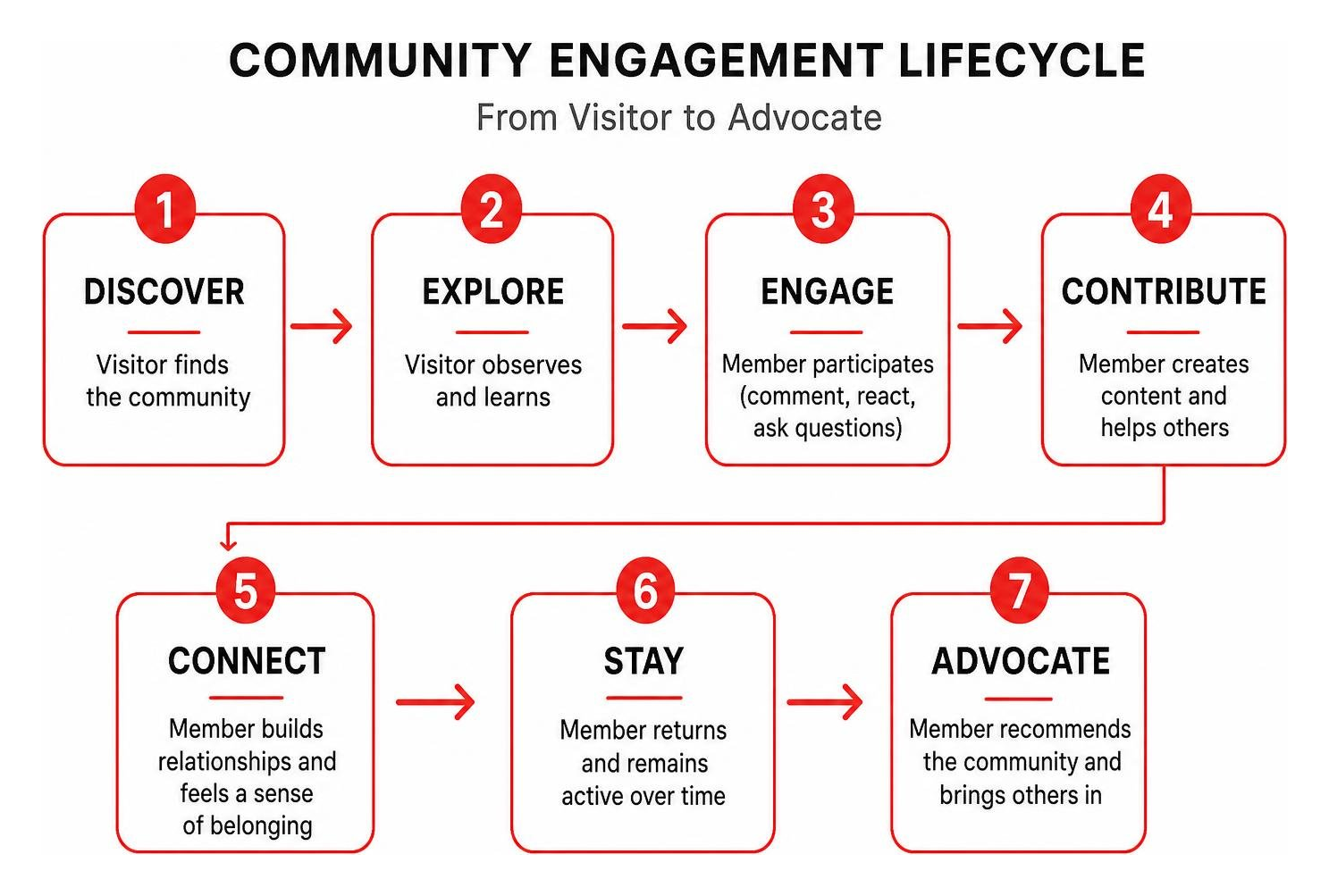
Infographic | Subject: Member journey from visitor to advocate | Format: Step-by-step visual
Introduction
In modern digital marketing, there is a fundamental difference between an audience and a community. An audience sits quietly in a theater, looking up at the stage while you broadcast messages into the dark. A community sits around a cozy café table, looking at one another, swapping stories, solving challenges, and sharing genuine recommendations. When brands treat their digital footprint like a broadcast channel, they end up trapped on an endless treadmill of creating content just to capture fleeting algorithmic attention.
When you foster peer-to-peer relationships, everything changes. Online spaces operate naturally under the classic participation inequality framework—often known as the 1-9-90 rule. In almost any digital collective, roughly 1% of members are super-contributors creating original discussions, 9% actively comment and react, and 90% are quiet observers who consume value behind the scenes.
Recognizing this natural balance is liberating. You do not need 100% of your members posting every day to maintain a healthy ecosystem. The quiet majority often derives immense value from reading practical solutions, applying insights to their workflows, and observing peer discussions. When community managers mistakenly view passive reading as disinterest, they risk forcing unnatural engagement tactics that alienate members.
The human desire for belonging drives long-term customer retention. When buyers feel seen, supported, and connected to peers facing similar journeys, their relationship with your business transcends pricing battles and advertising noise. A well-cultivated community transforms solitary buyers into an invested collective that collaboratively elevates your entire brand.
The Strategic Business Case: Why Brands Need an Owned Digital Home
Building a dedicated digital home is no longer merely a soft public relations initiative or an experimental marketing add-on; it represents a high-yield strategic growth engine. When brands build engaged online community hubs, industry research reveals that these platforms generate an average return on investment of 4,530%. For every single dollar invested in nurturing your community ecosystem, your organization can realize $45.30 in return through increased retention, expanded customer lifetime value, and organic peer-driven advocacy.
Beyond direct revenue acceleration, community-led operations deliver massive operational efficiencies across customer support and service workflows. When customers can turn to a searchable peer forum, an interactive knowledge base, or a dedicated discussion room to troubleshoot technical questions, support ticket volumes decrease significantly. Businesses with established online communities frequently reduce customer support costs by up to 50%, with software and services brands routinely recording a 28% drop in overall service ticket volume within months of launch. Organizations that systematically measure these benchmarks consistently realize compounding gains in customer satisfaction and brand loyalty.
Building authentic social media brand loyalty creates an emotional moat around your product line that competitors cannot easily duplicate. When customers connect regularly within an owned digital space, their purchasing behavior shifts dramatically: highly engaged community members spend an average of 60% more per transaction compared to non-engaged customers. Furthermore, peer recommendations remain the undisputed gold standard of commercial influence. Studies show that 92% of consumers trust organic recommendations from peers over traditional ads, and 76% trust content produced by real individuals over polished corporate advertising campaigns.
| Dimension | Owned Community Hub | Social Media Broadcast Channels |
|---|---|---|
| Communication Flow | Many-to-many peer interactions | One-to-many top-down broadcasting |
| Data Ownership | 100% first-party data and direct contact access | Platform-owned; rented audience |
| Algorithmic Control | Zero algorithmic suppression; chronological access | Heavy algorithmic filtering of business posts |
| Primary Value Asset | Searchable collective knowledge and relationships | Fleeting, perishable content feeds |
| Support Deflection | High self-service resolution and peer troubleshooting | Low; public customer complaints dominate |
| Conversion Influence | Sustainable advocacy and recurring revenue | Transactional, single-touch ad conversions |
Websites featuring integrated online communities attract twice as much organic search traffic and generate up to three times more revenue than isolated brochure sites. Rather than leaving your customer relationships vulnerable to sudden algorithm shifts or rising pay-per-click advertising costs, owning your community infrastructure provides long-term stability and compounding commercial value. By connecting your community data directly into your SEO and content creation workflows, you can systematically identify the exact topics and questions your target audience searches for every day.
Core Principles to Build Engaged Online Community Foundations
A thriving community cannot survive on broad, generic topics. If you build a general discussion group for “business growth” or “wellness,” you will inevitably attract disjointed noise. Lasting communities are built on four foundational pillars:
- Niche Definition: Pinpoint the exact intersection where your distinct expertise solves a recurring, specific challenge for a well-defined cohort. Specialization breeds relevance, trust, and authority.
- Transformation Promise: Frame your space around a clear, tangible outcome. Members do not join for software features or discussion boards; they join to evolve from their current frustration to an aspirational identity.
- Psychological Safety: Foster an environment where members can share real vulnerabilities, confess professional hurdles, and celebrate small wins without fear of spam, mockery, or aggressive sales pitches.
- Sustainable Trust: Deliver consistent, value-first moderation that prioritizes authentic peer support over immediate commercial extraction, demonstrating that member growth always comes first.
The Step-by-Step Blueprint to Build Engaged Online Community Spaces
Launching an online group to hundreds of strangers all at once almost always leads to a ghost town. When hundreds of users enter an empty digital room simultaneously, everyone stands quietly against the wall waiting for someone else to break the ice. To prevent this cold-start problem, seasoned community builders rely on the “white-hot coal” methodology.
Instead of opening the floodgates to a broad audience, begin with a small, hand-selected founding member cohort of 20 to 50 active advocates, power customers, or trusted industry peers. Before onboarding this group, pre-seed the community with 5 to 10 rich, practical conversation starters, resource templates, and thought-provoking prompts. When your founding members arrive, the space already feels warm, inhabited, and intellectually stimulating.

Inline image | Subject: Community management setup | Style: Photorealistic
Partnering with an agency for expert community management helps establish these critical operational workflows right from the start, ensuring proactive moderation, timely seed conversations, and structured engagement frameworks.
Defining Purpose, Member Personas, and Participation Rules
Every sustainable community begins with a crisp purpose statement that articulates who the group serves, what shared goals unite them, and how they interact. A compelling purpose statement acts as a north star for moderation decisions and helps prospective members immediately self-select into the space.
Once your transformation statement is clearly defined, establish detailed member personas. Categorize your audience based on their career stage, daily operational bottlenecks, and preferred learning styles. Are they early-career practitioners seeking tactical templates, or senior executives looking for strategic sanity checks? Designing distinct pathways for different member profiles ensures that both novices and veterans find relevant discussions without feeling overwhelmed.
Clear, transparent community guidelines preserve cultural integrity as membership scales. Outline expectations regarding self-promotion, respectful debate, and privacy. Post plain-language ground rules prominently in your onboarding sequence, establishing zero-tolerance policies for unsolicited direct-message spam and aggressive product pitches.
Structuring Focused Spaces for Connection Rather Than Noise
A common pitfall in new communities is creating dozens of hyper-specific channels on day one. When members see dozens of quiet discussion rooms, the entire platform feels deserted. Start with a lean, purposeful architecture containing no more than four to six core channels:
- Welcome & Introductions Lounge: A dedicated landing space where new members introduce themselves using a structured three-question prompt and receive warm welcomes from community leaders.
- The Main Brain Trust: A centralized forum space for substantive questions, strategic debates, industry news, and collaborative problem-solving.
- Curated Resource Vault: An organized library containing downloadable templates, standard operating procedures, expert webinars, and playbooks.
- Wins & Celebrations: An uplifting space designed exclusively for members to showcase revenue milestones, project launches, career pivots, and personal breakthroughs.
- Mastermind & Sub-Cohorts: Private, permission-gated channels reserved for dedicated accountability pods, advanced certification groups, or geographic chapters.
Proven Rituals and Tactics to Drive Continuous Member Retention
Communities do not thrive on accidental participation; they thrive on dependable, anticipated rhythms. Predictable rituals give members a psychological anchor, establishing habits that bring them back into your ecosystem week after week.
Consistently driving social media audience engagement requires blending structured weekly prompts with dynamic live experiences. Incorporating authentic, member-created user-generated content reinforces community ownership and transforms passive readers into vocal advocates. When members see their peers highlighted on the main stage, it validates their contributions and encourages others to share their own stories and expertise.
How to Build Engaged Online Community Rituals That Keep Members Active
To keep conversations fresh and meaningful without overwhelming your moderation team, implement a sustainable weekly cadence:
- Monday Momentum: A concise prompt asking members to declare their top two strategic priorities for the coming week.
- Tip Tuesday: A bite-sized, actionable tutorial or breakdown addressing a common industry hurdle.
- Mid-Week Ask-Me-Anything (AMA): Regular live Q&A sessions featuring internal leadership, product designers, or notable external practitioners dissecting specific case studies.
- Coffee Roulette: Automated or concierge-matched 15-minute virtual networking pairings that connect complementary members for peer-to-peer relationship building.
- Friday Wins & Reflections: An open floor inviting the community to celebrate completed deliverables, lessons learned, and client breakthroughs.
Leveraging Hybrid Gatherings and User-Led Discussions
While asynchronous forums provide convenience, live touchpoints generate deep emotional connection. Integrating hybrid brand community events allows you to bridge geographic boundaries, combining the intimacy of local meetups with the broad accessibility of global digital livestreams.
As your community matures, identify your top 5% of super-contributors—those members who consistently answer questions, provide thorough feedback, and support peers. Empower these individuals by delegating community leadership responsibilities. Elevate them to official roles such as Cohort Leads, Community Mentors, or Discussion Facilitators. When members lead discussions, your ecosystem becomes genuinely self-sustaining and less reliant on your internal staff.
To maximize long-term retention, consider integrating periodic gamification and recognition systems. Simple gestures like member-of-the-month spotlights, verified contributor badges, and private advisory invites reward meaningful behavior without trivializing participation. When paired with responsive moderation and high-value educational programming, these community rituals create compounding engagement loops that keep your digital home active, welcoming, and deeply relevant.
Platforms, Monetization Models, and Scaling Architecture
Selecting the right technological foundation depends on your target audience’s daily habits, your content format, and your long-term business model. The goal is to choose an environment that minimizes friction and maximizes meaningful peer interactions.
| Platform | Primary Strength | Ideal Business Model | Tech Ecosystem Fit |
|---|---|---|---|
| Circle | Clean modern UI, spaces for courses, rich events | Branded memberships, creator cohorts, premium B2B | Excellent integrations with Webflow, Zapier, Stripe |
| Mighty Networks | Structured learning paths, native mobile app options | Cohort-based courses, community-led academies | Strong all-in-one platform for courses and groups |
| Discord | Real-time voice, text channels, active developer ethos | Tech-savvy niches, Web3, gaming, real-time chat | Highly customizable with community bots and webhooks |
| Discourse | Searchable knowledge base, long-form discussion forums | Open-source software, technical support hubs | Superior SEO indexing and long-term data archiving |
Monetizing an online community should reinforce trust rather than create barriers. Successful models include:
- Tiered Premium Memberships: Offering free general discussion spaces alongside premium tiers that include monthly mastermind access, private advisory calls, and exclusive resources.
- Integrated Micro-Courses & Certifications: Bundling on-demand training curricula with structured peer review channels and accountability cohorts.
- Exclusive Masterminds & Executive Circles: Gating small, curated mastermind roundtables behind an application process, providing executive-level networking.
- Sponsored Showcases & Affiliate Partnerships: Collaborating with carefully vetted, non-competing vendors to provide exclusive tool discounts and sponsored workshops.
When scaling infrastructure, ensure that your community platform integrates seamlessly with your customer relationship management software, email marketing automation, and analytics tracking. This data alignment allows your marketing team to track how community engagement impacts conversion funnels, pipeline velocity, and customer renewal rates, providing complete transparency into the commercial value generated by your community investments.
Measuring Community Health and Avoiding Critical Mistakes
Managing a community purely by total member count is a dangerous trap. A bloated membership roster filled with inactive accounts generates zero business value. Instead, focus on actionable engagement and business impact metrics:
- 30-Day Activation Rate: The percentage of newly registered members who complete their profile, post an introduction, or reply to a thread within their first 30 days.
- Monthly Active Members (MAU / WAU): The ratio of members actively participating, reacting, or contributing over rolling 30-day and 7-day windows.
- Reply-to-Post Ratio: The average number of peer responses each new discussion receives. Healthy communities typically maintain a ratio between 3:1 and 8:1.
- Customer Retention & Lifetime Value Lift: The percentage increase in product renewal rates and contract expansion among community members compared to non-members.
- Support Deflection Savings: The quantified dollar value of customer support tickets resolved by community discussions rather than paid support staff.
To safeguard your community’s health, steer clear of the four most common operational missteps:
- Premature Expansion: Launching too many discussion channels before establishing a dense core of regular daily interaction.
- Over-Moderation: Policing conversations so strictly that members feel micromanaged and hesitate to share authentic opinions.
- Aggressive Commercial Pitching: Treating your discussion board as an advertising billboard rather than an educational sanctuary.
- Founder Dependency: Failing to empower volunteer leaders, leaving the entire community dependent on a single company executive to generate discussions.
By tracking the right health indicators and avoiding these operational pitfalls, your team can maintain a dynamic, self-sustaining community environment that continues delivering measurable business value month after month.
Frequently Asked Questions about Building Online Communities
What is the main difference between a social media audience and an online community?
A social media audience represents a one-to-many broadcast relationship hosted on rented digital real estate. The platform controls your distribution through shifting algorithms, and followers primarily consume your posts without interacting with one another.
An online community is a many-to-many ecosystem built on owned infrastructure. Members actively network, support each other, and exchange knowledge independently. You retain 100% ownership of your member data, communication channels, and direct contact access.
How do you solve the cold-start problem when launching a community?
To solve the cold-start problem, avoid public mass launches. Instead, execute a curated founding member beta by hand-picking 20 to 50 active brand advocates.
Before inviting them, pre-seed the community with 5 to 10 practical questions, industry templates, and conversational prompts. Personally welcome every founding member, tag them in relevant discussions, and encourage them to share their expertise. Once this core group establishes a warm, active culture, open the community to broader membership.
How can brands accurately measure the ROI of an online community?
Brands measure community return on investment across three key dimensions:
- Support Cost Reduction: Tracking the volume of support tickets deflected through peer-to-peer troubleshooting and searchable solution threads.
- Retention and Expansion: Comparing the renewal rates, churn metrics, and average customer lifetime value of active community members against non-members.
- Product Acceleration & Co-Creation: Quantifying the value of rapid feedback loops, user-sourced beta testing, and organic product feature validation.
Conclusion
Building a vibrant, engaged digital home transforms your customer base from passive buyers into an active, self-sustaining tribe. When you provide authentic peer connection, clear participation rituals, and safe spaces for shared learning, your community becomes an unshakeable competitive advantage that compounds in value over time.
Scaling an engaged community requires deliberate strategy, consistent moderation, and seamless alignment across your digital marketing ecosystem. If your team is ready to cultivate lasting brand advocacy, explore our professional social media management services to build a comprehensive community growth strategy tailored to your business goals.
Headquartered in San Jose, in the heart of Silicon Valley and the San Francisco Bay Area, SocialSellinator proudly provides top-tier digital marketing, SEO, PPC, social media management, and content creation services to B2B and B2C SMB companies. While serving businesses across the U.S., SocialSellinator specializes in supporting clients in key cities, including Austin, Boston, Charlotte, Chicago, Dallas, Denver, Kansas City, Los Angeles, New York, Portland, San Diego, San Francisco, and Washington, D.C.