

Demystifying Ranking Signals: Why Half the Rules You Follow Don’t Matter
Search Engine Ranking Factors: What Actually Matters Now
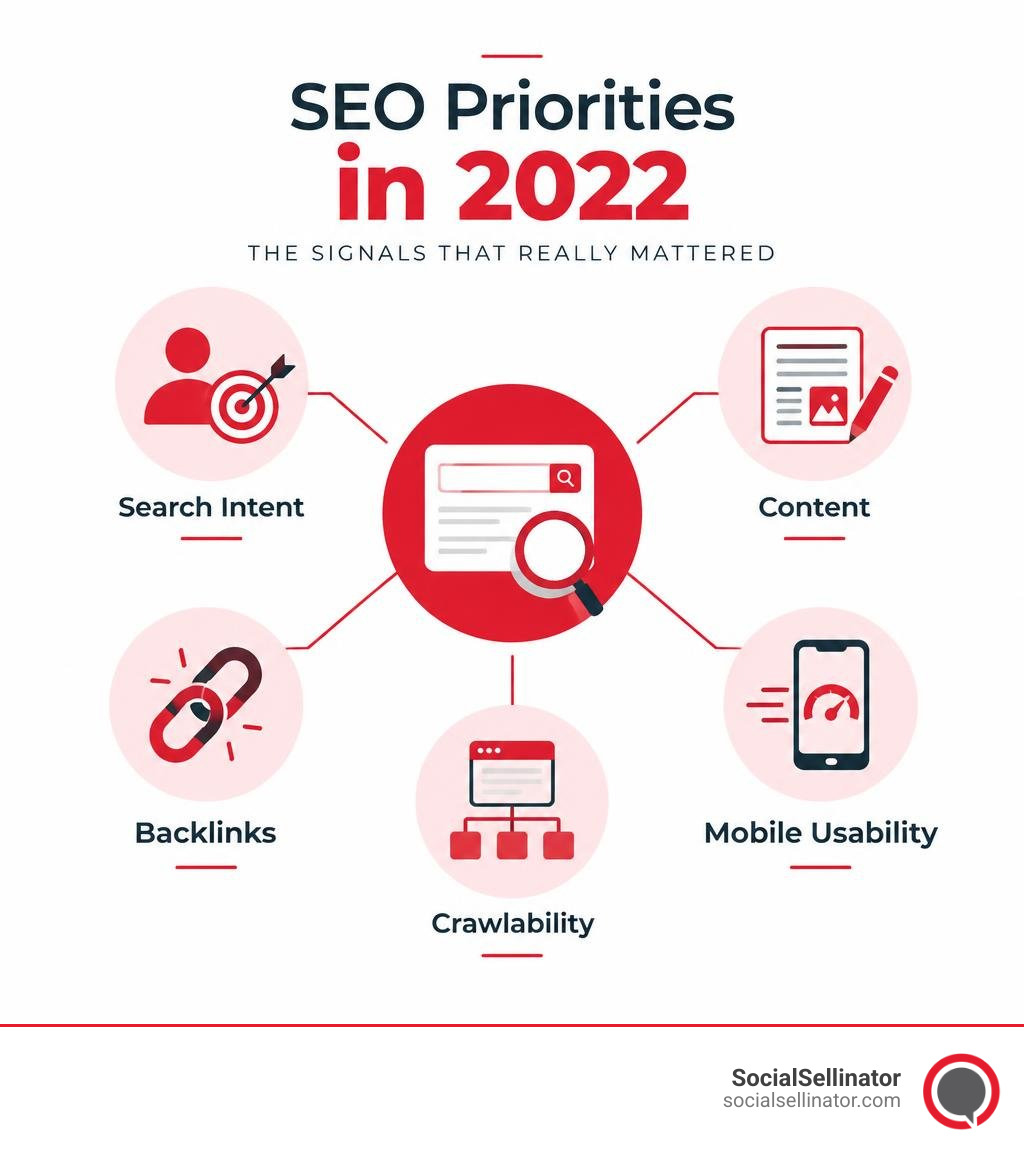
When evaluating how search engine ranking factors 2022 laid the groundwork for today’s search landscape in 2026, one core reality stands out: sustainable search optimization has always depended on matching user intent rather than gaming algorithmic loopholes. If you are revisiting those foundational benchmarks and wondering which lessons still apply today in 2026, start with five priorities: match search intent, publish useful and accurate content, earn relevant backlinks, make pages easy to crawl, and give mobile visitors a fast, usable site. There was no fixed checklist that could guarantee a top spot then, and there still isn’t one now. Google weighs signals differently depending on the search query.

That distinction matters when your time and budget are tight. A longer article or a higher click-through rate is not a shortcut to better rankings. Fix the gaps that keep people from finding or using your best pages first.
I’m Jock Breitwieser, and I’ll help you sort the ranking signals worth your effort from the rules you can stop chasing.
Helpful resources to guide your search strategy:
- Understanding the search engine ranking meaning
- Conducting a regular seo rankings check
The Reality Behind Search Engine Ranking Factors: Myth vs. Core Signals
For years, the digital marketing industry operated under the premise that ranking on Google meant checking off items on an imaginary, monolithic scorecard. Marketers scrambled to hit arbitrary word counts, inject exact keywords a set number of times, or buy high quantities of links. However, modern search algorithms operate on sophisticated probabilistic models rather than rigid, static checklists. In 2026, comprehensive academic and industry research on Search Engine Result Page (SERP) positions confirms that topical relevance, authority, and technical usability consistently outweigh superficial metrics.
Understanding organic search requires analyzing the distinctions between ranking factors, ranking signals, and ranking systems. A factor is a high-level condition (such as relevance or authority). A signal is a measurable data point evaluated in real time (like anchor text context, content freshness, or page load metrics). An algorithmic system is the overarching automated software engine—such as RankBrain or the Helpful Content System—that processes hundreds of signals simultaneously to compute search results.
| Element Type | Definition | Primary Examples | Algorithmic Role |
|---|---|---|---|
| Ranking Factor | High-level criteria determining topical fitness and trustworthiness. | Relevance, Domain Authority, Experience, Page Usability. | Sets the broad criteria for what constitutes a high-quality search result. |
| Ranking Signal | Specific, measurable data points collected from pages, links, and user interactions. | Anchor text context, HTTPS protocol, LCP load time, schema markup. | Provides real-time inputs into machine learning models to adjust individual page rankings. |
| Algorithmic System | Specialized sub-engines within Google’s core architecture. | RankBrain, BERT, MUM, Deduplication, Helpful Content System. | Interprets queries, synthesizes context, and applies ranking weights dynamically. |
When we evaluate the mechanics of search engine results, it becomes clear that no single signal operates in a vacuum. Instead, ranking systems synthesize vast data clusters to present the most helpful answer for a specific user query.
Factors, Signals, and Algorithms: Defining the Architecture
To understand how modern search engines function, we must peel back the layers of automated infrastructure. When you examine the process of cracking the code of Google’s ranking systems, you see an ecosystem of interconnected models working in harmony.
First, crawling and indexing systems catalog the web. The Caffeine update established a continuous global index, allowing Google to parse and update portions of the web instantly rather than waiting for massive, batch-driven index refreshes. Once indexed, query interpretation systems take over.
- RankBrain: Introduced as a core machine learning system, RankBrain helps Google interpret unfamiliar phrases, conversational language, and colloquialisms. It evaluates how words relate to underlying concepts, predicting search intent even when a user mistypes or uses ambiguous phrasing.
- Neural Matching: This system connects queries to web documents by matching underlying concepts rather than relying purely on identical strings of text. It enables search engines to map colloquial questions to expert technical resources.
- Deduplication Systems: When multiple URLs present nearly identical content, deduplication systems select the canonical version to avoid cluttering the Search Engine Results Pages (SERPs) with repetitive listings.
- Removal-Based Demotion Systems: These automated filters apply sitewide demotions if a domain exhibits high volumes of legal takedowns, personal data removal requests, or copyright infringements.
- Freshness Systems: For search queries that are time-sensitive, such as breaking news, trending events, or annual tax compliance deadlines, freshness algorithms prioritize recently updated documents over historical archives.
- Page Layout and Above-the-Fold Filters: Algorithms systematically evaluate whether content is immediately accessible or obscured by intrusive interstitials, aggressive pop-ups, and overwhelming ad units.
- SpamBrain AI Architecture: An artificial intelligence-based spam prevention system that actively detects unnatural link schemes, hacked spam, and scraped low-quality copy across billions of indexed pages.
These interconnected systems ensure that raw signals—such as keyword frequency, header structure, or outbound links—are weighted according to the topical category, intent nuance, and user context.
Debunking the 200 Ranking Factors Myth
The popular belief that Google uses an exact list of “200 ranking factors” originated largely from an offhand comment made during a 2009 industry presentation. While the number stuck as an enduring industry myth, the reality of modern algorithmic architecture is far more nuanced.
Search engines evaluate hundreds of signals, but they do not assign equal weight to each one across every vertical. Modern search engine codebases and industry analyses demonstrate that search engines utilize hundreds of distinct signals as dynamic variables rather than static checklists. These findings confirm what seasoned SEO professionals have long argued: search algorithms rely on a small cluster of foundational signals—content relevance, link authority, and technical usability—while hundreds of minor signals act merely as situational tiebreakers.
This reality aligns directly with the Pareto principle: roughly 20% of SEO signals drive 80% of your organic search performance. Chasing marginal signals (such as obsessing over exact keyword density percentages, micro-formatting variations, or minor domain registration details) provides diminishing returns. Instead, sustainable growth comes from mastering the core pillars that search engines rely on to satisfy their users, integrating strong content creation with disciplined technical maintenance.
The Core Ranking Triad: Content, Intent, and E-E-A-T
When industry surveys evaluate what drives organic visibility, relevance consistently ranks as the single most critical factor, with content quality and topical authority close behind. Together, these elements form the fundamental triad of modern search optimization.
Executing effective on-page SEO optimization requires moving past superficial keyword insertion. Modern algorithms evaluate topical depth, structural clarity, entity relationships, and the presence of verified facts.

Core Content Signals and Modern Ranking Benchmarks in Action
In an era saturated with automated publishing, original value has become a decisive differentiator. Pages that feature proprietary surveys, industry observations, and unique media consistently outrank regurgitated content. Understanding comprehensive SEO content strategy involves designing content architectures that answer both primary questions and relevant secondary queries.
Key elements of high-impact content include:
- First-Party Data and Original Research: Case studies, independent survey results, proprietary market statistics, and original data graphics that naturally attract editorial links.
- Structured Topical Completeness: Comprehensive coverage that answers natural follow-up questions without introducing irrelevant filler text or tangential fluff.
- Passage-Level Answer Architecture: Using clear H2 and H3 subheadings with direct, concise summary answers beneath them, allowing Google’s Passage Ranking system to pull specific excerpts into search snippets.
- Logical Visual Media and Diagrams: Informative flowcharts, data graphs, and contextual images with descriptive alt text that support reader comprehension and entity identification.
- Semantic Entity Enrichment: Referencing industry-standard terminology, related entities, and contextual concepts that help natural language processing models accurately map topic depth.
- Information Gain Score: Providing net-new perspectives and supplementary facts rather than merely paraphrasing what existing ranking pages already contain.
An industry study examining first-page Google results found that the average top-ranking webpage contains approximately 1,400 words. However, word count itself is not a direct ranking factor; rather, comprehensive, well-structured pages naturally require sufficient depth to resolve complex user problems thoroughly.
Search Intent Matching and Language Models (BERT & MUM)
Matching search intent is the primary hurdle in organic search. If a searcher wants a quick calculation tool, an in-depth 3,000-word historical essay will not rank, regardless of how many backlinks it holds. Search intent typically breaks down into four primary classifications: informational (seeking answers or instructions), navigational (locating a specific website or portal), transactional (preparing to complete a purchase), and commercial investigation (comparing services, pricing, or product specifications).
Google relies heavily on advanced transformer models like BERT (Bidirectional Encoder Representations from Transformers) and MUM (Multitask Unified Model). Introduced to handle complex queries, BERT processes words in relation to all other words in a sentence rather than one-by-one in sequence. This allows the algorithm to understand the nuance of prepositions (such as “for” or “to”) and contextual negation. MUM builds upon this foundation by processing multimodal information across text, images, and multiple languages simultaneously to answer multi-step conceptual queries.
Rather than trying to outsmart algorithms with repetitive phrasing, moving beyond keyword stuffing means writing naturally for human readers. Google’s synonym system affects more than 30% of all searches across languages. The search engine understands semantic relationships, topical synonyms, and conversational intents, making natural phrasing far more effective than rigid keyword density formulas.
E-E-A-T and the Harm-Based YMYL Evaluation
Google’s Search Quality Rater Guidelines provide a clear blueprint for how human raters evaluate content quality, which Google uses to calibrate its automated ranking systems. The framework centers on E-E-A-T: Experience, Expertise, Authoritativeness, and Trustworthiness. While all four elements contribute to page evaluation, Trustworthiness sits at the center as the foundational metric—without demonstrated trust, perceived experience or expertise cannot overcome poor accuracy or deceptive claims.
Google evaluates Your Money or Your Life (YMYL) content through a harm-based approach. Under this standard, any topic that could cause significant physical, financial, emotional, or societal harm if presented inaccurately is subjected to rigorous scrutiny.
To establish strong E-E-A-T signals across your domain:
- Highlight Author Credentials: Provide verifiable author bios detailing industry experience, formal credentials, certifications, and links to professional publications.
- Demonstrate Firsthand Experience: Incorporate original photographs, real-world case studies, proprietary customer data, and clear statements of testing methodology.
- Maintain Editorial Transparency: Clearly display publication dates, author attributions, editorial review disclosures, and accessible contact details on corporate pages.
- Eliminate Factual Inaccuracies: Cite authoritative primary sources, clinical studies, industry standards, or official regulatory bodies to support data-heavy claims.
- Demonstrate Brand Reputation: Garner genuine customer testimonials, independent reviews, and third-party media mentions that validate company standing.
Authority and Link Architecture: Do Backlinks Still Rule the SERPs?
Despite persistent claims that link building is declining in importance, inbound links remain a cornerstone of search engine ranking architecture. Industry surveys across hundreds of digital marketing and SEO specialists consistently show that high-quality backlinks remain among the top three most influential ranking signals. While acquiring editorial links through standard manual outreach has grown increasingly competitive, the equity passed by authoritative, topically relevant links continues to drive core domain visibility and search engine confidence.
Executing effective off-page SEO link building strategies requires focusing on the quality, relevance, and natural acquisition of links rather than sheer volume. A single link from a recognized industry publication can deliver more organic impact than hundreds of low-tier directory entries.
The Modern Value of Topically Relevant Backlinks
In modern algorithmic evaluations, not all backlinks carry equal weight. Search engines evaluate the link’s surrounding context, the topical authority of the referring domain, and the natural distribution of anchor text. Links embedded within high-value editorial commentary act as genuine endorsements of your organization’s subject matter expertise.
Modern link acquisition requires moving beyond standard outreach to earn high-quality backlinks, focusing instead on producing original industry studies, developing free business tools, and generating earned PR coverage.
Key characteristics of high-value backlinks include:
- Topical Alignment: A link originating from an authoritative industry publication within your niche carries far more weight than a link from an unrelated domain.
- Anchor Text Diversity: A natural link profile includes a balanced mix of branded terms, exact-match keywords, partial-match phrases, and generic navigational text.
- Editorial Placement: Links integrated naturally within the body text of high-traffic content pass substantially more equity than links placed in footers, sidebars, or author bios.
- Link Velocity and Consistency: A steady, organic rate of link acquisition signals sustainable business authority, whereas sudden, unnatural spikes can trigger spam detection filters.
- Domain Trust and Tiered Equity: Links from established domains that themselves boast clean backlink profiles and high topical trust pass clean, durable ranking equity down to your target URLs.
- Contextual Surrounding Text: Co-occurring keywords and topical phrasing surrounding the hyperlink validate the thematic relevance of the connection.
Internal Linking and Crawl Efficiency
While inbound links establish domain authority, internal linking structures dictate how search engine bots discover, crawl, and prioritize pages across your site. Learning how to master SEO rank analysis involves structuring your website to maximize crawl budget and distribute link equity efficiently.
Implement structured semantic silos by linking top-level pillar pages to supporting cluster articles using descriptive anchor text. Ensure critical landing pages reside within three clicks of the homepage. By eliminating broken links, orphaned content, and redirect chains, you preserve crawl budget and make it easy for search engine bots to index your high-priority content.
Strategic internal links also guide human visitors through the customer journey, reducing bounce rates and encouraging multi-page exploration. When an educational blog post links seamlessly to a relevant service offering or case study, search engine bots recognize the logical thematic grouping and boost the collective topical authority of the entire content hub.
Technical Page Experience and Infrastructure Foundations
Technical SEO ensures that search engine crawlers can access, parse, and render your web pages without friction. If your technical architecture prevents crawlers from rendering JavaScript or leaves URLs unindexed, even exceptional content will fail to generate organic traffic. A modern digital marketing strategy must treat technical stability as an indispensable operational foundation.
Conducting a thorough technical SEO analysis identifies structural bottlenecks before they compromise your search engine visibility.
| Metric | Core Measurement | Target Threshold | Ranking Significance |
|---|---|---|---|
| Largest Contentful Paint (LCP) | Loading performance: time taken to render the largest visible content block. | Under 2.5 seconds | Strong Page Experience signal; directly impacts user bounce rates. |
| Cumulative Layout Shift (CLS) | Visual stability: unexpected movement of visible page elements during loading. | Score below 0.1 | Usability signal; prevents accidental clicks and reading disruption. |
| First Input Delay (FID) / Interaction to Next Paint (INP) | Interactivity and responsiveness: time from user interaction to browser UI update. | Under 200 milliseconds | Foundation for site responsiveness and overall user experience quality. |
Technical Performance and Modern Ranking Benchmarks
Google’s Page Experience update made page speed and visual stability measurable ranking signals. Understanding why a fast website is your best SEO asset highlights how reducing server response times and optimizing code directly benefits both conversions and search rankings.
To optimize your technical performance:
- Optimize Visual Media: Compress images using modern WebP or AVIF formats and implement responsive image tags with explicit width and height attributes to avoid layout shifts.
- Streamline Code Execution: Minify CSS and JavaScript files, defer non-critical scripts, and eliminate render-blocking resources that delay browser rendering.
- Leverage Advanced Caching: Deploy browser caching and Content Delivery Networks (CDNs) to reduce Time to First Byte (TTFB) for global visitors.
- Manage Server Resources: Utilize modern HTTP/2 or HTTP/3 server configurations to enable multiplexing and reduce latency on asset-heavy pages.
- JavaScript Rendering Optimization: Implement server-side rendering (SSR) or dynamic rendering where appropriate to ensure crawlers receive fully formed HTML documents.
Mobile-First Indexing and Site Security Architecture
Google uses mobile-first indexing for all websites, meaning the mobile version of your page serves as the baseline for how content is indexed and ranked. A site that displays broken navigation, truncated text, or slow loading times on smartphones will see its rankings drop across both mobile and desktop searches.
Technical foundations to maintain include:
- Responsive Layout Design: Ensure page layouts adjust across all screen dimensions without horizontal scrolling, overlapping viewports, or tiny, unclickable touch elements.
- Universal HTTPS Encryption: Secure Socket Layer (SSL) certificates protect user data, prevent man-in-the-middle attacks, and serve as a baseline security signal for organic search.
- Logical URL Architecture: Knowing how to create SEO-friendly URLs means creating clean, descriptive, lower-case URL slugs that reinforce your page’s topical hierarchy.
- Structured Schema Markup: Implement JSON-LD schema (such as Organization, Article, LocalBusiness, Service, and FAQPage) to help search engines understand your entities and qualify your pages for rich snippet enhancements.
- Robots.txt and Canonicalization Management: Maintain clean robots directives and self-referential canonical tags to prevent duplicate content indexing and avoid crawler traps.
Frequently Asked Questions About Search Engine Ranking Signals
What are the three most critical ranking signals in search engines?
The three most impactful ranking signals across search engines are search intent matching, topical content quality, and high-authority backlinks. Search intent ensures your page delivers the exact format and depth of information the user is seeking. High-quality content provides accurate, comprehensive, and original insights that satisfy the query. Authoritative backlinks act as independent votes of credibility from third-party websites, reinforcing your site’s domain authority within Google’s algorithmic systems.
How did the Helpful Content System change content evaluation?
The Helpful Content System introduced an automated, sitewide machine learning signal designed to reward people-first content while demoting content created primarily to manipulate search engine algorithms. Instead of evaluating pages entirely in isolation, the system generates a domain-level signal. If a substantial portion of a website consists of low-value, aggregated, or unhelpful content, the entire domain can experience ranking declines until the unhelpful material is removed or revised to provide genuine, unique value.
Do user engagement signals directly dictate search rankings?
User engagement metrics—such as organic Click-Through Rate (CTR), dwell time, and pogo-sticking (when a user immediately clicks back to search results)—are not applied as simplistic, direct ranking dials. Instead, search engines use aggregated user interaction patterns as feedback loops to validate the accuracy of their machine learning models. If aggregate data shows that users consistently abandon a top-ranking result to find answers elsewhere, Google’s ranking systems adjust the SERP to surface more satisfying, relevant alternatives.
Does social media activity directly impact search engine rankings?
Social media shares, likes, and follower counts do not serve as direct organic search ranking factors. However, an active social media presence provides indirect SEO benefits by amplifying content reach, driving qualified referral traffic, and expanding brand visibility. When high-quality content earns broad exposure across social networks, it gains increased visibility among industry bloggers, journalists, and webmasters, which frequently leads to earned, natural editorial backlinks.
How often do search engine algorithms update their ranking systems?
Google releases thousands of minor algorithmic updates and system refinements every year, alongside major core updates that roll out several times annually. While minor updates make subtle adjustments to query interpretation and spam filtering, core updates recalibrate how the overarching ranking systems evaluate quality, expertise, and relevance across entire verticals.
What role does domain age play in organic rankings?
Domain age by itself is not a direct ranking factor. Search engines do not award higher rankings simply because a domain was registered ten years ago. However, older domains frequently possess more natural backlinks, established topical authority, and indexed history, which create a cumulative advantage over newly registered domains.
Conclusion: Aligning Your Strategy for Sustainable Organic Growth
Achieving sustainable organic visibility requires moving beyond outdated SEO myths and focusing on the core signals that truly drive search performance. Search engine algorithms have evolved into sophisticated systems that prioritize intent satisfaction, verified E-E-A-T credentials, seamless mobile page experience, and authoritative link equity.
By aligning your digital marketing, SEO, PPC, and content creation efforts with what users and search engines actually value, you can build lasting organic visibility that drives consistent business growth.
When you are ready to elevate your digital presence and outrank your competition, partner with experienced professionals who understand modern search algorithms. Explore our full suite of professional search engine optimization services to transform your organic search performance today.
Headquartered in San Jose, in the heart of Silicon Valley and the San Francisco Bay Area, SocialSellinator proudly provides top-tier digital marketing, SEO, PPC, social media management, and content creation services to B2B and B2C SMB companies. While serving businesses across the U.S., SocialSellinator specializes in supporting clients in key cities, including Austin, Boston, Charlotte, Chicago, Dallas, Denver, Kansas City, Los Angeles, New York, Portland, San Diego, San Francisco, and Washington, D.C.