

Cheat Sheet to Search Engine Ranking Factors
What Are Search Engine Ranking Factors (And Why They Matter)
Metadata: Dimensions 1200×630, Format JPG, File Name search-engine-ranking-factors-guide.jpg
Search engine ranking factors are the signals and criteria Google’s algorithm uses to decide where your page appears in search results.
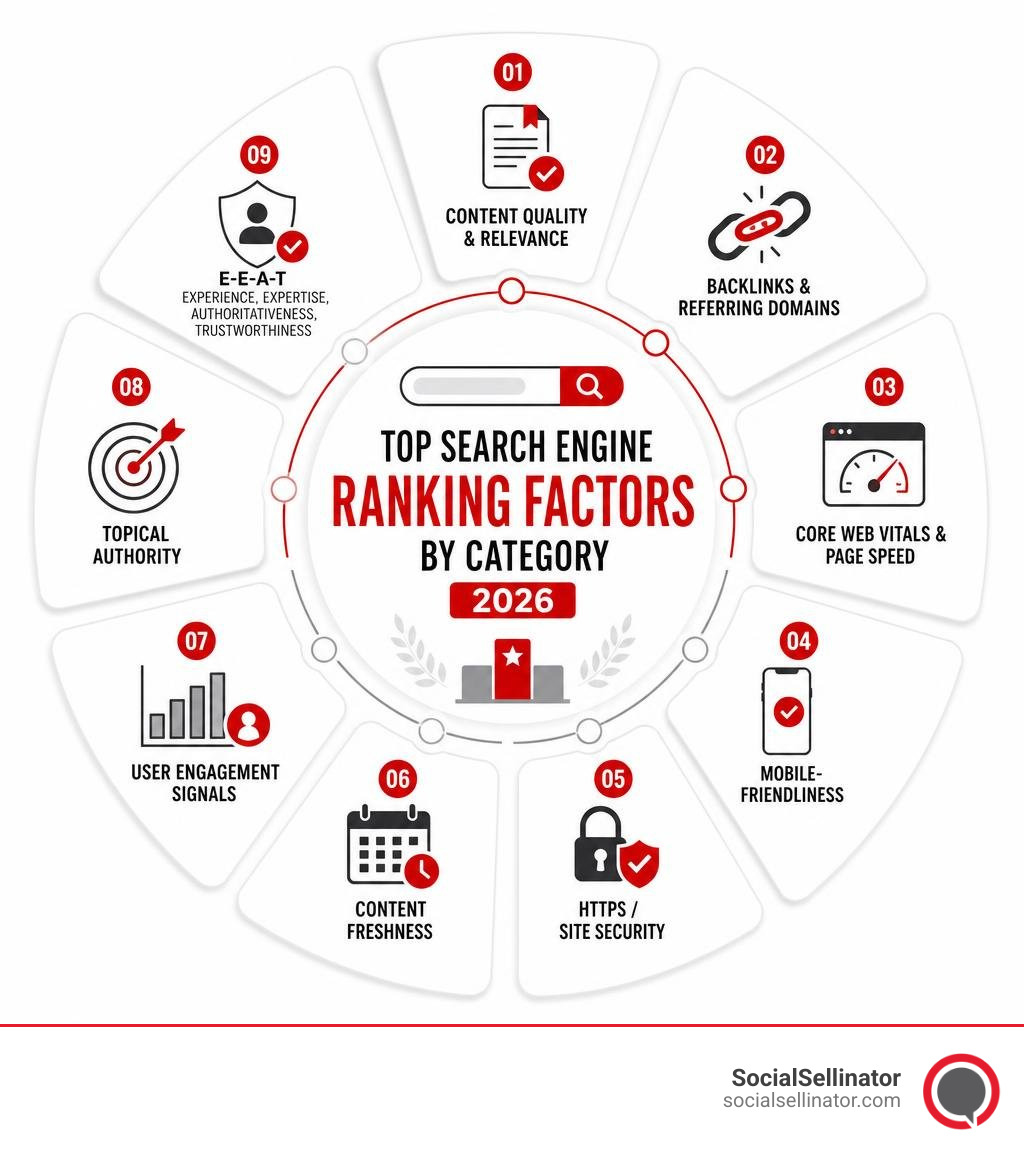
Here are the most important ones to know:
| Ranking Factor | Why It Matters |
|---|---|
| Content quality & relevance | Strongest correlation with top rankings |
| Backlinks & referring domains | #1 result has 3.8x more backlinks than positions 2-10 |
| Core Web Vitals & page speed | Confirmed technical ranking signal |
| Mobile-friendliness | Over 60% of searches happen on mobile |
| HTTPS / site security | 98-99% of top-10 pages use HTTPS |
| Content freshness | Weight jumped from under 1% to 6% of the algorithm |
| User engagement signals | Click data, dwell time, and direct traffic all correlate with rankings |
| Topical authority | How well your site focuses on a core subject area |
| E-E-A-T | Experience, Expertise, Authoritativeness, Trustworthiness |
Most SEOs will tell you Google uses “over 200 ranking factors.” That number has been repeated so often it feels like engineering fact. It isn’t. Google has only publicly confirmed a handful of signals. The 2024 Google Content Warehouse API leak surfaced over 14,000 internal attributes — which tells you the real picture is far more complex than any numbered list.
The frustrating part? Google doesn’t publish a rulebook. Their algorithm is one of the most closely guarded secrets in tech. So SEO professionals rely on a combination of official statements, correlation studies, legal depositions, and occasional leaks to piece together what actually drives rankings.
This guide cuts through the noise. It separates confirmed signals from speculation, explains the difference between ranking factors and ranking systems, and gives you a clear picture of what to prioritize in 2026.
I’m Jock Breitwieser, and having spent years helping businesses grow their organic visibility, I’ll walk you through everything you need to know — starting with the foundations.
Metadata: Dimensions 800×1200, Format JPG, File Name search-engine-ranking-factors-infographic.jpg
Understanding Search Engine Ranking Factors vs. Ranking Systems
To build a successful digital marketing strategy, we first need to clear up a common point of confusion: the difference between a ranking factor and a ranking system.
Think of a ranking factor as an individual ingredient in a recipe. It is a single data point—like your page load speed, the presence of your keyword in the title tag, or the number of websites linking back to you.
A ranking system, on the other hand, is the chef. It is the automated, overarching machine learning engine or algorithm that takes hundreds of these individual ingredients, processes them, and serves up the final search results page. Google’s search index contains hundreds of billions of web pages, and no single human could ever sort through them. That is why Google relies on these highly sophisticated, automated systems to evaluate signals and rank pages in a fraction of a second.
Before these systems can even begin their work, your website has to go through three distinct phases:
- Crawling: Search engine bots (spiders) discover your pages by following links across the web.
- Indexing: The search engine parses the content of those pages and stores them in a massive database (the index).
- Ranking: When a user types in a query, Google’s systems retrieve the most relevant pages from the index and order them using active ranking factors.
If you want to dive deeper into how this process works from the ground up, check out our comprehensive guide on How Do Search Engines Work Crawling Indexing and Ranking. Understanding this technical foundation is the first step in realizing What Is SEO and Why Is It Important for your business’s long-term growth.
Core Google Ranking Systems in 2026
Google’s ranking engine is not a single monolith. Instead, it is a collection of specialized systems that work in tandem. Over the years, these systems have evolved to become incredibly adept at understanding human language and intent. Here are the core systems shaping the search landscape in 2026:
- BERT (Bidirectional Encoder Representations from Transformers): Introduced to help Google understand the context of words in a search query. Instead of analyzing words one by one, BERT looks at the entire sentence, allowing Google to grasp the subtle nuances of conversational search.
- RankBrain: Google’s first machine learning-based system. It acts as a translation engine, helping Google understand search queries that it has never seen before by connecting them to known concepts and entities.
- MUM (Multitask Unified Model): A highly advanced AI system that is 1,000 times more powerful than BERT. MUM is multimodal, meaning it can understand information across text, images, and video simultaneously, making it incredibly effective at answering complex, multi-step questions.
- Neural Matching: This system helps Google connect abstract concepts to words. It allows Google to understand that a page about “how to fix a noisy pipe” is highly relevant to a query like “why is my wall making dripping sounds,” even if the exact keywords do not match.
- Passage Ranking: A system that allows Google to index and rank specific passages within a very long web page independently. If a single paragraph deep inside a 4,000-word article perfectly answers a niche question, Google can surface that specific passage in the search results.
- Deduplication Systems: To keep search results clean and helpful, Google uses automated deduplication to ensure that nearly identical pages do not clutter the first page. If your page is chosen as a Featured Snippet, Google’s deduplication system will often omit your standard organic listing from the first page to maintain variety.
- Site Diversity: This system generally limits search results to no more than two web page listings from the same domain. This prevents any single massive brand or website from monopolizing the top spots for a competitive search term.
The Role of Machine Learning in Search Engine Ranking Factors
The integration of machine learning has fundamentally changed how we optimize websites. Gone are the days when you could rank a page simply by repeating a keyword dozens of times. Today’s AI-driven algorithms focus heavily on search intent—the underlying reason why a user is searching in the first place.
Modern search engines use semantic search and entity recognition to map out relationships between people, places, things, and concepts. When a user searches for “Apple,” the algorithm looks at surrounding context to determine whether they are shopping for a new MacBook or looking up a recipe for apple pie.
For businesses, this means your content must focus on providing comprehensive, structured, and contextually rich answers. To explore how these advanced AI systems are reshaping the digital landscape, take a look at The Definitive Guide to Web Search Engine Ranking Today.
Content Quality, Relevance, and the Evolution of Document Signals
At the heart of every successful SEO campaign is high-quality content. But how does Google actually measure “quality” and “relevance” in 2026?
Industry data shows that top-ranking pages have an average text relevance score of 90.6% and an average content quality score of 76.9%. These are not arbitrary numbers; they reflect how well a document satisfies a user’s query.

Metadata: Dimensions 800×450, Format PNG, File Name content-quality-seo-optimization.png
To combat the massive influx of generic, AI-generated content flooding the web, Google relies heavily on two key metrics revealed in recent document analysis:
- Content Effort: An internal score that evaluates the human effort behind a page. Google’s systems can detect templated, easily replicable layouts. Pages that feature original research, custom visualizations, and unique insights receive a higher effort score.
- Information Gain: This measures whether your page actually adds something new to the conversation. If your article simply paraphrases the top three search results without adding new data, expert commentary, or unique perspectives, it will struggle to rank.
Furthermore, Google evaluates content using the E-E-A-T framework: Experience, Expertise, Authoritativeness, and Trustworthiness. While E-E-A-T is not a single ranking factor, it is a guideline that Google’s quality raters use to evaluate the helpfulness of search results, and Google’s algorithms are trained to mimic these human assessments. If you want to optimize your on-page elements to meet these high standards, our guide on On Page SEO Optimization provides a step-by-step framework to get you started.
On-Page Search Engine Ranking Factors That Move the Needle
While search engines have become incredibly smart, they still rely on traditional on-page elements to understand the structure and hierarchy of your page. Here are the core on-page factors that continue to move the needle:
- Title Tags: This remains one of the most critical on-page signals. Your primary keyword should be placed near the beginning of the title tag, keeping the total length under 60 characters to prevent truncation in search results.
- Header Hierarchy (H1 through H4): Use a clean heading structure. Your page should have exactly one H1 tag containing your primary topic. Subsections should use H2 and H3 tags logically to organize information, making it easy for both search bots and human readers to scan.
- Meta Descriptions: While meta descriptions are not a direct ranking signal, they are vital for driving clicks. A well-written, compelling meta description can boost your organic click-through rate (CTR), which sends positive engagement signals to Google.
- Image Alt Text: Search engines cannot “see” images the way humans do. Including descriptive, keyword-relevant alt text helps search bots index your images properly, which is crucial given that image search drives a growing share of web traffic.
- URL Structure: Keep your URLs short, clean, and descriptive. Avoid complex strings of numbers and parameters. A logical structure (such as
domain.com/category/subcategory/page) helps search engines categorize your content.
To learn how to avoid common pitfalls and focus only on the optimization tactics that deliver real results, read our breakdown on how to Stop Chasing Myths and Master These Top 10 SEO Factors.
Freshness and Topical Authority Signals
Google does not want to serve outdated information to its users. The average age of content on the first page of Google is about 714 days (almost two years), but for queries that require up-to-date information, the algorithm relies heavily on freshness signals.
However, simply changing the publish date on an old article will not fool modern search engines. Industry benchmarks suggest that an update must reflect a significant change of roughly 30% of the content to trigger freshness signals. This means adding new sections, updating statistics, and removing outdated advice.
At the site level, Google evaluates your Topical Focus. This is often measured internally using attributes like “site radius”—which evaluates how far an individual page strays from your website’s core topic. If a local dental clinic suddenly publishes an article about cryptocurrency, that page will have a high site radius (meaning it is far from the core topic) and will struggle to rank.
To maintain a tight topical focus, we often recommend content pruning—the practice of removing or redirecting low-performing, off-topic pages to strengthen your site’s overall topical authority.
Technical SEO, Page Experience, and Security Signals
You can write the most brilliant article in the world, but if your website takes ten seconds to load on a mobile device, your rankings will suffer. Technical SEO is the foundation upon which all your content and on-page efforts sit.
Google evaluates page experience through a set of real-world, user-centered metrics called Core Web Vitals:
- Largest Contentful Paint (LCP): Measures loading performance. To provide a good user experience, LCP should occur within 2.5 seconds of when the page first starts loading.
- Interaction to Next Paint (INP): Measures page responsiveness. This replaced First Input Delay (FID) as an official metric, tracking how quickly a page responds to user inputs like clicks or taps. A good INP score is under 200 milliseconds.
- Cumulative Layout Shift (CLS): Measures visual stability. Have you ever tried to click a link on a mobile page, only for the layout to suddenly shift, causing you to click an ad instead? CLS measures how often that happens. A good score is under 0.1.
Beyond Core Web Vitals, mobile-friendliness is a non-negotiable ranking signal. With over 60% of global searches occurring on mobile devices, Google uses mobile-first indexing, meaning it primarily evaluates the mobile version of your site for ranking.
Finally, HTTPS / site security is a confirmed ranking signal that acts as a critical tiebreaker. In fact, 98% to 99% of top-10 ranking pages use HTTPS. If your site is not secure, modern browsers will display a warning to visitors, leading to a massive spike in lost traffic. If you want to ensure your site meets these strict technical requirements, we recommend scheduling a professional Technical SEO Analysis.
User Engagement and Click Signals
For years, search engines publicly downplayed the role of user click data in their algorithms. However, recent legal depositions and API leaks have confirmed the existence of systems like NavBoost.
NavBoost is a system that re-ranks search results based on actual user click behavior over a rolling window. It tracks several key engagement metrics:
- Good Clicks vs. Bad Clicks: A “good click” occurs when a user clicks your search result and stays on your page to read. A “bad click” occurs when they click and immediately leave.
- Dwell Time: The amount of time a visitor spends on your page before returning to the search results. Longer dwell times signal to Google that your content is helpful and relevant.
- Pogo-sticking: This occurs when a user clicks your result, realizes it does not answer their question, and returns to the search results page within a few seconds to click a different link. High rates of pogo-sticking are a strong negative ranking signal.
- Direct and Branded Traffic: Having a strong brand presence matters. Industry data shows that top-ranking domains receive an average of 31.2% of their traffic from direct visits and 23.8% from branded search queries. When users actively search for your brand name, it signals immense trust to search engines.
Off-Page Authority, Backlinks, and Brand Trust
While on-page and technical SEO are fully within your control, off-page authority is about how the rest of the web perceives your brand.
Backlinks—links from other websites to yours—remain one of the most powerful search engine ranking factors. In fact, pages in the top organic positions have significantly more referring domains than lower-ranking pages.
However, in 2026, quality and relevance far outweigh raw volume. Earning a single link from an authoritative, topically relevant industry publication is worth more than a thousand low-quality links from spammy directories.
To build this level of trust, modern SEO strategies rely heavily on Digital PR—creating highly shareable, research-backed content, original studies, and expert commentary that naturally attract editorial links from reputable media outlets.
Additionally, internal linking plays a massive role in distributing this earned authority across your own site. By linking from your high-authority pages to your deeper service pages, you help search engines discover and rank your most important commercial content. To learn how to build a balanced, powerful authority profile, explore our guide on Cracking the Google Top 10 SEO Ranking Factors Code.
Correlation vs. Causation in SEO Studies
When reading SEO research and ranking factor studies, it is incredibly important to understand the difference between correlation and causation.
A Spearman correlation study measures how closely the presence of a specific feature matches higher search rankings. For example, studies often show a strong correlation between long-form content and high rankings. However, this does not mean that writing 5,000 words will automatically guarantee a top spot. The cause of the high ranking is likely that longer articles tend to cover topics more comprehensively, answer user intent better, and naturally earn more backlinks.
Similarly, we often observe the “brand factor” in search results. Well-known global brands often rank at the very top of search results even if their pages lack optimized H1 tags or have shorter content. This isn’t because Google has a manual bias for big brands; it is because these brands possess massive user trust, high volumes of branded search, and incredibly strong backlink profiles that naturally override minor on-page deficiencies.
Understanding these nuances is critical for businesses looking to maximize their digital marketing budgets. To learn why investing in a data-driven, holistic SEO strategy is one of the smartest moves your business can make, read about Why Is Search Engine Optimization Important to a Business.
Frequently Asked Questions About Search Engine Ranking Factors
What is the difference between a ranking factor and a ranking system?
A ranking factor is an individual signal or data point (such as page speed, mobile-friendliness, or backlink count) that Google evaluates. A ranking system is an automated, overarching machine learning process (like BERT or RankBrain) that takes hundreds of these individual ranking signals, processes them, and uses core algorithms to organize and display the final search results.
Does Google use Chrome browser data to rank websites?
Yes. While search engines historically denied using browser data, recent developer document leaks have confirmed that Google uses Chrome browser data (such as site-visit frequency and scroll depth) to evaluate user engagement, page experience, and real-world loading speeds.
Are meta descriptions a direct ranking factor?
No, meta descriptions are not a direct ranking factor. Google does not use the words in your meta description to calculate organic rankings. However, they are highly important because a compelling meta description directly improves your organic click-through rate (CTR), which drives more traffic and sends positive user engagement signals to search engines.
Conclusion
Navigating search engine ranking factors can feel like trying to hit a moving target. From understanding the inner workings of machine learning systems to optimizing technical page experience and building off-page authority, there are countless variables to manage.
But you do not have to navigate this complex landscape alone. At SocialSellinator, we specialize in taking the guesswork out of digital marketing. Our team of experienced professionals utilizes cutting-edge strategies to help you achieve measurable, cost-effective results. Whether you are looking to build a high-performing SEO strategy, drive immediate leads through targeted PPC campaigns, or establish trust with high-quality content creation, we work closely with you to tailor a plan that aligns perfectly with your business goals.
To understand the long-term value of a professional organic search campaign, check out our guide on The ROI of SEO What You Need to Know Before You Invest. If you are ready to boost your online visibility and grow your bottom line, we invite you to Learn more about our Search Engine Optimization services and get in touch with our team today.
Headquartered in San Jose, in the heart of Silicon Valley and the San Francisco Bay Area, SocialSellinator proudly provides top-tier digital marketing, SEO, PPC, social media management, and content creation services to B2B and B2C SMB companies. While serving businesses across the U.S., SocialSellinator specializes in supporting clients in key cities, including Austin, Boston, Charlotte, Chicago, Dallas, Denver, Kansas City, Los Angeles, New York, Portland, San Diego, San Francisco, and Washington, D.C.