
Building Beyond the Job Site: Why Every Modern Contractor Needs Social Media
Why Contractor Social Media Matters Beyond the Job Site
Contractor social media works best when it shows real work to the right local audience. Start with one or two platforms your customers use. Post project photos, helpful tips, and customer stories a few times a week. Reply to questions, then track inquiries and booked jobs—not just likes.
A strong profile gives people a way to check your work before they call. It can turn a finished project into proof of your skills and help past customers recommend you to their neighbors.
I’m Jock Breitwieser, and I’ll walk you through a practical plan for choosing platforms, creating posts, and measuring results.
Contractor social media word list:
- social media management services
- professional social media services
- digital marketing agency social media
Introduction
The construction and home services landscape has experienced a monumental shift. Gone are the days when a listing in the local Yellow Pages and a magnetized truck door sign were enough to keep a contractor’s calendar booked year-round. Today, modern homeowners—especially millennials, who now represent the largest cohort of recent homebuyers—do not evaluate trade professionals through traditional advertisements. Instead, they turn to digital channels to research, vet, and select service providers.
When a property owner experiences a plumbing leak, plans a major kitchen renovation, or requires an urgent roof replacement, their decision-making process is deeply tied to digital trust signals. With over 4 billion people actively using social platforms daily and the average user spending more than two hours each day browsing feeds, an active digital presence has become the modern baseline for legitimacy. In fact, nearly 97% of Fortune 500 businesses maintain active profiles to connect with audiences. For independent general contractors, plumbers, electricians, and HVAC specialists, social media accounts for roughly 10% of all local website traffic, establishing the critical first impression before a homeowner ever picks up the phone.
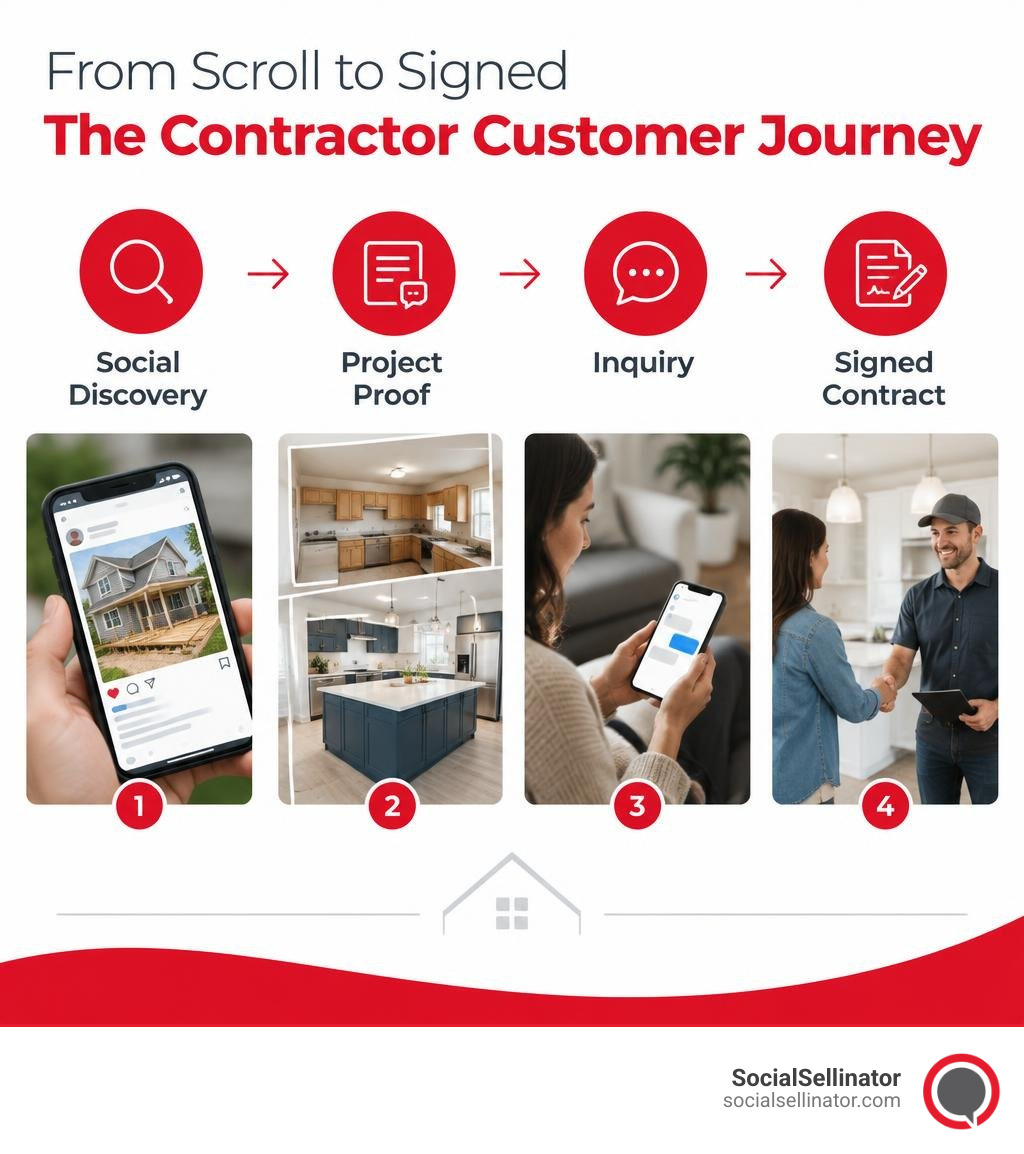
The modern homeowner’s journey is rarely linear. It requires multiple digital touchpoints—typically six to eight interactions—before a prospect feels confident enough to request a quote. A homeowner might first notice a contractor’s work through a shared project transformation photo on Facebook, see a helpful winterization tip on Instagram Reels a week later, and finally reach out via direct message after reading authentic customer reviews on a verified profile. By establishing a strategic digital presence, trade businesses can bridge the gap between completed job sites and long-term business growth.
The Core Benefits of Contractor Social Media in Today’s Market
For many builders and tradespeople, marketing has historically felt like an uncomfortable chore that distracts from on-site labor. However, executing a strategic approach to social media for local business turns everyday manual work into durable marketing assets.
A high-quality social profile acts as an open, always-accessible digital showroom. While a static website provides basic contact information, active social feeds demonstrate continuous activity, ongoing projects, and high standards of craftsmanship. It transforms abstract promises of quality into verifiable, visual social proof.
Building Trust and Local Brand Awareness
Trust is the single most valuable currency in the contracting world. Homeowners are inherently cautious about inviting trade professionals into their private living spaces or committing thousands of dollars to complex structural alterations.
Contractor social media bridges this trust gap by humanizing the brand. When contractors showcase the real faces behind the company—introducing master technicians, highlighting apprentice milestones, or sharing behind-the-scenes problem-solving on the job—they strip away customer apprehension. Highlighting clean work environments, organized tool trailers, and meticulous safety practices provides prospective clients with peace of mind.
Furthermore, consistent social posting builds neighborhood familiarity. When residents in communities like San Jose, Dallas, or Chicago repeatedly see your branded vehicles and team working on properties within their immediate neighborhoods, your company becomes the default, trusted recommendation when their own home repair needs arise.
Driving Qualified Inbound Leads and Referrals
While traditional word-of-mouth has always been the lifeblood of construction trades, digital platforms supercharge this dynamic by digitizing the referral process. When a satisfied client tags their remodeling contractor in a project reveal post, hundreds of local friends and family members instantly see that direct endorsement.
Beyond consumer remodeling and repair, an active social presence serves several high-value commercial functions:
- Commercial Subcontractor Vetting: Commercial property developers, facility managers, and general contractors routinely audit social feeds to confirm crew size, equipment standards, and project complexity before awarding subcontracts.
- Skilled Labor Recruitment: In an industry facing skilled labor shortages, social media serves as a continuous recruitment channel. Highlighting positive work cultures, fair wages, modern equipment, and team appreciation attracts skilled journeymen and apprentices.
- Direct Messaging Consultations: Prospective clients increasingly favor the low-friction option of sending a direct message with an attached photo of their problem area to receive preliminary guidance before scheduling an on-site estimate.
Choosing the Right Platforms for Your Contracting Business
Contractors frequently make the mistake of attempting to maintain a profile on every emerging network, quickly spreading their internal resources too thin. Success does not require omnipresence; it requires dominating the specific channels where local property owners and decision-makers spend their time.
The Associated General Contractors’ Contractors Guide to Using Social Media likewise recommends integrating social activity into a broader marketing strategy.
Industry data reveals clear platform adoption patterns among construction professionals. Approximately 45.1% of contractors report using social media regularly, representing hundreds of thousands of active businesses across the United States. Furthermore, 70.2% of survey respondents in trade connectivity studies are upper management professionals (VP level or higher). Among trade professionals who use social platforms, 94.2% visit Facebook, with roughly 70% accessing the platform daily. YouTube follows closely, utilized by 62% of social-active contractors, with 81% checking the channel daily or weekly.
Essential Platforms for Contractor Social Media Success
- Facebook: The undisputed cornerstone for residential contractors. Facebook provides robust local community infrastructure, allowing trade businesses to share long-form project narratives, photo albums, customer testimonials, and hyper-targeted geographic advertisements.
- Instagram: The ultimate visual portfolio. Instagram allows remodeling contractors, custom home builders, roofers, and landscape architects to showcase stunning visual aesthetics, short-form transformation reels, and interactive daily story updates.
- YouTube: An under-utilized channel with massive long-term value. Publishing time-lapse project builds, detailed installation explanations, and equipment overviews captures search traffic and cements trade authority.
- LinkedIn: The ideal environment for commercial builders, tenant-improvement contractors, and civil engineers. LinkedIn allows you to connect directly with architects, commercial real estate brokers, and corporate facility directors.
- Google Business Profile Integration: While technically a local search asset, integrating regular social-style posts and job site updates directly into your Google profile enhances local map rankings and complements localized campaigns like Contractor SEO San Jose.
Dominating Local Neighborhood Groups and Community Channels
One of the most immediate, cost-effective lead generation tactics available to residential contractors is active participation in local neighborhood groups on Facebook and community message boards. Homeowners frequently bypass traditional search engines entirely, posting directly in neighborhood groups: “Can anyone recommend an honest plumber to replace a water heater?” or “Looking for a reliable roofer after yesterday’s storm.”
To succeed in community groups without being flagged as spam:
- Prioritize Helpful Advice First: Answer homeowner questions about building permits, seasonal maintenance, or minor troubleshooting without immediately pitching your paid services.
- Maintain Community Etiquette: Never drop generic sales links into comment sections. Provide a professional, concise response detailing your experience, licensing, and insurance, accompanied by an invitation to message privately.
- Tag Geographical Service Areas: Ensure all project showcase posts explicitly mention the local neighborhood, city, or county to build hyper-local search relevance.
High-Performing Content Ideas and Posting Cadence
The most common hurdle contractors face is figuring out what to post on a regular basis. Fortunately, contracting is inherently visual, tactile, and transformation-driven. Every job site contains dozens of compelling micro-stories waiting to be shared.
A successful content strategy avoids pure self-promotion. Instead, balance your content across three core pillars:
- 50% Visual Craftsmanship & Transformations
- 30% Helpful Homeowner Education
- 20% Company Culture, Team Highlights, and Community Involvement
Using a structured approach to content creation for social media ensures your channels maintain a steady stream of authentic assets without disrupting daily trade operations.
Visual Storytelling: Before-and-Afters, Time-Lapses, and Jobsite Video
Nothing captures a homeowner’s imagination quite like a dramatic visual transformation. Clean, well-composed visuals consistently outperform generic promotional graphics.
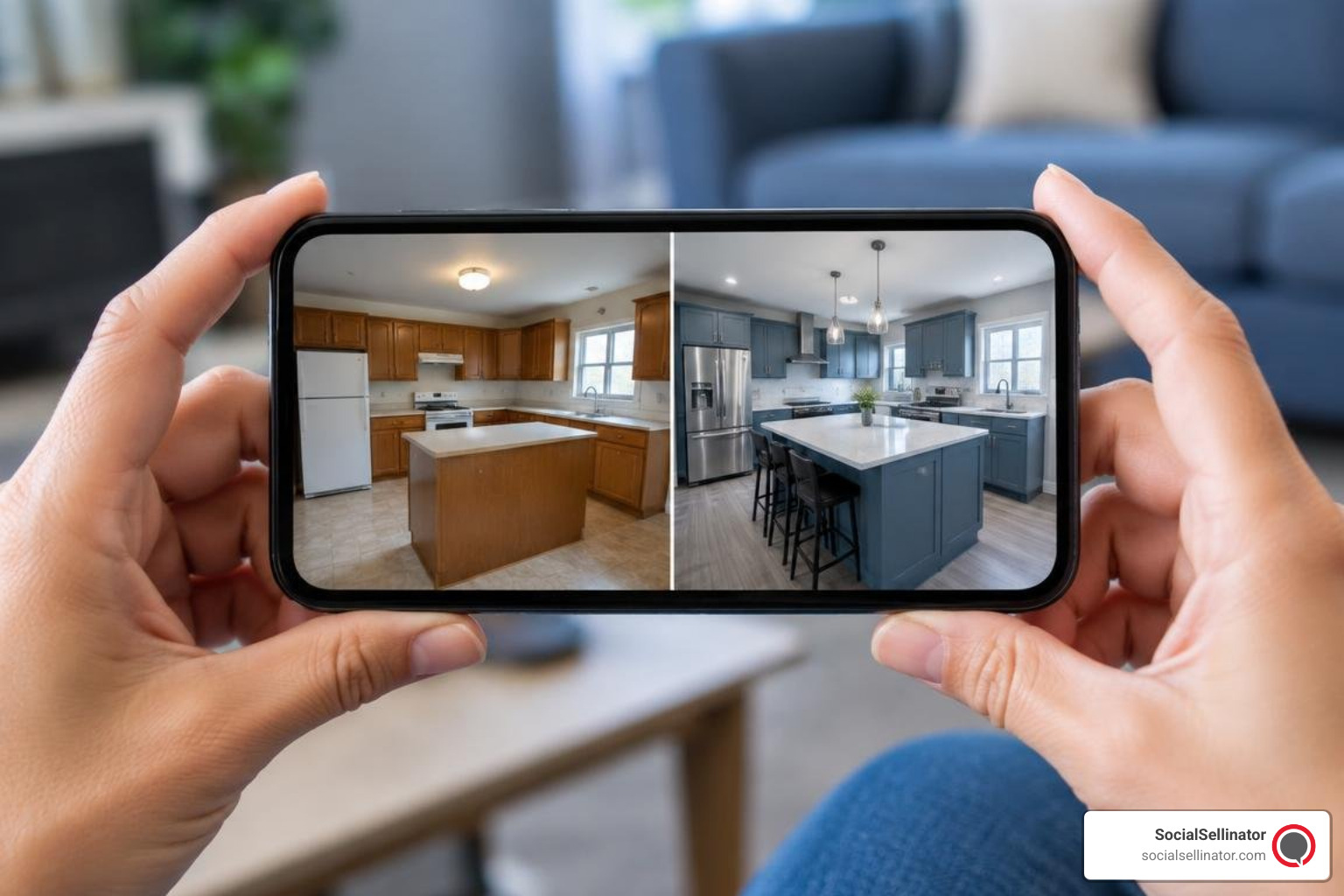
- Before-and-After Galleries: Always photograph the project site before any demolition occurs. Capture the finished space from the exact same camera angle, height, and lighting conditions. These side-by-side posts clearly demonstrate the tangible value of your craftsmanship.
- Cinematic Time-Lapse Videos: Setting up a fixed, weather-protected camera or smartphone to record an entire day’s work—such as pouring a foundation, framing a roof, or installing custom cabinetry—condenses hours of skilled labor into an engaging 30-second video.
- Jobsite Walkthroughs: Have the lead project manager or business owner walk the site with a smartphone, pointing out common construction challenges and explaining how your team solved them to ensure structural integrity.
Educational Content, Seasonal Promotions, and Team Spotlights
Beyond project visuals, prospective clients look for indicators of reliability and customer service.
- Preventative Maintenance Checklists: Help property owners protect their investments. Share seasonal tips, such as winterizing irrigation systems, checking roof flashing before rainy seasons, or replacing HVAC filters.
- Technician & Apprentice Spotlights: Introduce your crew members, share their professional certifications, and celebrate work anniversaries. Showing the people behind the tools humanizes your brand and builds comfort for clients inviting technicians into their homes.
- Interactive Homeowner Q&As: Use Instagram and Facebook story stickers to ask homeowners what remodeling questions they have. Answering these inquiries on video is one of the most effective methods for boosting social media engagement while establishing your technical authority.
Contractor Social Media and Local SEO
A common debate among trade business owners is whether to invest marketing budgets into social media or focus entirely on search engine optimization and paid search ads. In reality, these two digital channels are not competitors—they are powerful multipliers that work together.
Search engine optimization (SEO) captures high-intent, immediate demand (pull marketing), such as a homeowner searching for “emergency AC repair near me.” Social media, conversely, builds continuous brand equity and relationship nurturing (push marketing), ensuring that when a homeowner eventually requires a major service, your company is already their first choice.
Furthermore, social channels generate referral traffic and brand search volume that send strong authority signals to major search engines, driving higher rankings on local map packs.
| Marketing Metric / Dimension | Contractor Social Media Marketing | Local SEO & Search Marketing |
|---|---|---|
| Primary Audience Intent | Discovery, Consideration, & Research | Immediate Need & Active Searching |
| Primary Content Formats | High-Res Photos, Reels, & Stories | Service Pages, Blogs, & Citations |
| Time to Initial Results | 30 to 90 Days for Audience Traction | 3 to 6 Months for Rank Maturation |
| Lead Generation Nature | Nurtured Referrals & Direct Messages | Inbound Search Calls & Form Fills |
| Long-Term Asset Value | Brand Equity & Engaged Local Following | Organic Search Rankings & Map Authority |
| Strategic Synergy | Humanizes brand and nurtures past leads | Captures active demand driven by brand buzz |
To maximize regional visibility, many trade business owners combine social storytelling with dedicated local SEO consultant services, creating an integrated digital marketing ecosystem where social proof and search visibility feed into one another.
Execution Pitfalls and How to Choose the Right Agency Partner
Executing a consistent digital strategy requires discipline and dedicated time. Unfortunately, many contracting companies experience a predictable cycle: they post enthusiastically for two weeks, get overwhelmed by job site demands, abandon their profiles for four months, and conclude that social marketing does not work for their trade.
Recognizing the common operational traps—and understanding when to seek out the best social media management for small business—is essential for building a sustainable marketing pipeline.
Common Contractor Social Media Mistakes to Avoid
- Inconsistent Posting Schedules: Algorithms reward consistent activity. Posting four times in one day and then disappearing for six weeks kills organic reach and signals to potential customers that the business may be disorganized or inactive.
- Over-Reliance on Stock Photography: Modern consumers easily spot generic, polished stock photos of models holding pristine tools. Using stock assets destroys authenticity. Real photos of real work—even taken on a smartphone—outperform studio stock images every time.
- Ignoring Inbound Comments and Reviews: Treating social media as a one-way broadcasting megaphone rather than a two-way conversation damages your reputation. Unanswered questions in comment sections signal poor customer service.
- Neglecting Short-Form Video Formats: Relying solely on static text updates misses the vast majority of social reach. Algorithms across major networks heavily prioritize short-form vertical video.
- Completely Pausing Marketing During Peak Season: When crews are booked out months in advance during summer, contractors often stop marketing entirely. This inevitably leads to empty project pipelines when the winter slowdown arrives.
Key Qualities to Look for in a Social Media Marketing Partner
When delegating social media marketing, contractors should partner with specialists who understand the unique dynamics of trade industries:
- Trade-Specific Understanding: Your agency partner must understand construction workflows, permitting terminology, and the difference between trade specialties.
- Streamlined Jobsite Media Workflows: A quality partner does not require you to write copy or edit videos. They provide frictionless systems where your crew simply uploads raw job site photos and videos via a phone app, which the agency transforms into branded content.
- Transparent Lead Attribution: Look for agencies that provide clear reporting dashboards connecting digital activities directly to booked calls and inquiries, allowing you to accurately track your social media marketing ROI.
- Flexible Contract Terms: Avoid agencies that insist on locking trade businesses into rigid multi-year agreements. Confident, performance-focused agencies operate on flexible month-to-month terms backed by measurable outcomes.
Frequently Asked Questions About Social Media for Contractors
How often should a contractor post on social media to see results?
To maintain algorithm visibility and keep local audiences engaged, contractors should aim to post 3 to 4 times per week on their primary feeds (such as Facebook and Instagram). In addition, sharing quick daily behind-the-scenes moments through 24-hour Stories keeps your company at the top of followers’ feeds without cluttering your permanent visual portfolio. Consistency is far more impactful than sheer volume; a predictable schedule of three high-quality posts per week will consistently outperform sporadic daily posting followed by weeks of silence.
Will social media directly generate booked construction and remodeling jobs?
Yes, but it primarily acts as a trust-building and nurturing channel that accelerates the sales cycle. While emergency trade services (such as a burst pipe at midnight) often come from direct search queries, high-ticket services like custom home additions, full kitchen remodels, and commercial renovations have longer consideration cycles. Social media keeps your business top-of-mind during this research phase, turning cold prospects into warm inbound inquiries via direct messages, website referral forms, and phone calls.
How can contractors measure the ROI of their social media marketing efforts?
Contractors can accurately measure marketing return on investment by tracking concrete lead attribution metrics rather than vanity indicators like follower counts:
- Direct Message Inquiries: Count the number of preliminary project inquiries received directly through platform messaging.
- Trackable Referral Traffic: Utilize Google Analytics to monitor how many website visitors, quote requests, and estimate bookings originate from social platforms.
- Dedicated Call Tracking Numbers: Implement unique phone numbers on social profiles to track inbound estimate calls generated exclusively from social campaigns.
- Customer Intake Surveys: Consistently ask every new caller, “How did you first hear about our work?” to capture word-of-mouth recommendations that originated on social channels.
Conclusion
The construction and trade industries will always be rooted in skilled craftsmanship, hard work, and tangible results. However, the methods modern homeowners and commercial clients use to discover and evaluate contractors have permanently shifted. Building a thriving, resilient contracting business requires establishing a digital presence that reflects the same quality and professionalism you bring to the physical job site.
By regularly capturing project milestones, showcasing authentic transformations, engaging with local community groups, and demonstrating technical expertise, you turn completed jobs into permanent lead-generating assets. Whether you manage your accounts in-house or partner with experienced professionals for done-for-you social media marketing, an active social strategy ensures your business remains visible, respected, and consistently booked across every season.
Headquartered in San Jose, in the heart of Silicon Valley and the San Francisco Bay Area, SocialSellinator proudly provides top-tier digital marketing, SEO, PPC, social media management, and content creation services to B2B and B2C SMB companies. While serving businesses across the U.S., SocialSellinator specializes in supporting clients in key cities, including Austin, Boston, Charlotte, Chicago, Dallas, Denver, Kansas City, Los Angeles, New York, Portland, San Diego, San Francisco, and Washington, D.C.