

Ultimate Checklist for Social Media Community Growth
What Is Social Media Community Growth (And Why It Matters in 2026)
Metadata: Format: JPEG, Resolution: 1200×630, Source: Unsplash
Social media community growth is the process of turning passive followers into an active, connected group of people who engage with each other — not just with your brand.
Here’s a quick-reference breakdown to address what most marketers want to know right away:
| Question | Quick Answer |
|---|---|
| What is a social media community? | A group that shares goals, values, or interests and actively interacts on social platforms |
| How is it different from having followers? | Followers are passive. Community members talk to each other, not just to you |
| Why does it matter? | Brands with active communities see up to 53% higher customer retention rates |
| What platforms work best? | Depends on your audience: Facebook Groups, LinkedIn, Discord, Instagram, TikTok |
| How long does it take? | Expect 9-24 months before seeing compounding returns |
| What’s the first step? | Define a clear community identity and niche goal before choosing a platform |
Most brands treat social media like a megaphone. They broadcast content, count likes, and measure follower growth. But in July 2026 — with AI-generated content flooding every feed and organic reach shrinking — that approach is no longer enough.
The brands winning right now have made a different bet. They’ve stopped asking “how do we reach more people?” and started asking “how do we build something people would actually miss?”
That question matters more than it sounds. One useful test: if your social media accounts disappeared tomorrow, would anyone notice? If the honest answer is no, you have an audience — not a community.
The gap between the two is enormous. An audience is fragile. It exists because an algorithm sends people your way. A community is resilient. It exists because members have relationships with each other, and those relationships don’t disappear when a platform changes its ranking rules.
The data backs this up. Brands with dedicated community managers report a 70% increase in customer retention. Community-acquired customers carry 40-60% lower acquisition costs at maturity and show 2.3-3.1x higher lifetime value compared to customers acquired through paid channels.
This guide is a practical, step-by-step checklist for building that kind of community — one that grows, compounds, and protects your brand over time.
 Metadata: Format: JPEG, Resolution: 1024×768, Source: Unsplash
Why Social Media Community Growth is the Ultimate Moat in 2026
In the current digital landscape of July 2026, brands are facing unprecedented hurdles. Paid customer acquisition costs have climbed past eighty dollars for most direct-to-consumer and business-to-business categories. Algorithms are increasingly prioritizing zero-click strategies, keeping users strictly within their social platforms and making organic search visibility harder to secure. Simultaneously, generative AI tools have made it incredibly easy to flood social feeds with high-volume, generic content.
When anyone can generate a thousand blog posts or social updates with the click of a button, content volume ceases to be a competitive advantage. The only asset that cannot be replicated by an AI model is a genuine human relationship. This is why focusing on social media community growth is no longer a soft brand-building initiative; it has become a hard unit economics lever. For actionable advice on navigating this landscape, check out our Social Media Marketing Tips.
A thriving, engaged community acts as a gravity well. It naturally pulls in high-intent buyers, lowers marketing costs, and creates a highly defensible moat around your brand. When your customers feel a deep sense of belonging, they do not just consume your products — they actively advocate for your business.
The Shift from Broadcast Audience to Social Media Community Growth
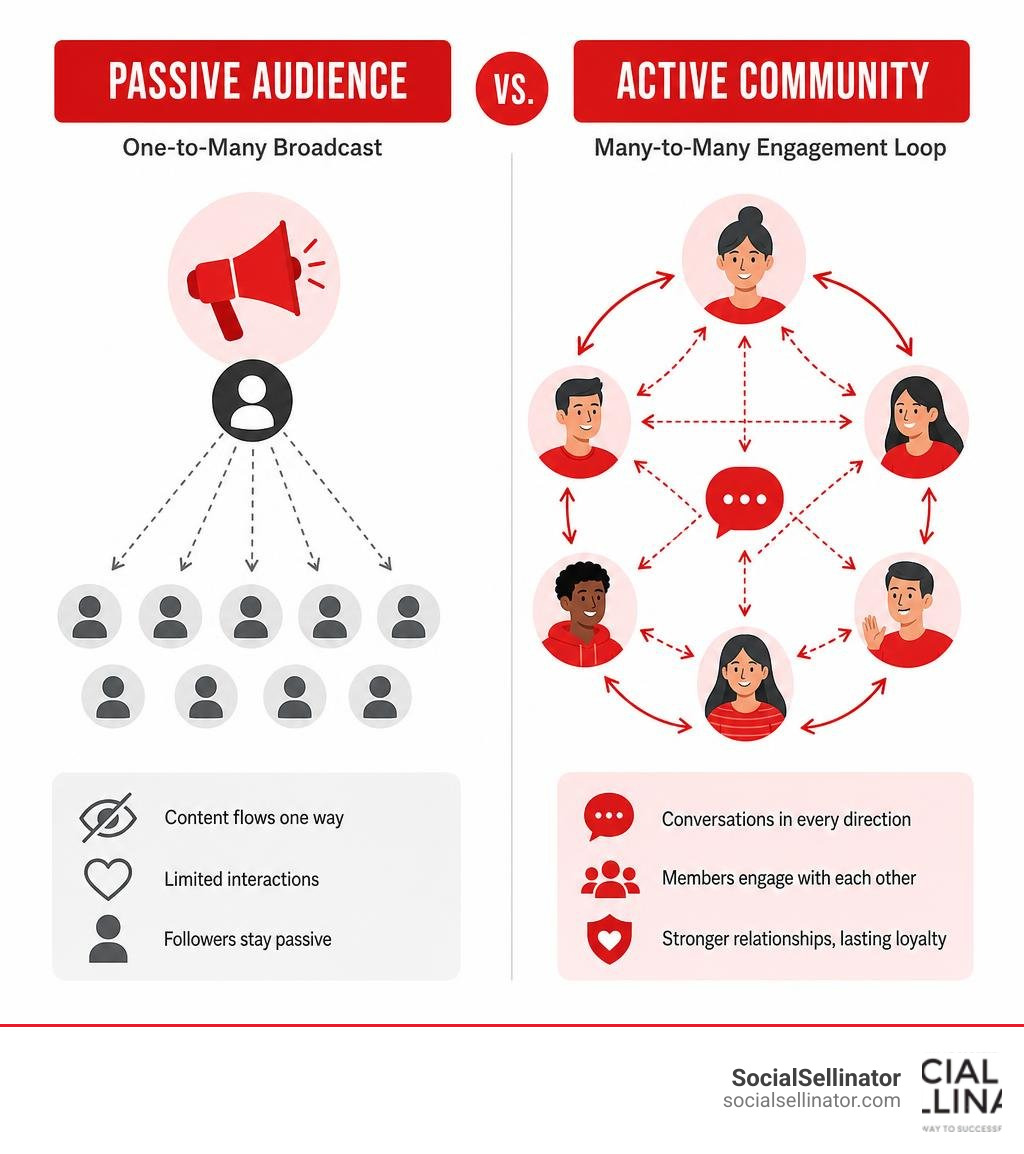
To understand how to build a community, we must first dissect the structural shift from a broadcast audience to a many-to-many ecosystem. Traditional social media management operates on a one-to-many model. The brand creates content, posts it to a page, and broadcasts it to passive followers. The flow of information is entirely linear, moving from the business to the consumer. Success in this model is measured by impressions, reach, and superficial click-through rates.
In contrast, true community building relies on many-to-many dynamics. The brand does not act as a distant broadcaster; instead, it serves as a facilitator or host. Information flows in multiple directions: from the brand to the members, from the members to the brand, and crucially, from member to member.
This peer-to-peer interaction is where the magic happens. When community members start answering each other’s questions, sharing their personal stories, and celebrating milestones together, they form tight-knit bonds. They are no longer isolated consumers; they are part of a shared collective. This horizontal engagement dramatically increases brand affinity and customer lifetime value. It transforms your social channels from a quiet, transactional catalog into a vibrant, self-sustaining neighborhood.
How Community Fosters Crisis-Resistant Brand Reputation
Every business will eventually face a public relations challenge, a product bug, or a customer service hiccup. When these moments arrive, the strength of your community determines how well your brand survives.
In a traditional audience model, when a brand makes a mistake, the public response is often swift and unyielding. Passive followers have no personal relationship with the business, making them quick to judge or abandon ship.
However, a highly engaged community acts as a natural buffer during a crisis. Because your community members have established deep trust with your brand and each other, they are far more likely to extend grace. More importantly, loyal community advocates will often step in to publicly defend your brand in comment sections and discussion threads without any prompting from your internal team. They clarify misunderstandings, share their positive personal experiences, and help de-escalate negative sentiment.
Furthermore, an active community provides an immediate, unfiltered customer feedback loop. Instead of guessing how a new update or product launch is being received, your community manager can source real-time insights directly from the group. This public, transparent communication shows that your brand is listening, adapting, and taking action, turning a potential customer service crisis into a powerful demonstration of authenticity and care.
The 5-Step Framework for Social Media Community Growth
Building a vibrant online community does not happen by accident. It requires a structured, intentional framework that aligns your business goals with the human needs of your audience. Partnering with professional Social Media Marketing Services can help streamline this process.

Metadata: Format: PNG, Resolution: 800×600, Source: Pexels
Let’s walk through the essential steps to design, launch, and scale your social media community.
Step 1: Define Your Community Identity and Goals
Before you select a platform or write a single post, you must define the core identity of your community. A common mistake is trying to build a community around a generic product or a broad industry. If your group is for “anyone who likes marketing,” it will likely remain a ghost town.
Instead, you need to narrow your focus to a highly specific member persona and a shared mission. Ask yourself:
- Who is the exact person this community is built for? (e.g., “bootstrapped SaaS founders in the United States scaling past ten thousand dollars in monthly recurring revenue”)
- What is the shared enemy or pain point that unites them? (e.g., rejecting bloated venture capital funding and fighting high customer acquisition costs)
- What is the primary value they will receive by participating?
- What are the specific business objectives this community will support? (e.g., lowering customer support tickets, increasing product retention, or generating qualified leads)
Your community’s identity should also reflect your unique brand voice. Whether your tone is highly technical, deeply professional, or lighthearted and humorous, consistency is key. By establishing clear guidelines around your shared values, you create a safe, welcoming environment where the right people feel an instant sense of belonging.
Step 2: Choose the Right Platform for Social Media Community Growth
Once you have defined your community’s identity, you need to decide where it will live. Different platforms support different communication styles, demographics, and engagement rhythms.
- Slack: The default choice for professional, business-to-business communities. It is ideal for high-trust conversations, networking, and direct industry exchange. Because many professionals already use Slack daily for work, it minimizes the friction of checking a new app.
- Discord: Exceptional for highly active, real-time engagement, especially among tech-savvy, creator, or gaming audiences. Discord supports complex channel structures, voice rooms, and automated roles, making it highly customizable for large communities.
- Facebook Groups: Excellent for local communities, hobbyists, and older demographics. With over seventy percent of users aged fifty and older active on Facebook, it remains a powerful tool for broad, high-volume consumer engagement.
- LinkedIn: The premier platform for professional networking and leadership. It is highly effective for top-of-funnel reach, industry discussions, and showcasing company culture.
- Instagram and TikTok: Best suited for highly visual, social-first communities. These platforms excel at driving rapid, short-form engagement, leveraging popular music, and encouraging user-generated content challenges.
The key is to meet your audience where they already spend their time. Do not try to maintain an active presence across five different community platforms simultaneously. Pick one primary hub, optimize it fully, and focus your energy on making it outstanding. To manage these platforms efficiently, you can leverage the Best Social Media Management Tools available today.
Step 3: Establish Rituals and Rhythms
A community without regular rhythms is like a town without events — eventually, everyone stops showing up. To keep your members engaged, you must establish predictable, recurring rituals that give them a reason to return.
These rituals create a steady heartbeat for your community. For example, your weekly schedule might include:
- Feedback Fridays: A dedicated thread where members can share what they are working on and receive constructive feedback from their peers.
- Weekly Wins: A Monday morning post encouraging members to celebrate their personal or professional achievements from the past week.
- Monthly Live Q&As: Interactive, virtual sessions where members can ask questions directly to your founders or industry experts.
- Themed Discussion Prompts: Regular, open-ended questions designed to spark conversations, share advice, and reveal member insights.
By structuring your content around consistent pillars, you make participation frictionless. Members know exactly what to expect and when to tune in, which helps transform casual visitors into active, contributing participants over time.
Step 4: Leverage User-Generated Content and Advocates
Your most valuable community asset is the content created by your members. User-generated content is incredibly powerful because it is inherently authentic. Research shows that ninety percent of consumers consider user-generated content more trustworthy than polished, branded advertisements.
To accelerate your community’s growth, you must design systematic loops that encourage and reward member contributions:
- Spotlight Your Best Members: Regularly feature outstanding contributions, success stories, or helpful answers in your main social feeds. This not only makes the featured member feel valued, but it also inspires others to participate.
- Create Branded Hashtag Campaigns: Encourage your community to share photos, videos, or case studies using a specific brand hashtag. This builds a rich library of social proof that you can easily repurpose.
- Build an Advocate Program: Identify your top five to ten percent of highly active contributors and give them special recognition. This could include exclusive badges, early access to new product features, or direct communication lines with your product team.
By turning your members into co-creators, you reduce the pressure on your internal team to generate all the community content. More importantly, you empower your advocates to pull in new members through organic, word-of-mouth referrals.
Step 5: Balance AI Automation with Human Connection
As conversational AI tools continue to advance, many brands are using them to manage their social media interactions at scale. While AI is incredibly useful for analyzing community sentiment, tracking keywords, and automating routine moderation tasks, it must never replace genuine human empathy.
The most successful communities use a hybrid model. Let AI act as a scout behind the scenes to flag potential issues, categorize discussions, and handle initial, repetitive customer service inquiries. However, when a member shares a complex struggle, celebrates a major life win, or expresses frustration, a real human community manager must step in.
A human touch — like responding with a personalized video, using a warm, authentic tone, or signing off with a personal identifier — builds deep, emotional connections that an AI bot simply cannot replicate. Transparency is crucial: always let your community know when they are interacting with an automated tool versus a real team member.
Measuring the ROI of Your Community Efforts
One of the primary reasons community initiatives fail is that businesses try to measure them using the wrong metrics. If you evaluate your community using the same short-term transactional key performance indicators as your paid advertising campaigns, you will likely cut your funding before the flywheel has a chance to spin.
Community growth is a long-term play that requires a dedicated health scorecard. To measure the true business impact of your efforts, focus on these compounding metrics, which are essential for Measuring Social Media Success:
- Active Participation Rate: This is the percentage of your total community members who actively post, comment, or react on a weekly or monthly basis. A healthy community target is twenty to thirty percent. Tracking this ensures you are building an engaged home, not just accumulating passive followers.
- Referral Rate and Organic Reach: Monitor how many of your new customers or community members are joining via direct referrals from existing members. A referral rate above thirty percent indicates a highly enthusiastic, self-sustaining ecosystem.
- Customer Retention and Lifetime Value: Compare the churn rates and overall lifetime value of your active community members against non-community customers. On average, brands with engaged communities experience a fifty-three percent higher customer retention rate.
- Customer Support Cost Savings: Track how many customer questions are successfully answered by other community members rather than your internal support staff. This peer-to-peer resolution directly reduces your operational overhead.
By presenting a quarterly scorecard that connects these engagement metrics to long-term financial health, you can clearly demonstrate the immense return on investment of your community growth strategy to your executive leadership.
Frequently Asked Questions About Social Media Community Growth
What is the difference between social media management and community management?
While these two terms are often used interchangeably, they have completely different goals, metrics, and approaches:
- Social Media Management: Focuses on content creation, scheduling, and distribution. It is primarily a one-to-many broadcasting channel aimed at driving top-of-funnel awareness, impressions, and click-through rates.
- Community Management: Focuses on relationship building, moderation, and facilitating peer-to-peer interactions. It is a many-to-many engagement model aimed at driving long-term customer loyalty, retention, and brand advocacy.
In short, social media management gets people to look at your brand, while community management gets them to talk to each other and stay.
How long does it take to see compounding returns from community growth?
Building a thriving community is a long-term investment, not a quick marketing hack. While you may see initial engagement spikes within the first few weeks, it typically takes nine to twelve months of consistent effort to see meaningful impact on your customer acquisition costs.
By month eighteen to twenty-four, the economics of a mature community begin to compound dramatically. At this stage, your advocates are actively driving organic referrals, user-generated content is reducing your creative production costs by thirty to fifty percent, and your customer retention rates are significantly higher than the industry average. Patience and consistent execution are essential.
What is a healthy active participation rate for an online community?
A healthy, well-engineered community typically maintains a weekly active participation rate of twenty to thirty percent.
To understand this dynamic, it is helpful to look at the traditional distribution of online engagement, often described as the 1-9-90 rule:
- 1% are Creators: The highly active power users who start new discussion threads, share detailed stories, and drive the overall culture.
- 9% are Contributors: The members who regularly reply to posts, attend virtual events, and participate in existing conversations.
- 90% are Lurkers: The passive members who read discussions and derive immense value from the community but rarely, if ever, post or comment.
Your primary goal should be to lower the friction of contribution so you can move more members from the ninety percent group into the active ten percent. However, never punish your lurkers — they are still consuming your brand’s value and are often highly loyal customers behind the scenes.
What are the most common mistakes brands make when trying to grow a social media community?
Even with the best intentions, many organizations stumble during the early stages of community building. The three most frequent pitfalls include:
- Treating the Community as a Direct Sales Channel: If every post or discussion thread is a thinly veiled sales pitch, members will quickly lose interest and leave. A community must be a space for mutual value, education, and connection, not a continuous promotional campaign.
- Failing to Moderate and Maintain Safety: A community without clear guidelines and active moderation can quickly devolve into spam, self-promotion, or toxic arguments. Consistent, gentle moderation is essential to keep the environment welcoming and focused.
- Expecting Instant Results: Community building is a slow-burn strategy. Brands that expect immediate transactional returns often abandon their efforts right before the compounding effects begin to take hold.
Conclusion
In an era of rising ad costs and automated noise, building a genuine social media community is the ultimate competitive advantage. It turns transactional buyers into lifelong brand advocates, protects your business during public challenges, and fuels sustainable, long-term growth.
Success requires shifting your mindset from broadcasting to hosting, establishing consistent engagement rituals, and prioritizing real human connection over simple automation.
Ready to transform your social media presence from a quiet broadcast channel into a thriving, high-conversion community? Partnering with an experienced team can help you build and manage these high-value relationships without burning out your internal resources. Discover how our SocialSellinator Social Media Management Service can support your goals.
Headquartered in San Jose, in the heart of Silicon Valley and the San Francisco Bay Area, SocialSellinator proudly provides top-tier digital marketing, SEO, PPC, social media management, and content creation services to B2B and B2C SMB companies. While serving businesses across the U.S., SocialSellinator specializes in supporting clients in key cities, including Austin, Boston, Charlotte, Chicago, Dallas, Denver, Kansas City, Los Angeles, New York, Portland, San Diego, San Francisco, and Washington, D.C.