
The Non-Boring Guide to Your Custom Social Media Strategy
What Is a Custom Social Media Strategy (and Why Does It Matter)?
A custom social media strategy is a documented plan built specifically around your business goals, your audience, and the platforms where your customers actually spend time — not a generic template copied from someone else’s industry. In digital marketing, social media marketing is defined as the use of social media platforms and websites to promote a product or service.
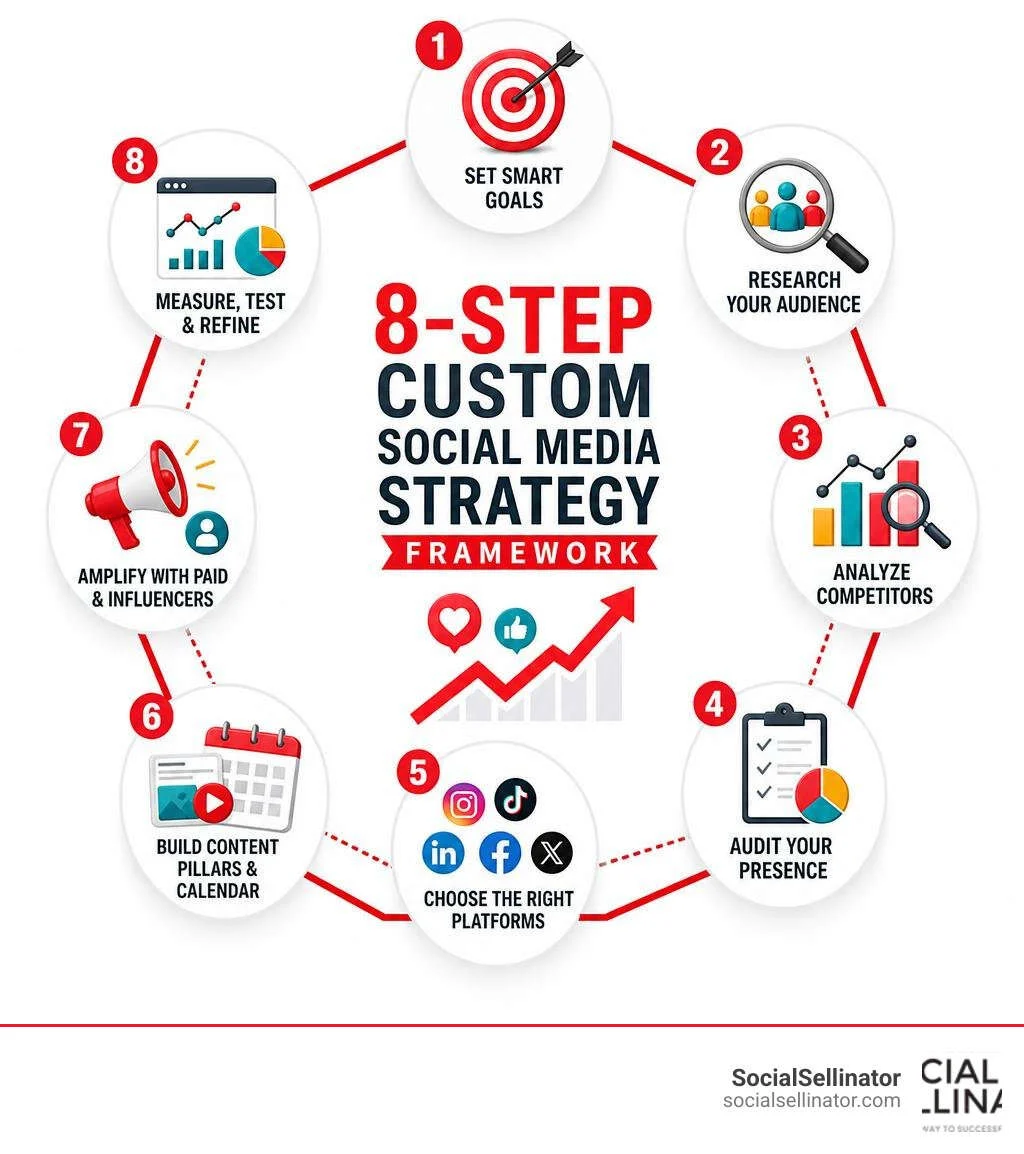
Here’s a quick breakdown of what it covers:
- Set SMART goals tied to real business outcomes (revenue, leads, retention)
- Research your audience using real data, not assumptions
- Analyze competitors to find gaps and opportunities
- Audit your current social presence for consistency and performance
- Choose the right platforms based on where your audience is active
- Build content pillars and a publishing schedule you can sustain
- Integrate paid amplification and influencer partnerships where needed
- Measure, test, and refine on a regular 90-day cycle
Most businesses start social media with good intentions. They create profiles, post a few times a week, and wait for results. But without a clear plan, posting becomes inconsistent — and inconsistent social media delivers inconsistent results.
The numbers back this up. Businesses that set measurable goals are 377% more likely to report success in their marketing campaigns. Yet most brands still treat social media as a series of disconnected posts rather than a unified strategy.
Social media is no longer a supporting tactic. For most businesses, it’s the first place a potential customer encounters your brand.
Consider this: 78% of consumers say a brand’s social media presence directly affects whether they trust it. And 76% of social users say social platforms have influenced their purchases in the past six months. That’s not a side channel — that’s your storefront.
The problem isn’t that social media doesn’t work. The problem is that generic plans don’t work. A local B2B software company and a direct-to-consumer retailer cannot use the same strategy and expect the same results. Their audiences are different. Their platforms are different. Their goals are different.
That’s exactly what a custom approach solves.
Metadata: Format: JPEG, Resolution: 1200×800, Style: Diagram/Infographic.
Custom social media strategy terms to learn:
- social media management includes
- effective social media management
- tips for improving social media presence
Why Your Business Needs a Custom Social Media Strategy in 2026
The social media landscape of June 2026 is vastly different from even just a couple of years ago. We are living in an era defined by extreme platform fragmentation, creator-first algorithms, agentic AI search, and sweeping privacy changes. If you are still relying on a generic, one-size-fits-all posting schedule, your brand is likely getting lost in the noise.
Organic reach has experienced a massive, multi-year decline. On Facebook, organic reach has hovered around 5.2% of a page’s followers, while Instagram organic reach sits at roughly 9%. This means that simply broadcasting promotional messages to your existing follower base is no longer a viable growth engine. If your content doesn’t instantly hook a user and align with what they actually care about, the algorithms will bury it.
Furthermore, privacy updates—such as those introduced in iOS 17 and subsequent iterations—have made client-side tracking pixels highly unreliable, missing between 30% and 60% of web conversions. This shift has forced brands to move away from basic ad tracking and toward more integrated, native social journeys.
When you develop a brand social media strategy tailored specifically to your unique business, you build a protective moat around your brand. A custom approach ensures that you aren’t wasting resources trying to be “everywhere at once.” Instead, it aligns your target audience’s online behaviors with your operational capacity, turning social media from a vague branding expense into a measurable growth lever.
To make this work, your brand needs a cohesive digital marketing strategy for social media that moves beyond reactive posting. A custom plan gives your marketing team the structural framework they need to confidently say “no” to content requests that don’t serve your core business objectives, keeping your brand voice clear, consistent, and highly authoritative.
The Step-by-Step Framework to Build and Optimize Your Strategy
Building a custom social media strategy isn’t about guessing what might go viral; it is about establishing a repeatable, data-driven framework that aligns platform actions with business outcomes. When we partner with businesses as a specialized social media strategy agency, we guide them through a structured journey that eliminates the guesswork.
The process begins by analyzing your current digital footprint, identifying competitive gaps, and mapping out a clear path to conversion. This strategic framework operates like a living document—one that adapts to quarterly algorithm updates while keeping your core business objectives front and center. Let’s break down the exact steps required to build and optimize your custom strategy from the ground up.
Setting SMART Goals for Your Custom Social Media Strategy
Every successful marketing campaign starts with clarity. If your goal is simply to “increase brand awareness” or “get more followers,” you are setting yourself up for frustration. These are vanity metrics. While having a large follower count looks impressive on paper, it does not guarantee revenue growth, customer retention, or qualified leads.
Instead, we must set S.M.A.R.T. (Specific, Measurable, Achievable, Relevant, and Time-bound) goals that tie directly to your broader business objectives. For example, instead of aiming to “get more leads,” a SMART goal would be: “Generate 50 qualified B2B demo requests through LinkedIn native lead forms in Q3.”
To help keep your team focused on what truly drives growth, we recommend aligning your goals with the metrics that actually impact your bottom line. Here is how we compare vanity metrics against business impact metrics:
| Metric Category | Vanity Metrics (Focus Less) | Business Impact Metrics (Focus More) |
|---|---|---|
| Awareness | Total Follower Count, Raw Likes | Reach, Share of Voice, Branded Search Traffic |
| Engagement | Post Views, Surface-Level Comments | Saves, Shares, Direct Messages (DMs), Comment Sentiment |
| Conversion | Link Clicks (without context) | Click-Through Rate (CTR), Cost Per Acquisition (CPA), Form Fills |
| Revenue | Viral Post Count | Attributed Pipeline, Direct Social Commerce Sales, Customer Lifetime Value (LTV) |
By shifting your team’s focus toward business impact metrics, you ensure that every hour spent creating content is contributing to your company’s financial health. For more guidance on aligning your objectives, check out our deep dive on setting social media marketing goals.
Researching Your Audience and Building Personas
The audience you think you are talking to and the audience actually consuming your content are often two entirely different groups. To build a strategy that resonates, you need to move beyond basic demographic data (like age, gender, and location) and focus on psychographics, behavioral patterns, and real-world pain points.
We recommend using the Jobs-To-Be-Done (JTBD) framework to map your audience’s social behavior. Instead of asking, “Who is our customer?” ask, “What ‘job’ is our customer hiring our content or product to do?”
- Are they looking to solve a highly technical software bug on LinkedIn?
- Are they looking for quick, entertaining category education on TikTok?
- Are they seeking visual inspiration for a home renovation on Pinterest?
To build accurate audience personas, gather real-world data from multiple sources:
- Native Platform Analytics: Dig into your existing audience insights to see who is currently engaging with your posts.
- Social Listening: Monitor industry-specific conversations, brand mentions, and competitor threads to uncover unfiltered customer questions.
- CRM and Sales Data: Talk to your sales and customer service teams. What are the most common objections, questions, and pain points customers bring up before buying?
Once you compile this data, build 2-3 detailed customer personas that outline their primary motivations, their favorite social channels, their content format preferences, and the specific hurdles that slow down their purchasing decisions.
Conducting a Competitive Analysis and Social Media Audit
You cannot stand out if you do not know where everyone else is standing. A thorough competitive analysis allows you to identify your competitors’ strengths, weaknesses, and—most importantly—the market opportunities they are completely ignoring.
Start by selecting 3 to 5 direct competitors. Document their active platforms, posting frequencies, content formats (e.g., vertical video, carousels, text-only updates), and average engagement levels. Do not just look at what they are doing right; look at where they are falling short.
- Are they ignoring customer questions in their comment sections?
- Is their messaging highly promotional and dry?
- Are they failing to leverage short-form video on channels like YouTube Shorts or Instagram Reels?
Once you have benchmarked your competitors, conduct an internal social media audit. This involves taking an inventory of all your active accounts, checking for brand consistency (making sure your bios, profile images, and color schemes match across channels), and identifying your top-performing content from the last six months.
Additionally, search for any impostor accounts or inactive profiles that might be diluting your brand integrity. Your social media presence should feel like a cohesive, high-quality portfolio that immediately communicates your unique value proposition.
Measuring Success, Proving ROI, and Continuous Optimization
Proving the return on investment (ROI) of social media remains one of the largest hurdles for modern marketing teams. In fact, many marketing leaders struggle to clearly connect their social media activities to direct revenue. To overcome this, you must build a clear measurement chain that connects leading indicators to lagging business outcomes.
- Leading Indicators (Weekly): Track metrics like saves, shares, and video watch time. These signal that your content is highly relevant and that the algorithm will continue to favor it.
- Platform KPIs (Monthly): Track audience growth rate, inbound DM volume, and click-through rates on your primary links.
- Business Outcomes (Quarterly): Measure attributed pipeline, direct-response conversions, and customer retention rates.
Because client-side tracking pixels are increasingly restricted by modern privacy updates, we highly recommend implementing server-side conversion tools, such as Meta’s Conversions API (CAPI), TikTok Events API, and LinkedIn Conversions API. These tools establish a direct, secure connection between your website’s server and the social platform, ensuring accurate conversion attribution.
Once your measurement framework is in place, run a structured review every 90 days. Treat your strategy as a living system: run A/B tests on your hooks, evaluate which content formats are driving the lowest cost-per-acquisition, and adjust your content mix based on hard performance data. For a complete guide on how to track and analyze these numbers, read our articles on social media marketing metrics and social media marketing measurement.
Content Operations: Calendars, Pillars, and Platform Optimization
Designing a beautiful strategy is only half the battle; the real work lies in executing it consistently without burning out your team. Content operations is the engine that keeps your social media presence running smoothly day in and day out.

Metadata: Format: PNG, Resolution: 1200×800, Style: Clean/Minimalist.
To build an efficient operation, you must match your content to the unique strengths of each platform. Rather than copying and pasting the exact same post across every network, adapt your message to match the specific mindset of the users on that channel. For example, a B2B audience on LinkedIn is looking for industry insights and professional growth, whereas an audience on Instagram is looking for visual storytelling and brand affinity. Aligning these nuances is the cornerstone of a successful B2B marketing social media strategy.
Designing Your Content Pillars and Messaging Framework
To prevent your brand from sounding scattered, establish 3 to 5 core content pillars. These are broad, evergreen themes that represent your brand’s expertise, align with your audience’s interests, and support your business goals.
For a balanced approach, we recommend structuring your content mix around a fixed ratio:
- 40% Educational: Share actionable tips, industry trends, and step-by-step guides that solve your audience’s immediate problems.
- 30% Entertaining: Use humor, relatable industry scenarios, and short-form vertical video to build an emotional connection.
- 20% Inspirational: Share customer success stories, company culture milestones, and your brand’s core values.
- 10% Promotional: Highlight your services, share limited-time offers, and direct users toward your primary lead magnets.
To ensure your team maintains a consistent brand voice across all touchpoints, we recommend building a unified messaging framework template and a dedicated campaign messaging framework. These resources act as your brand’s editorial guidelines, outlining the specific words, tone, and perspectives your brand should always use—and those it should completely avoid.
Building a Consistent Posting Schedule
Consistency is the heartbeat of social media success. In fact, brands that maintain high consistency across their digital channels typically see an average revenue increase of 23%. However, consistency does not mean posting five times a day on every single platform until your team is exhausted. It means establishing a realistic cadence that you can maintain indefinitely.
Based on current algorithmic best practices for 2026, we recommend the following posting cadences:
- LinkedIn: 3 to 5 high-quality, text-and-image or carousel posts per week.
- Instagram: 3 to 5 feed posts (focusing heavily on Reels) per week, with daily interactive Stories to engage your core community.
- TikTok: 3 to 5 short-form vertical videos per week.
- YouTube: 1 to 2 long-form, search-optimized videos per month, paired with 2 to 3 Shorts per week.
To manage this workflow, you need a centralized content calendar that maps out your topics, formats, visual assets, and publishing dates well in advance. Planning your content in weekly or monthly batches allows your team to focus on high-quality production rather than scrambling for last-minute post ideas. To learn how to build your own, read our step-by-step guide on creating a social media calendar.
Integrating Paid Amplification and Influencer Marketing
While organic content is fantastic for building trust and nurturing your existing community, relying solely on organic reach makes scaling a slow process. To accelerate your growth, you must combine organic efforts with targeted paid advertising (PPC) and strategic influencer partnerships.

Metadata: Format: JPEG, Resolution: 1200×800, Style: Informative/Graphic.
We recommend using an organic-first paid loop. Instead of guessing which ad creatives will perform best, use your organic feed as a testing ground. When an organic post achieves exceptionally high engagement, shares, or watch time, use your paid ad budget to amplify it to a broader, highly targeted audience.
When it comes to influencer marketing, the landscape has shifted heavily toward authenticity and niche trust. While celebrity influencers boast massive follower counts, their engagement rates are often incredibly low.
Instead, focus your budget on nano-influencers (1,000 to 10,000 followers) and micro-influencers (10,000 to 100,000 followers). Nano-influencers frequently see up to 10% higher engagement rates because their audiences view them as trusted peers rather than paid spokespeople.
When structuring these partnerships, give creators the creative freedom to present your brand in their own authentic voice. Audiences can spot a rigid, corporate script from a mile away—authenticity is what drives conversions.
Implementing Your Custom Social Media Strategy with AI and Automation
By June 2026, AI has transitioned from a novel writing assistant to an essential workflow partner. Today, roughly 86% of social media marketers utilize AI in their daily operations, with over 92% reporting a significant increase in productivity.
However, the key to winning with AI is using it for speed and operational scale, while relying on your unique human voice for judgment and emotional resonance.
- Where AI helps: Use AI tools for brainstorming content hooks, generating initial video outlines, resizing visual assets for different platforms, transcribing audio, and drafting platform-specific variations of a core message.
- Where humans are required: Use your team’s expertise to fact-check, inject unique brand perspectives, ensure emotional authenticity, and manage direct community interactions.
Additionally, leverage modern automation tools to schedule your posts during peak audience activity hours and to streamline your community management. Setting up simple automation rules—such as sending an automated, resource-rich DM reply when a user comments a specific keyword on your post—can dramatically increase your conversion rates while freeing up hours of manual work for your marketing team.
Frequently Asked Questions About Custom Social Media Strategies
How often should we update our custom social media strategy?
Your custom social media strategy should be treated as a living document, not a static file that sits in a folder. We recommend running a light performance review every month and a comprehensive strategy refresh every 90 days. This quarterly review allows you to analyze shifting audience behaviors, adapt to major platform algorithm updates, evaluate your competitor’s recent moves, and ensure that your content pillars remain tightly aligned with your current business goals.
How many social media platforms should our business focus on?
When it comes to platform selection, concentration beats coverage. It is far better to build a highly engaged, authoritative presence on two platforms than to post mediocre, automated updates across six. For most small-to-medium businesses, we recommend prioritizing one primary “discovery” platform (like TikTok or Instagram for reach) and one “relationship” platform (like LinkedIn or YouTube for deep category education and trust building). Expand to additional channels only when your team has fully mastered and automated your core platforms.
Can a custom social media strategy directly drive sales and revenue?
Absolutely. While social media is incredibly powerful for building brand awareness, a custom strategy is designed to guide users through a complete marketing funnel—from initial discovery to final purchase. By combining value-first organic content, native social commerce features (like shoppable posts), and strategic paid retargeting campaigns, you can dramatically shorten your sales cycle and drive measurable revenue.
Conclusion
Building a custom social media strategy is the single most effective way to turn your brand’s social media presence from a daily chore into a powerful growth engine. By setting SMART goals, deeply understanding your audience’s unique needs, establishing consistent content operations, and leveraging the right mix of paid amplification and automation, you build a digital storefront that builds trust and drives revenue.
But we also know that managing all of this in-house can be incredibly overwhelming. Between algorithm shifts, video production, community management, and paid ad optimization, running a modern social department requires a diverse team of specialists.
That is where we come in. At SocialSellinator, we partner with B2B and B2C brands to design and execute highly customized digital marketing, SEO, PPC, and social media management programs that deliver clear, measurable business results. If you are ready to stop guessing and start growing, explore our comprehensive social media management services and let us help you build a presence that is impossible to scroll past.
Headquartered in San Jose, in the heart of Silicon Valley and the San Francisco Bay Area, SocialSellinator proudly provides top-tier digital marketing, SEO, PPC, social media management, and content creation services to B2B and B2C SMB companies. While serving businesses across the U.S., SocialSellinator specializes in supporting clients in key cities, including Austin, Boston, Charlotte, Chicago, Dallas, Denver, Kansas City, Los Angeles, New York, Portland, San Diego, San Francisco, and Washington, D.C.