

Social Media for Small Businesses: How to Thrive Online
Why Your Small Business Needs Social Media Now More Than Ever
Image metadata:
- Title: Small business owner engaging customers on social platforms
- Caption: A small business owner uses a tablet to manage brand presence and customer interactions across social channels.
- Credit: SocialSellinator
- License: All rights reserved
Social media small business success is no longer optional—it’s essential for survival and growth in today’s digital marketplace. With over 5 billion active social media users worldwide, your customers are already online, waiting to find your brand.
Social media offers immense benefits for small businesses:
- Brand Awareness: Reach millions of potential customers.
- Lead Generation: A majority of consumers find new brands on social media.
- Customer Engagement: Build authentic relationships that drive loyalty.
- Cost-Effective Marketing: Achieve results with lower costs than traditional advertising.
- Competitive Edge: Level the playing field against larger competitors.
- Local Visibility: Connect with your community and nearby customers.
The numbers don’t lie. A significant percentage of small business customers have increased their social media usage, and most people now find products and services through these platforms. This is a massive shift in consumer behavior that smart business owners cannot ignore.
What makes social media so powerful for small businesses is the ability to be authentic and responsive—qualities larger corporations often struggle with. While big brands can get lost in corporate messaging, you can showcase your personality, respond quickly to customers, and build genuine community connections.
The challenge isn’t whether to use social media, but how to use it strategically. Many small businesses jump in without a plan, posting randomly and wondering why they’re not seeing results. This guide will show you how to leverage social media to grow your business, from choosing the right platforms to measuring your success.
Social media small business vocab explained:
- Effective social media management
- What social media management includes
- Top social media management platforms
The Essential Platforms: Choosing Where Your Small Business Should Shine
When it comes to your social media small business strategy, picking the right platforms is like choosing the perfect storefront location. It’s not about being everywhere; it’s about being where your ideal customers are and where your unique content will shine.
Trying to be active on every platform can lead to burnout and ineffective marketing. For a small business, time and resources are precious, so making smart choices about where to focus is critical. Consider your audience: Who are they? What are their online habits? Is your business B2B (Business-to-Business) or B2C (Business-to-Consumer)? Different platforms cater to different types of connections.
To help you narrow down the options, here are the most impactful platforms for small businesses today:
Facebook
- Best for: Community building, local awareness, events, groups, and customer service messaging.
- Audience: Broad, strong with adults 25–54; effective for local SMBs and service-based businesses.
- Content that performs: Short videos, live sessions, local announcements, testimonials, and offers.
Instagram
- Best for: Visual storytelling, product showcases, e-commerce, and influencer collaborations.
- Audience: Strong reach with 18–34; growing multi-generational adoption.
- Content that performs: Reels, carousels, behind-the-scenes, UGC, and shoppable posts.
LinkedIn
- Best for: B2B networking, professional services, employer branding, and thought leadership.
- Audience: Professionals, decision-makers, and buyers, typically 25–49.
- Content that performs: Educational posts, case studies, industry insights, and employee spotlights.
TikTok
- Best for: Short-form video, rapid brand awareness, and organic reach with creative, authentic content.
- Audience: Strong with Gen Z and Millennials; older demographics quickly growing.
- Content that performs: How-tos, behind-the-scenes, tips, challenges, and trending audio formats.
Google Business Profile
- Best for: Local SEO visibility, reviews, Maps findy, and driving calls, bookings, and foot traffic.
- Audience: Local customers actively searching for products and services near them.
- Content that performs: Frequent updates, offers, photos, and prompt responses to reviews.
Focus on one to three platforms where your target customers are most active, where your content naturally fits, and where you can show up consistently. That focused approach will deliver stronger results than spreading yourself too thin everywhere.
Crafting Your Winning Strategy: A Social Media Small Business Blueprint
So, you’ve chosen the perfect platforms for your social media small business. Now, let’s craft a strategy that shines. This isn’t just about posting pretty images; it’s about strategic planning, consistency, and understanding what makes your business special. This is your chance to stand out from larger competitors. While they might have bigger budgets, you have the advantages of agility, authenticity, and the ability to connect with customers on a personal level.
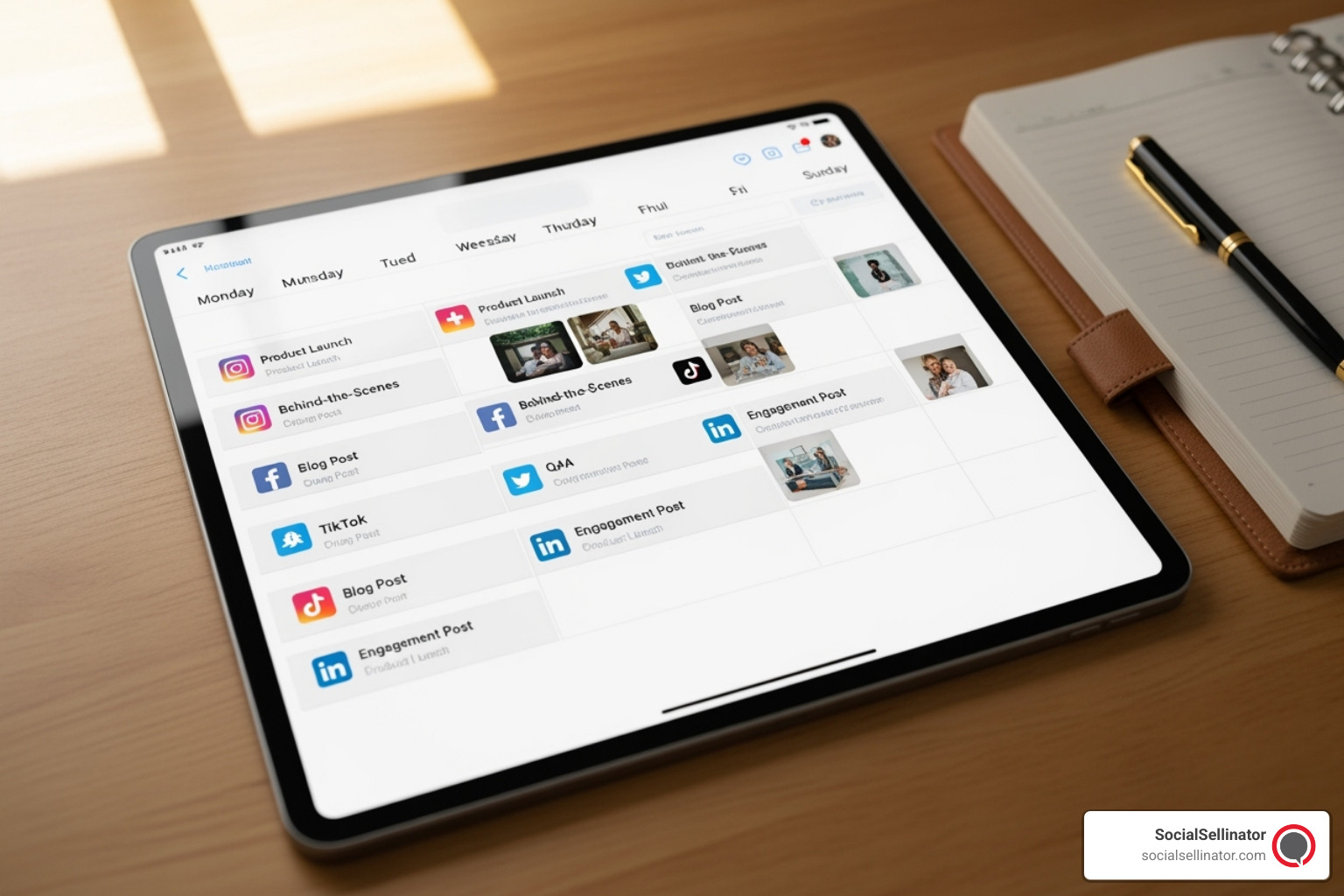
Image metadata:
- Title: Social media content calendar overview
- Caption: A weekly content calendar organizes post types, platforms, and publishing times for a small business.
- Credit: SocialSellinator
- License: All rights reserved
Step 1: Defining Your Goals and Brand Voice
Before you post, ask yourself: What do you hope to achieve with social media? Setting SMART goals—Specific, Measurable, Attainable, Relevant, and Time-Bound—is essential for guiding your path.
Your aim might be to boost brand awareness goals, meaning you want to increase your follower count or reach a specific number of new accounts each month. Perhaps you’re focused on lead generation goals, hoping to capture contact information from potential customers. Or, you might set sales goals, driving a specific number of website conversions or online purchases directly from social media.
Once your goals are clear, define your unique brand voice. This is how your social media small business communicates online. Is your voice witty and playful, informative, empathetic, or quirky? Many brands experiment with their tone of voice to find what resonates with their audience. Your voice should be consistent across all platforms and genuinely reflect your business’s personality. This consistency is a cornerstone of effective small business social media company success strategies.
Step 2: Creating Content That Captivates and Converts
Content is the heart of your social media presence. A well-planned content calendar will become your best friend, helping you outline what you’ll post, when, and on which platform. It’s also wise to establish content pillars—the main themes or topics that align with your brand and resonate with your audience. For example, a coffee shop’s pillars might be “coffee education,” “behind-the-beans,” and “community spotlights.” Expert content creation ensures your messages are clear, compelling, and consistent across all channels.
To captivate your audience, consider these engaging content types:
- Edutainment: This is where education meets entertainment. A large percentage of social users find this the most engaging type of brand content. Think quick tips, how-to videos, or informative infographics with a sprinkle of humor.
- User-Generated Content (UGC): Encourage customers to share photos or videos featuring your product. This builds immense trust and provides authentic social proof, serving as a cost-effective content source.
- Video Testimonials: Short, heartfelt video testimonials from satisfied customers are incredibly powerful. They’re relatable and show potential customers the real-world value you provide.
- Behind-the-Scenes: Pull back the curtain! Show your team at work, give a glimpse into your creation process, or share a “day in the life” of your business. This humanizes your brand and builds a deeper connection.
- Employee Spotlights: Introduce your team members. This personalizes your business, makes your staff more approachable, and helps foster a sense of community.
Original, authentic content is what makes a brand memorable. Our services include comprehensive content creation to ensure your posts are always fresh, engaging, and aligned with your goals, helping you with captivating your audience through social media services for small businesses.
Step 3: Building Relationships Through Engagement
Social media isn’t a megaphone; it’s a two-way street for connection. Active engagement is vital for building strong customer relationships and brand loyalty.
- Respond to Comments & DMs: Make it a point to respond promptly and personally to every comment, message, and review. Consumers expect brands to prioritize personalized customer service on social media. Ignoring a complaint can alienate more than just the individual who posted.
- Personalized Customer Service: Show your audience you’re listening and that you care. Addressing customer feedback directly on social media can turn a challenge into an opportunity to showcase excellent service.
- Run Contests & Polls: These are simple, effective ways to generate excitement, spark interaction, and gather valuable insights from your audience.
- Ask Questions: Ignite conversations by posing open-ended questions related to your industry or products. This encourages comments and makes your audience feel heard.
- Join Conversations (Outbound Engagement): Don’t just wait for people to come to you. A growing trend involves joining comment sections on creators’ posts. This proactive “outbound engagement” is a cost-effective way to gain visibility and establish your expertise.
Active, genuine engagement is how you boost your small business presence with social media.
Step 4: Overcoming Common Challenges for a social media small business
Managing social media can feel like a full-time job, especially for a social media small business owner. But common challenges have practical solutions.
- Time Constraints: This is a huge hurdle. The solution? Scheduling tools. Platforms that let you schedule posts in advance can save you hours each week. Dedicate one block of time to plan and schedule, then focus on daily engagement. Our social media management solutions can streamline this process.
- Limited Budget: You don’t need a massive budget to make an impact. Focus on strong organic strategies—great content, consistent engagement, and user-generated content. When you’re ready for paid ads, start small with boosted posts to expand your reach and test what works.
- Content Creation Block: Stuck for ideas? Repurpose existing content. Turn a blog post into a series of social media snippets, transform data into an infographic, or create a short video from longer content. Customer FAQs are also a goldmine for new ideas.
- Lack of Expertise: It’s okay if you’re not a social media guru. Start small, learn as you go, and don’t be afraid to experiment. You can also consider partnering with digital marketing experts like us. Our team can provide the guidance and support you need, highlighting the role of social media services in small business growth.
Measuring What Matters: Analytics, ROI, and Optimizing Your Efforts
You wouldn’t run a store without checking sales figures, and the same applies to your social media small business efforts. Data and analytics are your compass in the digital world—they guide you toward what’s working, help you understand your audience, and show where your efforts are paying off.
The beauty of social media marketing is its measurability. Unlike traditional advertising, social media gives you detailed insights into every interaction. We emphasize data-driven decisions in all our digital marketing services, including social media management, because the numbers tell the real story of your success.

Image metadata:
- Title: Social analytics dashboard for small businesses
- Caption: A dashboard highlights engagement rates, reach, CTR, and follower growth to guide optimization.
- Credit: SocialSellinator
- License: All rights reserved
Understanding Key Social Media Metrics
Social media platforms offer a treasure trove of data, but knowing which metrics matter most is key. Let’s break down the numbers that move the needle.
Reach versus impressions can be confusing. Reach is the number of unique people who saw your content. Impressions count every time your content appeared on a screen, even if the same person saw it multiple times. If 100 people saw your post twice, your reach is 100, but your impressions are 200.
Engagement rate is where the magic happens for any social media small business. This metric measures how actively your audience interacts with your content through likes, comments, shares, and clicks. A high engagement rate means your content resonates with people. This is far more valuable than having thousands of followers who never interact.
Click-through rate (CTR) is your best friend when driving traffic to your website. If you’re promoting a sale or sharing a blog post, CTR tells you what percentage of people who saw your post clicked the link. It’s a direct measure of how compelling your call to action is.
Conversion rate is the holy grail of social media metrics. This tracks how many people from social media completed a desired action—making a purchase, signing up for a newsletter, or requesting a consultation. It’s the difference between social media being a nice-to-have and a genuine revenue driver.
Follower growth provides insight into your brand’s expanding reach. While it shouldn’t be your only focus, consistent growth indicates that more people are choosing to connect with your brand. Quality matters more than quantity; engaged followers are worth far more than passive ones.
Social listening goes beyond your own metrics to monitor conversations about your brand, industry, and competitors. It’s like having your ear to the ground of the digital conversation, helping you find customer praise or identify common pain points.
All major platforms provide built-in analytics tools. Our effective social media services for small business success leverage these tools to give you clear visibility into your performance without data overload.
How to Measure the ROI of your social media small business campaigns
Measuring return on investment (ROI) is essential for justifying your efforts and making smart decisions about where to invest your time and money.
Tracking conversions with pixels is your secret weapon. By installing tracking pixels (like the Meta Pixel) on your website, you can see the complete customer journey, from a social media click to a final purchase. This technology bridges the gap between social engagement and real business outcomes.
Assigning value to leads helps you quantify the financial impact of your social media efforts. If you know that 20% of your leads become customers with an average purchase of $500, then each lead from social media has an expected value of $100. This calculation helps you understand if your investment is paying off.
Customer lifetime value (CLV) reveals the long-term impact of social media. Social media excels at building loyalty, meaning customers acquired through these channels often stick around longer and spend more over time.
Cost per acquisition (CPA) gives you a clear picture of efficiency in paid campaigns. Divide your total campaign cost by the number of customers you acquired. If you spent $200 on ads and gained 10 new customers, your CPA is $20. This metric helps you compare the effectiveness of different campaigns.
Platform ad reports provide detailed insights for paid campaigns. Platforms offer comprehensive reporting that breaks down performance by demographics, interests, and more, showing you who responded best to your ads.
Understanding these metrics is crucial for optimizing your marketing spend. We help clients dive deep into these reports to make informed decisions, ensuring achieving success with social media marketing for small biz becomes a measurable reality.
Using Data to Refine and Optimize
Analytics are your roadmap for continuous improvement. The real power comes from using this data to make your social media small business strategy more effective.
A/B testing content is like conducting mini-experiments. Try different headlines or post formats (e.g., carousel vs. single image). Your analytics will show which version performed better, taking the guesswork out of content creation.
Identifying optimal posting times can dramatically improve your reach. Your analytics reveal when your specific audience is most active. Posting when your audience is online means more people will see and interact with your content.
Optimizing ad targeting becomes precise when you use performance data. Ad reports show which age groups, interests, and locations respond best. You can then focus your budget on the audience segments that deliver results.
Doubling down on what works is a key optimization strategy. If behind-the-scenes videos consistently get high engagement, make them a regular part of your content calendar.
Learning from underperforming content is equally valuable. Analyze posts that didn’t do well. Was the topic uninteresting? Did the visual fail to grab attention? These insights help you avoid similar mistakes.
The key to successful optimization is consistency. Regular analysis and adjustment are fundamental to small business social media marketing key strategies that deliver real business results.
Conclusion: Your Next Steps to Social Media Success
The world of social media small business marketing is dynamic and brimming with potential. We’ve journeyed from understanding why social media is essential, to selecting platforms, crafting winning strategies, and measuring success with data.
Let’s reflect on the key pillars that support social media success. Authenticity remains your secret weapon; being real and human lets your brand’s personality shine. Consistency builds trust and keeps your audience engaged. It’s not about posting daily, but about showing up reliably for your community. Strategic planning ties it all together. When you define clear goals and plan your content, every post serves a purpose.
Finally, data analysis transforms guesswork into informed decision-making. Successful social media small business owners use analytics to understand what resonates and continuously refine their approach based on real performance data.
The journey to mastering social media is ongoing. Algorithms evolve, new platforms emerge, and audience preferences shift. But with a solid foundation built on these core principles and a commitment to learning, your small business won’t just survive online—it will thrive.
If managing these moving pieces feels overwhelming, you don’t have to do it alone. Partnering with experienced digital marketing professionals can accelerate your growth, allowing you to focus on what you do best: running your business. At SocialSellinator, we offer comprehensive digital marketing solutions, including social media management, SEO, and PPC advertising, designed to help businesses like yours achieve measurable results.
Headquartered in San Jose, in the heart of Silicon Valley and the San Francisco Bay Area, SocialSellinator proudly provides top-tier digital marketing, SEO, PPC, social media management, and content creation services to B2B and B2C SMB companies. While serving businesses across the U.S., SocialSellinator specializes in supporting clients in key cities, including Austin, Boston, Charlotte, Chicago, Dallas, Denver, Kansas City, Los Angeles, New York, Portland, San Diego, San Francisco, and Washington, D.C.