
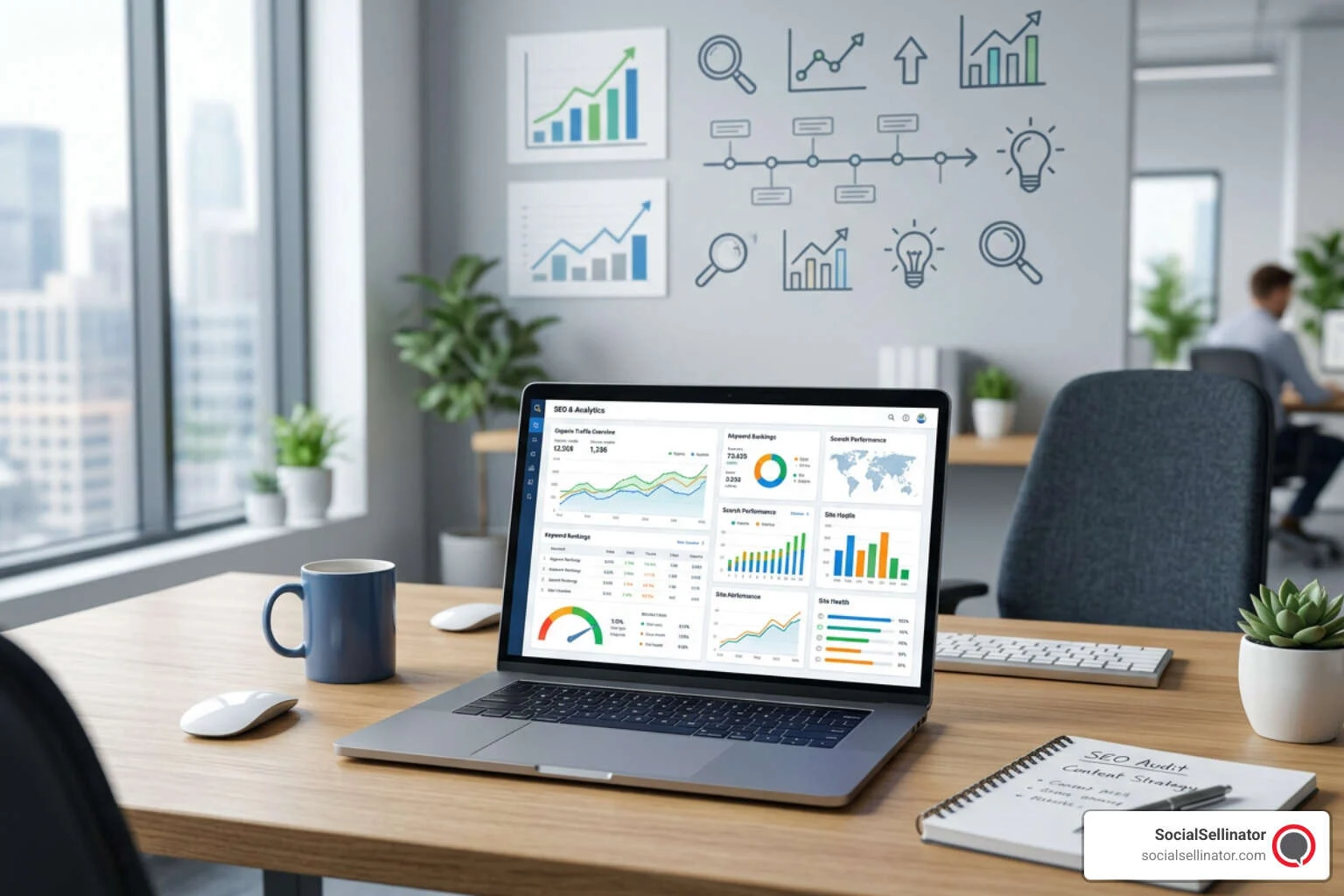
Proven Strategies for Boosting Your Search Position
Why Increasing SEO Rankings Still Matters More Than Ever in 2026
Metadata: Format: JPG, Resolution: 1200×630, File Size: 120KB
Increasing seo rankings is still one of the highest-ROI moves a marketing team can make — but the rules have changed significantly. As search engines transition from simple keyword-matching directories into highly sophisticated, AI-driven answer engines, businesses must adapt their strategies to remain visible. The modern search landscape demands a holistic approach that balances technical precision, deep topical authority, and an outstanding user experience.
Here’s what actually works right now:
- Match search intent — align your page type and content to what users actually want at each stage of their journey
- Optimize on-page elements — title tags, headings, meta descriptions, and keyword placement done right
- Build topical authority — cover subjects deeply with pillar pages and supporting cluster content
- Fix technical foundations — fast load times, mobile-first design, and Core Web Vitals compliance
- Earn quality backlinks — a few relevant, trusted links beat dozens of weak ones
- Optimize for AI Overviews — use direct answers, question-shaped headings, and structured data so AI engines can cite you
- Refresh content regularly — update existing pages every 6 months to stay relevant and crawled
Organic search drives 53% of all website traffic, making it the single largest traffic channel available to most businesses. And the top three positions on Google capture between 50 and 65% of all clicks for a given query. This means that securing a top spot is not just about vanity; it directly impacts your bottom line by funneling highly qualified leads to your website.
But here’s what’s shifted: roughly 60% of Google searches now end without a click at all. AI Overviews appear on nearly half of all searches, and when they do, clicks to the top organic result drop by about 34.5%. This zero-click reality has forced marketers to rethink how they measure success.
That’s not a reason to abandon SEO. It’s a reason to do it smarter.
The businesses winning in 2026 aren’t just chasing keyword rankings — they’re building content that gets cited inside AI-generated answers, earns trust signals Google’s systems reward, and loads fast enough to keep real users engaged. By focusing on comprehensive, high-quality content and robust technical foundations, you can secure your place at the top of the search results.
This guide breaks down exactly how to do that, step by step.
Increasing seo rankings vocabulary:
How Search Engines Evaluate and Rank Your Website
To understand how we can go about increasing seo rankings, we must first pull back the curtain on how search engines actually function. At its core, search engine optimization is about aligning your website with these complex systems. For many years, search engines were viewed as simple matching directories. You would type in a word, and the engine would find pages containing that exact word. Today, search engines have evolved into highly sophisticated answer engines that prioritize meaning, context, and user satisfaction over simple keyword matching.
The process begins with search engine crawlers (often called bots or spiders). These automated programs constantly scan the internet, jumping from link to link to discover new and updated web pages. Once a crawler finds a page, it parses the content, analyzes its structure, and adds it to a massive database called the index. If your website is not indexed, it cannot appear in search results. This makes technical crawlability the absolute first step in any search strategy.
Once a page is indexed, relevance algorithms take over whenever a user types a query. These algorithms evaluate hundreds of signals to determine which pages provide the most accurate, helpful, and comprehensive answers. The goal is to deliver the best possible user experience, ensuring that searchers find what they need without having to return to the search results page to click on another link.
While the exact weight of every ranking signal remains a closely guarded secret, recent industry insights and technical disclosures have confirmed several critical factors that drive search engine evaluations:
- User Behavior Signals (NavBoost): Search engine systems use historical click data to adjust search results in real time. This system tracks metrics like “good clicks” (where a user stays on a page to read), “bad clicks” (where a user immediately leaves), and the “last longest click” (which indicates the user finally found the answer they needed). If users consistently click your page and spend time reading it, your rankings will climb. This highlights the importance of creating engaging, high-quality content that immediately hooks the reader.
- siteAuthority: Despite public denials in past years, internal search systems utilize site-wide authority metrics to evaluate the overall trust of a domain. This means that building a reputable, cohesive website elevates the ranking potential of every individual page on that site. A single high-performing page can lift the visibility of your entire domain.
- hostAge Sandbox: New websites often experience a delay before they can rank for highly competitive terms. This built-in holding period, sometimes referred to as the sandbox, is designed to filter out low-quality spam. For brand new sites, sustained quality improvements, consistent publishing, and patience are required during the first three to six months.
- chromeInTotal Browser Data: Search engines analyze broader browser traffic data to evaluate site quality. Direct traffic, returning visitors, and overall brand search volume serve as strong signals that your website is a trusted destination for users. This means that building a recognizable brand offline and across social channels directly supports your organic search performance.
To dive deeper into how these search engine mechanisms influence your visibility, check out our comprehensive guide on SERP SEO Ranking 101: From Zero to Hero on Google and explore Everything You Need to Know About the Ranking of Web Pages in Search Engines.
Understanding Search Intent for Increasing SEO Rankings
At the heart of any successful search strategy is the alignment of your content with what the user is actually trying to accomplish. We categorize this user behavior into three main stages of the customer journey:
- Awareness Stage: The user is experiencing a problem and looking for broad information or educational resources. They want to understand the “why” behind their challenges. (Example: “Why is my website traffic dropping?”)
- Consideration Stage: The user has identified their problem and is actively comparing different solutions, services, or locations. They are looking for guides, comparisons, and expert insights. (Example: “Best digital marketing services near me” or “SEO vs paid ads.”)
- Purchase Stage: The user knows exactly what they want and is ready to buy or contact a provider. They are looking for pricing, testimonials, and direct contact options. (Example: “Hire SocialSellinator for SEO services.”)

Metadata: Format: JPG, Resolution: 800×600, File Size: 95KB
To successfully improve your search presence, you must map your target keywords to the correct page types. A user in the awareness stage wants an in-depth, educational blog post that answers their questions without a hard sales pitch. A user in the purchase stage wants a clean, high-converting landing page with a clear call-to-action. If you try to rank a product page for an informational keyword, or a long blog post for a direct buy-now query, you will struggle to rank because you are not satisfying the user’s immediate intent. Understanding this alignment is crucial for long-term success.
If you are working with a fresh domain and want to learn how to navigate these intent stages from day one, read our step-by-step playbook on How to Rank Your Brand New Website.
On-Page Strategies for Increasing SEO Rankings
On-page SEO is the practice of optimizing individual web pages to help both search engines and users understand their relevance and quality. In 2026, on-page optimization has shifted away from rigid keyword density metrics toward topical depth, semantic clarity, and user engagement.
To set up your pages for success, we must focus on several core structural elements:
- Title Tags: Your title tag is the single most important on-page HTML element. It should be between 50 and 60 characters long, lead with your primary keyword, and be written to attract human clicks. Think of it as a compelling ad headline rather than a list of terms. A well-crafted title tag can significantly boost your click-through rate, sending positive signals to search algorithms.
- Meta Descriptions: While meta descriptions do not directly impact rankings, they heavily influence your click-through rate (CTR). Write a short, persuasive summary of 130 to 160 characters that includes a clear benefit and a soft call-to-action. This is your opportunity to pitch your page to searchers before they even click.
- Heading Structure (H1, H2, H3): Use headings to establish a logical hierarchy on your page. Your page should have exactly one H1 tag containing your primary topic. Use H2 and H3 tags to organize subtopics, phrasing some of them as direct questions that users frequently search. This structure helps search engines understand the relationship between different sections of your content.
- Semantic SEO and Entities: Modern search algorithms do not just look for isolated keywords; they look for entities (concepts, brands, tools, locations, and processes) and evaluate how they relate to one another. Instead of repeating a single keyword, cover all the closely related subtopics and terms that naturally belong in a professional discussion of the subject. This builds a richer context that search engines reward.
- Topic Clusters: Do not write isolated articles. Instead, build a pillar-and-cluster model. Create one comprehensive pillar page that covers a broad topic, and support it with 5 to 10 narrower cluster articles. Link all the cluster articles back to the pillar page using descriptive, keyword-relevant anchor text. This signals to search engines that you possess deep, well-organized expertise on the subject, establishing your site as a go-to resource.
By implementing these structural best practices, you make it incredibly easy for search engines to crawl, parse, and reward your content. For more detailed tips on getting your site noticed, explore our guide on how to Boost Your Website SEO and Finally Get Noticed and learn How to Master SEO Rank Analysis and Finally Beat the Bots.
Content Freshness and Its Role in Increasing SEO Rankings
Publishing a great page is only the first step. To maintain your search visibility over time, you must establish a consistent content maintenance strategy. Search engines prioritize websites that are regularly updated, as fresh content is more likely to be accurate and relevant to users.
When you refresh your content, you encourage search engine crawlers to scan your website more frequently. This increased crawl frequency allows new updates and pages to be indexed and ranked much faster. It also prevents your older, high-performing pages from losing traffic to newer competitor articles.
We recommend implementing a strict 6-month content review cycle. During this review, you should:
- Identify high-performing pages and update them with new statistics, fresh examples, and updated dates to maintain their relevance.
- Prune or consolidate thin, duplicate, or outdated pages that are no longer driving traffic or serving your audience, funneling their authority into stronger pages.
- Check for broken links and replace them with fresh, highly authoritative resources to ensure a seamless user experience.
Regularly updating your existing content library is often the fastest, most cost-effective way to boost your overall search visibility without needing to write dozens of new articles from scratch. To keep track of your performance during these updates without getting overwhelmed, check out our practical advice on How to Find Your Rank Without Losing Your Mind.
Optimizing for AI Overviews and Generative Engine Optimization (GEO)
With nearly half of all searches triggering an AI Overview, modern SEO requires us to optimize for two surfaces: traditional blue links and generative AI answers. This practice is known as Generative Engine Optimization (GEO).
AI engines compile their summaries by scanning the top organic search results and synthesizing the most direct, accurate answers. To ensure your content is cited inside these AI-generated panels, use the following formatting framework:
- Definition-First Sentences: Start key sections with a concise, 40-to-60-word direct summary or definition. Place this right below a clear heading. This makes it incredibly easy for AI crawlers to extract your text as a direct citation.
- Question-Shaped Headings: Use H2 or H3 tags that mirror the exact conversational questions users ask (e.g., “What is the role of technical SEO?”). This aligns perfectly with how natural language processing models search for answers.
- Structured Data and Schema Markup: Implement JSON-LD schema markup (such as Article, Organization, and FAQPage schema) to give search engines explicit context about your content, authors, and organization.
- Ensure Crawler Access: Check your robots.txt file to ensure you are not accidentally blocking major AI crawlers like GPTBot, ClaudeBot, or PerplexityBot. If these crawlers are blocked, your brand will remain invisible in AI-generated answers, missing out on a massive source of modern search traffic.
Technical Performance and the Core Web Vitals Baseline
No matter how exceptional your content is, it will struggle to rank if your website delivers a poor user experience. Technical SEO is the foundation that ensures search engines can crawl your site and users can navigate it without frustration. A technically sound website provides a smooth, secure, and fast environment that search engines love to reward.
Since Google uses mobile-first indexing, your website must be fully responsive, readable, and functional on mobile devices before desktop optimization even comes into play. Furthermore, secure protocols (HTTPS) are a non-negotiable baseline for establishing trust with both users and search engines. If your site lacks an SSL certificate, browsers will flag it as insecure, driving potential customers away.

Metadata: Format: WebP, Resolution: 800×500, File Size: 70KB
To measure and improve user experience, we focus on Core Web Vitals — a set of specific real-world metrics that track loading speed, interactivity, and visual stability:
| Core Web Vital Metric | What It Measures | Good Threshold | Needs Improvement | Poor Threshold |
|---|---|---|---|---|
| Largest Contentful Paint (LCP) | Loading performance (how fast the main content loads) | Under 2.5 seconds | 2.5 – 4.0 seconds | Over 4.0 seconds |
| Interaction to Next Paint (INP) | Interactivity and responsiveness to user inputs | Under 200 milliseconds | 200 – 500 milliseconds | Over 500 milliseconds |
| Cumulative Layout Shift (CLS) | Visual stability (preventing unexpected layout shifts) | Under 0.1 | 0.1 – 0.25 | Over 0.25 |
To hit these “Good” thresholds, you must take a proactive approach to development and design. Compress your images using next-generation formats like WebP or AVIF, which offer superior quality at a fraction of the file size. Eliminate render-blocking JavaScript and CSS that delay the rendering of your page. Additionally, ensure your hosting infrastructure is optimized for speed, utilizing Content Delivery Networks (CDNs) to serve your site from servers closest to your visitors. By optimizing these technical elements, you create a fast, seamless experience that keeps users on your site longer and boosts your search rankings.
Frequently Asked Questions About Search Visibility
How long does it take to see the impact of SEO changes?
SEO is a long-term investment, not an overnight switch. While minor technical fixes, such as correcting broken links or optimizing title tags, can sometimes show results within a few days, a comprehensive strategy typically takes 3 to 6 months to demonstrate significant, sustained ranking improvements. This timeline depends on several factors, including your industry’s competitiveness, your domain’s existing authority, and the quality of your content.
If your website has been affected by a major search engine core update, recovery usually requires sustained quality enhancements and technical audits over several months, with full visibility returning during the next broad algorithmic update. Consistency and patience are key to long-term success.
Is E-E-A-T a direct ranking factor for Google?
No, E-E-A-T (Experience, Expertise, Authoritativeness, and Trustworthiness) is not a single, direct algorithmic ranking factor. Instead, it represents a conceptual framework that Google’s systems use to evaluate the overall quality, credibility, and helpfulness of your content. Google trains human Quality Raters to evaluate search results based on these guidelines, and their feedback is used to refine the ranking algorithms.
You can satisfy these guidelines by showcasing real author bios with professional credentials, citing reputable sources, publishing original research, and avoiding mass-produced, unedited content that adds no unique value. Demonstrating first-hand experience with your subject matter is one of the best ways to build trust with both users and search engines.
Should I optimize my website for search engines other than Google?
Yes. While Google remains the dominant global search engine, diversifying your search visibility is a smart way to reduce single-algorithm risk. Relying solely on one platform leaves your business vulnerable to sudden algorithm changes.
Optimizing for Bing, DuckDuckGo, and Brave Search allows you to capture high-intent audiences who prefer alternative platforms. Furthermore, because popular conversational AI tools pull search data from alternative indexes (such as Bing’s index), maintaining a strong presence across multiple search engines ensures your brand gets cited in modern AI search environments as well. This multi-engine approach broadens your reach and secures your digital footprint.
Conclusion
Increasing SEO rankings is no longer about trying to trick an algorithm with keyword stuffing or low-quality links. It is about building a fast, secure, and authoritative digital presence that delivers the absolute best answer to a user’s question, whether they find you through a classic blue link or an AI-generated answer. By focusing on user intent, technical excellence, and high-quality content, you can build a sustainable source of organic traffic that grows over time.
At SocialSellinator, we specialize in helping growing businesses navigate this changing landscape. As an award-winning digital marketing agency, we design customized, data-driven strategies that combine advanced technical SEO, high-converting PPC management, social media optimization, and expert content creation to deliver measurable, compounding results.
Ready to elevate your online presence and outpace the competition? Explore our comprehensive SocialSellinator Digital Marketing Services and get in touch with our team today.
Headquartered in San Jose, in the heart of Silicon Valley and the San Francisco Bay Area, SocialSellinator proudly provides top-tier digital marketing, SEO, PPC, social media management, and content creation services to B2B and B2C SMB companies. While serving businesses across the U.S., SocialSellinator specializes in supporting clients in key cities, including Austin, Boston, Charlotte, Chicago, Dallas, Denver, Kansas City, Los Angeles, New York, Portland, San Diego, San Francisco, and Washington, D.C.