
LinkedIn Lead Generation: Tactics That Actually Work in 2026
Why Most B2B Marketers Are Leaving Pipeline on the Table
Metadata: Width 1080px, Height 720px, Format JPG, Alt: LinkedIn lead generation tactics 2026.
The proven LinkedIn lead tactics that actually fill a pipeline in 2026 are not complicated — but most marketing teams still aren’t using them consistently.
Here’s a quick answer if you’re short on time:
Top Proven LinkedIn Lead Tactics (2026)
- Optimize your profile as a landing page — outcome-focused headline, problem-first About section, social proof
- Post content consistently — use a 60% educational / 25% inspirational / 15% personal mix
- Use Sales Navigator filters — stack criteria including activity signals to find decision-ready prospects
- Send structured outreach sequences — 3 to 4 touches over 2 to 3 weeks, short and conversational
- Act on engagement signals — follow up with people who like, comment, or view your profile within the hour
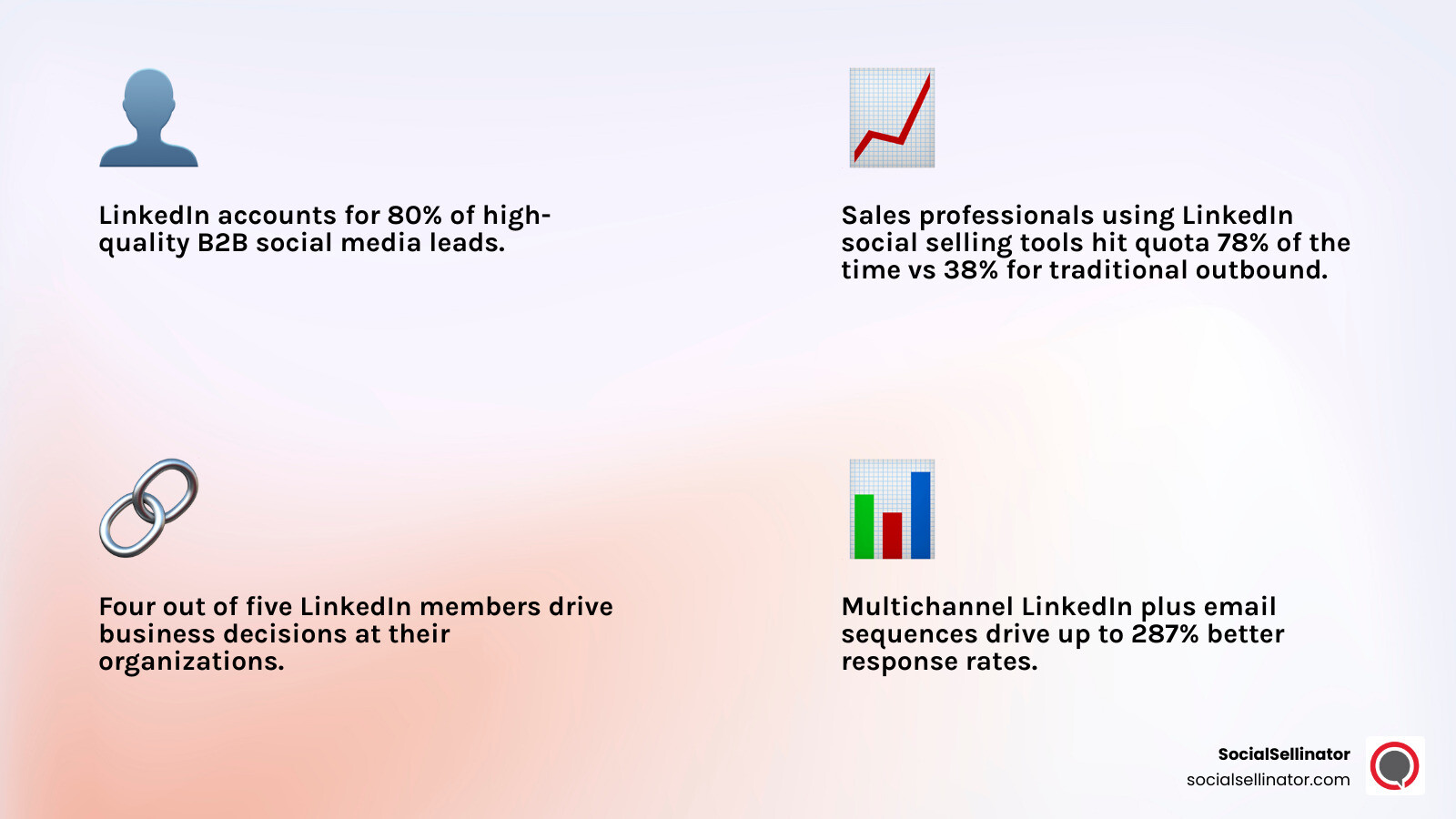
- Pair LinkedIn with email — multichannel sequences drive up to 287% better response rates
- Track real metrics — connection acceptance rate, reply rate, and meetings booked (not just likes)
LinkedIn is not just another social channel. Four out of five LinkedIn members drive business decisions at their organizations. The platform accounts for 80% of high-quality B2B social media leads, and sales professionals who use LinkedIn’s social selling tools hit quota 78% of the time — compared to just 38% for those running traditional outbound.
Yet most B2B teams still treat LinkedIn like a broadcast channel. They post a few company updates, send generic connection requests, and wonder why the pipeline stays dry.
The gap between average results and exceptional ones is not about budget or even time. It’s about system. Teams that build a deliberate, repeatable process — from profile to content to outreach to measurement — consistently outperform those who wing it.
This guide breaks down exactly what that system looks like in 2026.
 Metadata: Width 1200px, Height 630px, Format JPG, Alt: Proven LinkedIn lead tactics overview infographic with stats, steps, and benchmarks infographic.
Terms related to proven linkedin lead tactics:
Why LinkedIn Dominates B2B Lead Generation in 2026
The B2B buying landscape has shifted dramatically over the last few years. The buyer’s journey is no longer a straight line from discovery to demo. It is a complex, self-guided, and highly collaborative process. In 2026, the average B2B buying process involves between 3.1 and 4.6 different stakeholder groups spanning departments like IT, finance, HR, and operations.
Before a decision-maker ever speaks to a sales representative, they consume between 7 and 10 pieces of content to build their confidence. They are looking for expert perspectives, peer reviews, and clear proof of concept. This is where Lead Generation on LinkedIn becomes your most powerful asset.
Unlike entertainment-focused social networks where users scroll passively to escape work, LinkedIn users log on with a distinct professional mindset. They are actively seeking industry insights, looking for solutions to their operational challenges, and networking with other professionals. This high level of business intentionality explains why LinkedIn’s visitor-to-lead conversion rate is 277% higher than Facebook or Twitter. For broader context on the platform itself, LinkedIn serves as the premier professional network.
Visitor-to-Lead Conversion Rate Comparison:
- LinkedIn: 277% higher
- Facebook: lower than LinkedIn
- Twitter/X: lower than LinkedIn
Furthermore, standard cold outreach channels like email are facing historic challenges. With aggressive spam filters, tighter security protocols, and inbox overload, cold email reply rates have fallen significantly. On LinkedIn, however, the playing field is entirely different. InMail open rates comfortably hover above 50%, compared to roughly 21% for standard email.
Because professionals treat their LinkedIn profiles as extensions of their personal reputations, they engage in more authentic, human-to-human communication. When you leverage proven LinkedIn lead tactics, you bypass the gatekeepers and land directly in the primary inbox of the exact decision-makers you want to reach.
Proven LinkedIn Lead Tactics: Profile Optimization as a Landing Page
Before you write a single post or send a single connection request, you must address your digital storefront: your personal profile.
Many B2B professionals still treat their LinkedIn profiles like passive resume cabinets. If your profile is written to help you find your next job, it will not help you find your next client. To generate high-quality leads, you must treat your profile like a high-converting landing page.
When a prospect receives a connection request or encounters your content in their feed, they will click through to your profile. Within three seconds, they should understand exactly what you do, who you help, and what action they should take next.

Figure 1: Diagram of an optimized LinkedIn profile showing headline, about section, and featured media. Metadata: Width 800px, Height 600px, Format JPG.
To achieve this level of clarity, focus on optimizing these core elements of your profile:
1. The Headline is Your Value Proposition
Your headline should not simply list your job title and company name (e.g., “Sales Director at Acme Corp”). Instead, rewrite it as an outcome-oriented statement that speaks directly to your target audience. Use a proven formula such as:
I help [Ideal Customer Profile] achieve [Desired Outcome] without [Common Pain Point].
For example: “Helping B2B SaaS founders scale from $1M to $10M ARR without burning out their sales teams.” This immediately communicates the value you bring and qualifies the visitor.
2. The About Section is Your Sales Pitch
Your About section should not be a dry, third-person biography. Write it in the first person and structure it as a compelling narrative focused on your client’s challenges.
- The Hook: Start with a relatable problem your target audience faces.
- The Solution: Explain your unique approach to solving that problem.
- The Proof: Share brief, data-backed results or achievements (e.g., “We helped a mid-market logistics firm reduce operational churn by 34%”).
- The Call to Action (CTA): Tell them exactly what to do next, whether it is booking a discovery call, downloading a resource, or sending you a direct message.
3. The Featured Section is Your Lead Magnet
Use the Featured section to showcase your best assets. Pin high-performing posts, customer case studies, video testimonials, or links to high-value landing pages. This provides instant social proof and gives interested prospects an immediate path to engage deeper with your brand.
To learn more about transforming your personal brand into a client-attracting asset, read our comprehensive guide on Maximizing Your LinkedIn Profile for Lead Generation Best Practices.
Organic Content Strategies That Drive Inbound Leads
Once your profile is fully optimized, you need to drive consistent traffic to it. The most sustainable way to do this is through a value-first organic content strategy.
In 2026, the LinkedIn algorithm heavily prioritizes authentic engagement over raw reach. Viral posts with shallow “engagement bait” no longer translate into business opportunities. Instead, the platform rewards content that sparks genuine, professional conversations in the comment section.
To build an organic engine that consistently attracts inbound leads, we recommend structuring your content around three primary pillars:
Organic Content Mix:
- 60% Educational Content (industry insights, guides)
- 25% Inspirational Content (lessons learned, growth)
- 15% Personal Content (behind-the-scenes, values)
1. Educational Content (60%)
This is the foundation of your authority. Share actionable advice, step-by-step guides, industry trends, and breakdowns of common challenges. Your goal is to solve one specific problem for your prospect right in the feed. When you give away your best ideas for free, prospects realize how valuable your paid services must be.
2. Inspirational & Proof Content (25%)
Share client success stories, case studies, and lessons learned from failure. Instead of bragging, frame these stories around the transformation your client experienced. Use specific numbers and real-world scenarios to build credibility. For example, detail how a product with customer reviews is statistically 270% more likely to be purchased than one without, and explain how you helped a partner build that social proof.
3. Personal & Behind-the-Scenes Content (15%)
People buy from people they know, like, and trust. Share your personal values, behind-the-scenes looks at how you run your business, or communication quirks you’ve developed over the years. This humanizes your brand and makes you approachable.
For this mix to work, consistency is far more important than daily frequency. Posting three times a week with highly valuable insights will yield much better results than posting low-effort content every day.
Additionally, you must actively participate in the community. Spend 15 minutes before and after you post commenting on the updates of your prospects, industry leaders, and peers. This collaborative approach is a key part of a successful LinkedIn Engagement Strategy, drawing highly targeted profile views back to your optimized landing page.
Advanced Outbound and Targeting Strategies
While a strong organic presence builds authority and attracts inbound interest, active outbound prospecting allows you to control your pipeline growth. By combining precision targeting with highly personalized outreach, you can proactively connect with decision-makers who fit your ideal customer profile (ICP).
Sales Navigator and Advanced Targeting Filters
Generating high-quality outbound leads begins with building a highly refined list. Standard LinkedIn search is useful, but Sales Navigator is essential for serious B2B pipeline development.
The secret to success with Sales Navigator is avoiding overly broad searches. Instead of targeting “VP of Sales in the United States,” which returns hundreds of thousands of generic results, use stacked filters and Boolean search operators (AND, OR, NOT) to narrow your list to highly qualified prospects.
Broad Search vs. Stacked Filtering:
- Broad: “VP of Sales” -> 150,000+ generic results
- Stacked: VP of Sales + 50-200 Employees + US Region + Hiring SDRs + Posted in Last 30 Days -> 350 highly active, high-intent prospects
When building your lists, look for specific buying signals and trigger events:
- Recent Activity: Filter by prospects who have “posted on LinkedIn in the last 30 days.” Active users are far more likely to accept connection requests and reply to messages.
- Company Growth & Hiring: Look for companies that are actively hiring in departments related to your service. A company hiring new sales representatives, for instance, is highly likely to need help with lead generation or training.
- Department Headcount Growth: A steady increase in department size indicates budget availability and scaling initiatives.
By focusing your efforts on these high-intent segments, you can significantly improve your campaign efficiency. For practical tips on setting up these advanced filters, read our collection of LinkedIn Sales Navigator Tips.
Structuring High-Response Outreach Sequences with Proven LinkedIn Lead Tactics
Once you have built your target list, the next step is designing your outreach sequence. In 2026, the era of the long, generic sales pitch is officially over. Decision-makers receive hundreds of messages weekly; they can spot a generic, automated template instantly.
To stand out, your outreach should feel like a quick text message exchange rather than a formal, multi-paragraph email. We recommend a structured 3-to-4 touchpoint sequence spread over two to three weeks:
Touch 1: The Connection Request
Our research shows that blank connection requests often yield a higher acceptance rate (typically 30-45%) than requests containing a generic pitch. If you do choose to include a note, make it highly specific to their recent activity. Reference a post they recently published, a mutual connection, or a shared professional interest. Never pitch your services in the connection request.
Touch 2: The Value-First Message (2-3 days after acceptance)
Once they accept your request, send a short, friendly message that provides value without asking for anything in return. You might share an insightful article, a relevant industry report, or a quick tip addressing a challenge common to their role.
Example:
“Hi [Name], thanks for connecting. I noticed you recently posted about the challenges of scaling outbound sales this year. We recently put together a quick breakdown of how three mid-market firms bypassed email spam filters to book 20+ meetings a month. Thought you might find it useful: [Link]. No pitch, just hope it helps!”
Touch 3: The Soft Follow-Up (5-7 days later)
If they haven’t replied, follow up with a brief, low-friction question to start a conversation. Focus on their current processes or pain points rather than booking a call.
Example:
“Hey [Name], just wanted to see if you had a chance to look at that breakdown. Are you guys currently relying more on cold email or LinkedIn for your outbound efforts?”
Touch 4: The Final Touchpoint (7 days later)
If there is still no response, send a polite final message offering one last piece of value and letting them know you will step back. This low-pressure approach often triggers a delayed response from busy decision-makers.
By keeping your messages conversational, short, and focused on their challenges, you can achieve reply rates of 15% to 25%, which is significantly higher than cold email benchmarks. For more detailed advice on starting natural conversations with prospects, check out these 5 Tips for Engaging with Prospects Through LinkedIn.
Scaling Safely and Avoiding Platform Restrictions Using Proven LinkedIn Lead Tactics
When implementing outbound campaigns, safety and account longevity must be your top priorities. LinkedIn actively monitors account activity to protect its user experience from spam. To keep your account in good standing, you must scale your outreach carefully and maintain a high-quality presence.
Recommended Daily Activity Limits (Per Profile):
- Connection Requests: 10 – 20 per day
- Direct Messages: 20 – 30 per day
- Profile Views: 50 – 70 per day
To scale your outbound efforts safely, keep these best practices in mind:
- Respect Platform Limits: Limit your daily activity to approximately 15 to 20 connection requests and 30 direct messages per sender. Exceeding these limits can trigger warnings or temporary account restrictions.
- Monitor Your Social Selling Index (SSI): LinkedIn assigns every profile an SSI score based on four pillars: establishing your professional brand, finding the right people, engaging with insights, and building relationships. Profiles with higher SSI scores are granted more natural reach and are less likely to face restrictions. You can check your score directly on LinkedIn.
- Prioritize Personalization: The best way to avoid being flagged as spam is to ensure your messages are genuinely helpful and personalized. High reply rates tell LinkedIn’s algorithm that your outreach is welcome and valuable.
By treating LinkedIn as a relationship-building platform rather than a mass-messaging tool, you can build a highly predictable sales pipeline while keeping your profile secure. For additional tips on safe, effective prospecting, read our guide on Social Selling on LinkedIn: 9 Tips to Prospects.
Frequently Asked Questions About LinkedIn Lead Generation
What is the average connection acceptance rate on LinkedIn?
For a well-targeted campaign with an optimized profile, the benchmark for a healthy connection acceptance rate is between 30% and 45%.
If your acceptance rate falls below 20%, it is usually an indicator of one of two issues:
- Your profile is not optimized: When prospects click on your name, they see a generic headline or a self-serving pitch, making them hesitant to connect.
- Your targeting is too broad: You are reaching out to people who do not see the immediate relevance of connecting with you.
To improve your acceptance rate, refine your target list to active users and ensure your headline clearly communicates how you add value to your industry.
How do organic and paid LinkedIn lead tactics compare?
Both organic and paid tactics play vital roles in a comprehensive digital marketing strategy, but they serve different purposes:
Organic vs. Paid Tactics:
- Organic LinkedIn Tactics
- Zero direct ad spend
- Builds long-term authority
- Higher conversion rates
- Requires consistent time and effort to scale
- Paid LinkedIn Ads
- Instant, scalable reach
- Highly precise targeting
- Cost per lead is higher
- Lower conversion rate than warm organic traffic
For companies looking for immediate, predictable volume, combining organic positioning with native Lead Gen Forms and Sponsored Content is highly effective. If you are operating on a tighter budget, focusing on organic networking and value-first content is the best way to generate high-quality leads for free. For a detailed comparison, explore our A How-to Guide on LinkedIn Lead Generation.
How do you measure the ROI of LinkedIn lead generation?
To accurately track the return on investment of your LinkedIn efforts, you must look beyond basic engagement metrics like likes and comments. Instead, focus on conversion and business-level metrics:
- Connection Acceptance Rate: Measures the appeal of your profile and target lists.
- Response Rate: Tracks the effectiveness of your messaging sequences.
- Positive Response Rate: The percentage of replies that lead to a meaningful conversation or a booked meeting.
- Cost Per Acquisition (CPA): The total cost (including tools, content creation, or agency services) divided by the number of closed clients.
By integrating your LinkedIn activity with a CRM, you can track prospects from their initial touchpoint all the way to closed-won revenue, giving you a clear picture of your campaign’s financial impact.
Conclusion
Building a predictable pipeline on LinkedIn does not require viral posts, massive budgets, or spammy automation. It requires a commitment to a structured, value-first system. By treating your profile as a high-converting landing page, sharing educational content, and targeting high-intent decision-makers with personalized outreach, you can turn LinkedIn into your most reliable source of B2B opportunities.
At SocialSellinator, we understand that managing a comprehensive digital marketing strategy can be time-consuming for busy business owners. Our team of experienced professionals specializes in creating customizable solutions—including top-tier digital marketing, SEO, PPC, social media management, and content creation—to help you achieve measurable results quickly and cost-effectively. Whether you want to attract inbound leads through organic content or scale your outbound prospecting safely, we have the tools and expertise to help your business thrive.
Headquartered in San Jose, in the heart of Silicon Valley and the San Francisco Bay Area, SocialSellinator proudly provides top-tier digital marketing, SEO, PPC, social media management, and content creation services to B2B and B2C SMB companies. While serving businesses across the U.S., SocialSellinator specializes in supporting clients in key cities, including Austin, Boston, Charlotte, Chicago, Dallas, Denver, Kansas City, Los Angeles, New York, Portland, San Diego, San Francisco, and Washington, D.C.