
How to Use AI Automation as Your LinkedIn Lead Gen Assistant
Why LinkedIn Lead Gen Automation Is a Game-Changer for B2B Marketers
Alt Text: AI-powered B2B lead generation dashboard on a laptop screen; Metadata: 1200×630 px, PNG format
LinkedIn lead gen automation is the use of software and AI tools to handle the repetitive work of finding, qualifying, and reaching out to potential B2B customers on LinkedIn — so your team can focus on closing deals instead of chasing them.
Quick answer: What is LinkedIn lead gen automation and how does it work?
| Step | What Automation Does |
|---|---|
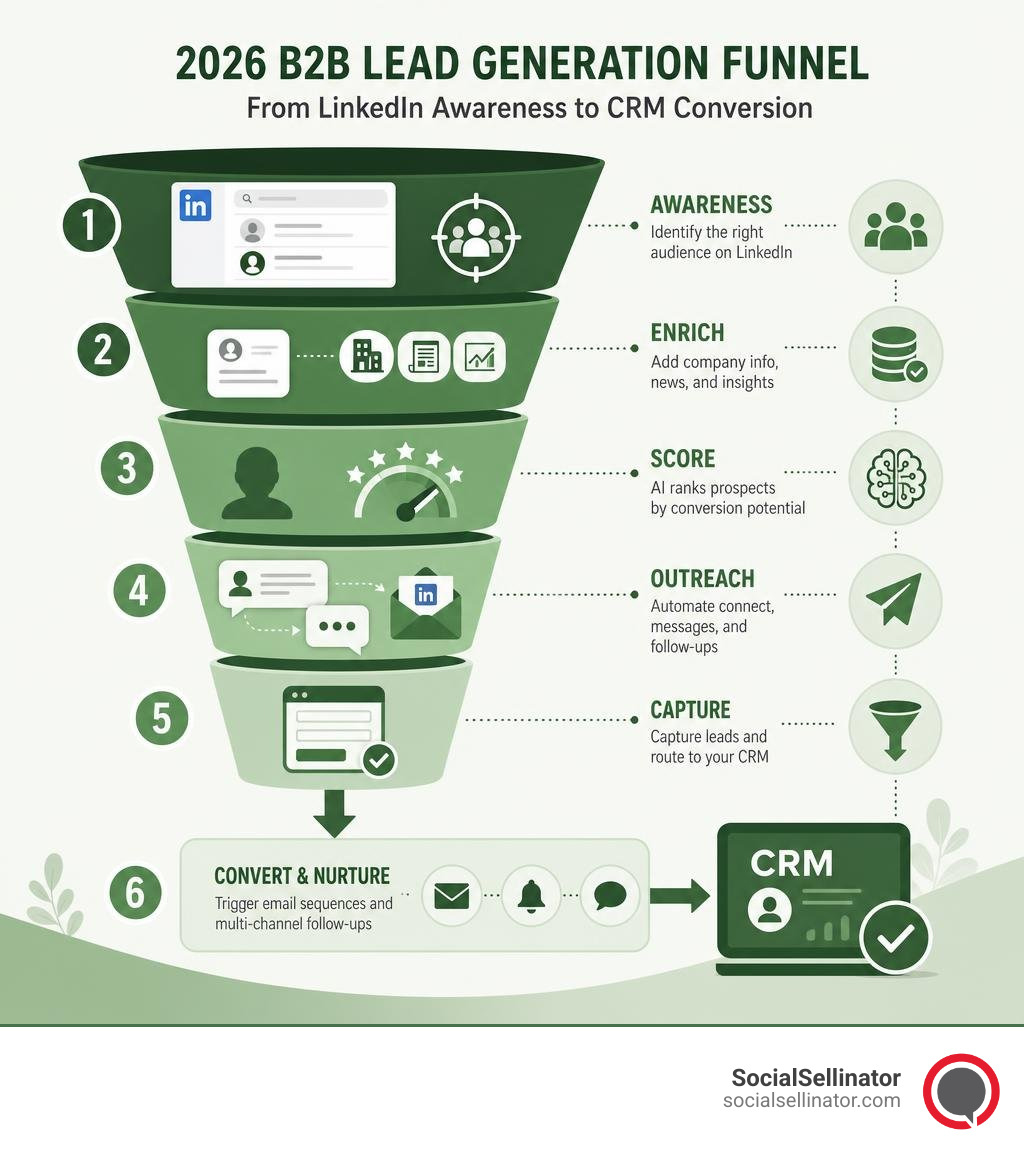
| 1. Find prospects | Scans LinkedIn using your Ideal Customer Profile (ICP) criteria |
| 2. Enrich data | Pulls company info, recent posts, and news to build context |
| 3. Score leads | Uses AI to rank prospects by likelihood to convert |
| 4. Send outreach | Automates connection requests, messages, and follow-ups |
| 5. Capture leads | Routes form submissions directly into your CRM |
| 6. Nurture | Triggers email sequences and multi-channel follow-ups automatically |
LinkedIn is not just another social network for B2B marketing teams — it’s the highest-converting lead generation platform available. LinkedIn’s visitor-to-lead conversion rate is 277% higher than Facebook or Twitter. Its ads convert at a 136% higher rate than Google Ads. And 4 out of 5 people on the platform are corporate decision-makers.
But here’s the problem: doing it manually doesn’t scale.
A typical sales rep can send roughly 50 connection requests per week by hand. They spend hours scrolling through search results, copy-pasting names into spreadsheets, and writing individual messages. Research shows the average SDR spends 60% of their time on tasks that don’t require a human at all.
That’s where automation changes everything.
Modern LinkedIn automation tools — from cloud-based outreach platforms to AI-powered scoring agents — can handle prospecting, personalized messaging, and lead routing around the clock. Teams using multi-channel LinkedIn automation report 10x more replies and save more than 10 hours per rep, per week.
This guide walks you through exactly how to set up, run, and measure a LinkedIn lead gen automation strategy that works in 2026 — without putting your account at risk.
Linkedin lead gen automation terms simplified:
The Strategic Value of LinkedIn Lead Gen Automation
In B2B marketing, efficiency is the ultimate differentiator. Traditional outbound prospecting often feels like throwing paper airplanes into a gusty wind—you spend incredible effort crafting a message, only to watch it drift away without a response.
By implementing structured automation, we shift the burden of repetitive administrative tasks from human shoulders to intelligent software. The strategic value here goes far beyond simply sending more messages. It fundamentally changes how we approach LinkedIn Lead Generation.
When we automate the top of the funnel, we unlock immediate, measurable benefits:
- Dramatic Time Savings: Instead of spending hours hunting down email addresses, verifying job titles, and copy-pasting initial greeting templates, your sales development representatives (SDRs) can focus entirely on active conversations. Automation platforms regularly save sales representatives upwards of 10 hours per week.
- Lowered Cost-Per-Lead (CPL): By targeting highly specific segments and utilizing automated native lead capture systems, businesses routinely beat their historic cost-per-lead goals. Removing manual steps from the lead capture process directly translates to higher conversion rates and lower acquisition costs.
- Increased Account Executive (AE) Leverage: When outbound pipelines are automated and qualified intelligently, AEs can service up to three times more clients. They are no longer bogged down by cold outreach; instead, they step in only when a prospect has shown verified interest.
The goal of automation is to build a predictable, scalable system. It turns LinkedIn from a noisy, manual social network into a highly structured pipeline engine that runs in the background while your team does what they do best: building genuine relationships and closing deals.
Aligning Sales and Marketing Teams on Lead Scoring
One of the greatest points of friction in any B2B organization is the age-old divide between sales and marketing. Marketing complains that sales isn’t following up on leads; sales complains that the leads marketing provides are low-quality.
To bridge this gap, modern organizations rely on “smarketing”—the tight integration of sales and marketing teams into a single, collaborative unit with shared key performance indicators (KPIs). At the center of this alignment is a robust, automated lead scoring system.
By leveraging predictive analytics and machine learning, we can automatically score leads based on real-time behavior rather than static, outdated criteria. Instead of manually guessing whether a prospect is ready to buy, automated engines evaluate:
- Firmographic Fit: Does the prospect’s company size, industry, and geographic location align with your Ideal Customer Profile (ICP)?
- Engagement Signals: Have they viewed your profile, liked a specific industry post, or commented on a shared case study?
- Intent Data: Are they actively posting about pain points that your product or service solves?
By setting up a mutually agreed-upon definition of Marketing Qualified Leads (MQLs) and Sales Qualified Leads (SQLs), we ensure that only high-scoring, high-intent prospects are routed to your sales reps. Low-scoring leads are automatically funneled back into automated nurturing sequences, ensuring no marketing budget is wasted.
This systematic approach is a core pillar of The Blueprint for Scalable LinkedIn Lead Gen Success, allowing teams to maintain absolute quality control even as outreach volume scales.
Building a Multi-Channel Outreach Strategy
While LinkedIn is an incredibly powerful starting point, relying on a single communication channel is a risky bet. In 2026, decision-makers are constantly inundated with messages across every platform. To break through the noise, we must meet them wherever they are active.
A true multi-channel outreach strategy combines the professional context of LinkedIn with the direct, reliable nature of email and other social touchpoints.
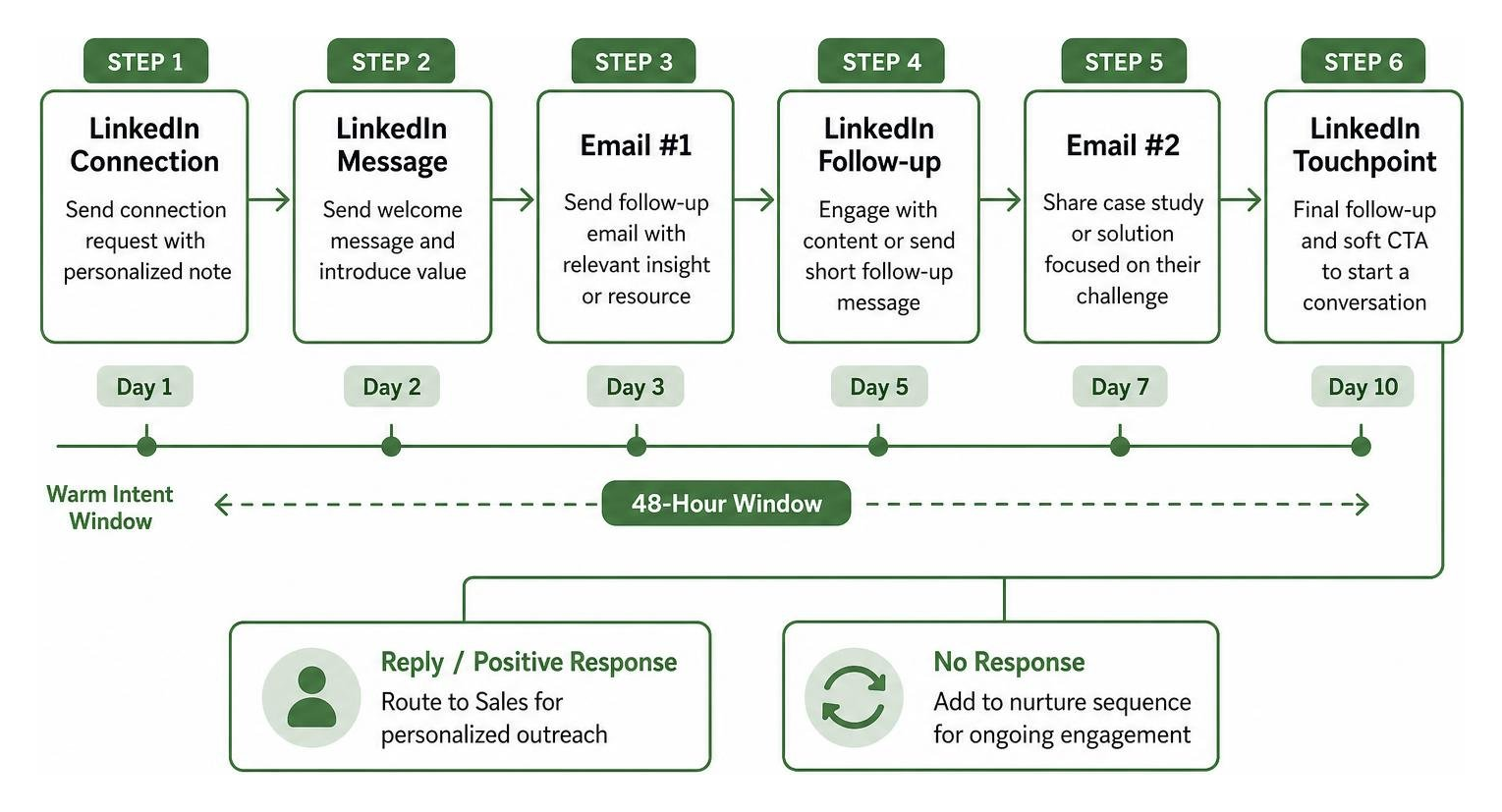
Alt Text: Multi-channel B2B outreach sequence flowchart; Metadata: 800×600 px, JPG format
When designing these multi-channel sequences, timing is everything. Specifically, we must optimize for the warm intent window. This is the critical 48-hour period after a prospect accepts your LinkedIn connection request or engages with one of your posts. During this short window, your brand is top-of-mind, and their receptivity to a conversation is at its peak.
A high-converting multi-channel cadence might look like this:
- Day 1 (Soft Touch): Visit the prospect’s LinkedIn profile and engage with their latest post (like or thoughtful comment).
- Day 2 (The Connection): Send a highly personalized, context-rich connection request.
- Day 3 (The Warm Window): Once the connection is accepted, send a brief, value-first message referencing their recent activity.
- Day 5 (The Pivot): If they haven’t replied on LinkedIn, send a structured, personalized follow-up email to their professional inbox.
- Day 8 (The Social Touch): Interact with another piece of their content or send a soft follow-up message on LinkedIn.
By spreading these touchpoints across multiple channels, you dramatically increase your chances of booking a meeting. In fact, teams utilizing multi-channel sequences see up to 10x more replies compared to single-channel outreach. For a deep dive into structuring these touchpoints, check out our guide on How to Generate Leads on LinkedIn.
Personalizing Messaging at Scale with LinkedIn Lead Gen Automation
The biggest mistake marketers make when implementing linkedin lead gen automation is treating it like a digital megaphone. They write a single generic pitch, load up a list of a thousand names, and hit “send.” This “spray and pray” approach is the fastest way to get your account flagged, burn your target audience, and destroy your brand’s reputation.
True automation is not about sending more generic messages; it is about automating the intelligence required to send highly personalized messages at scale.
Modern AI-powered tools allow us to write hyper-personalized messages by analyzing a prospect’s public profile data, recent posts, and company news.
One of the most exciting advancements in 2026 is voice-matched drafting. Advanced AI models can analyze 5 to 10 of your previously sent, successful direct messages to capture your unique writing fingerprint—including your typical sentence length, tone of voice, question frequency, and even emoji preferences.
The AI then uses this fingerprint to draft personalized connection requests and follow-ups. Instead of a robotic template, the prospect receives a message that sounds genuinely human:
“Hi [Name], loved your recent thought on the Postgres migration challenges you posted about yesterday. Replicating those write-heavy workloads is always a headache. Would love to connect and share how we solved this for a mid-market SaaS team last month.”
By using conditional branching logic within your sequences, the system can automatically adapt the message based on how the prospect interacts. If they viewed your profile, they get one message; if they accepted your invite but didn’t reply, they get another. This level of personalization ensures that your outreach feels like a natural, one-to-one conversation rather than a cold, automated broadcast.
Top Tools and Technologies for LinkedIn Lead Gen Automation in 2026
The landscape of linkedin lead gen automation has evolved rapidly. We have moved past simple browser extensions that blindly click buttons on your screen. Today, the market is split into sophisticated cloud-based platforms, API-driven scrapers, and autonomous self-hosted AI agents.
To choose the right tool for your business, it is essential to understand how these technologies differ in features, security, and deployment:
| Feature/Criteria | Cloud-Based SaaS Platforms | Self-Hosted AI Agents / Open-Source |
|---|---|---|
| Examples | Meet Alfred, Quicklead | OpenOutreach, Prospero, CLI Lead Engines |
| Hosting & Infrastructure | Cloud-servers with dedicated residential IPs | Local machine, Docker, or self-hosted cloud instances |
| Technical Complexity | Low (plug-and-play, user-friendly dashboards) | High (requires API keys, command line, or basic coding) |
| Safety Profile | High (smart limits, randomized human-like delays) | Extremely High (can run browserless using offline data) |
| Primary Use Case | Sales teams, agencies, and recruiters scaling volume | Technical founders and developers running custom pipelines |
| Data Control | Shared with the SaaS provider | 100% private and owned locally |
When selecting your stack, consider your team’s technical capabilities. If you have dedicated operations or development resources, self-hosted tools combined with open-source automation platforms (like n8n) offer unparalleled flexibility. For instance, some advanced setups use the Google Custom Search API to find indexed LinkedIn profiles and snippets, completely bypassing the need to scrape LinkedIn directly. This allows teams to discover up to 1,000 highly targeted leads daily at virtually zero cost.
On the other hand, if you want a user-friendly system that your sales team can manage without writing a single line of code, cloud-based platforms like Meet Alfred and Quicklead are the gold standard. They provide centralized inbox management, native multi-channel sequencing, and built-in safety controls out of the box. Finding the right balance of these technologies is key to choosing the best Lead Generation Software for your organization’s growth.
Ensuring Account Safety with LinkedIn Lead Gen Automation
Let’s address the elephant in the room: LinkedIn’s terms of service strictly prohibit automated scraping and third-party outreach tools. If you run automation carelessly, LinkedIn will not hesitate to restrict or permanently ban your account.
However, there is a massive difference between spamming the platform and using automation responsibly to mimic natural human behavior. To keep your personal and corporate accounts completely safe, you must adhere to strict safety protocols:
- Respect Connection Limits: Standard LinkedIn accounts are generally capped at 20 to 40 connection requests per day, or roughly 100 to 200 per week. Never attempt to bypass these limits. If you need more volume, implement a multi-sender strategy that rotates outreach across multiple team member accounts rather than overloading a single profile.
- Avoid Browser Extensions: Legacy browser extensions run locally on your computer, injecting code directly into your browser. LinkedIn’s security algorithms can detect this instantly. Instead, use cloud-based platforms that run on dedicated, isolated cloud sessions with residential proxies matched to your physical location.
- Implement Warm-Up Sequences: If you are starting automation on a new or historically quiet LinkedIn account, you must warm it up gradually. Start by sending 5 connection requests a day, slowly increasing the limit over several weeks.
- Incorporate Gaussian Jitter: Ensure your automation tool randomizes the delays between actions (e.g., waiting 47 seconds before visiting a profile, then 112 seconds before sending a message). Fixed, mathematical intervals are a dead giveaway of bot activity.
- Use Human-in-the-Loop Approval: Never automate 100% of your outreach. Use systems where the AI drafts the personalized messages and saves them in an approval queue (such as a shared database or a Notion board). A human should review and approve every single draft before it is sent. This guarantees absolute message quality and protects your professional reputation.
Streamlining Lead Capture with Native Forms and CRM Integrations
One of the most effective ways to maximize your conversion rates is to reduce friction at the point of lead capture. Traditional campaigns often direct prospects to external landing pages where they are forced to manually type in their name, email, company, and job title. On mobile devices, this manual typing causes massive drop-offs.
LinkedIn Lead Gen Forms solve this problem by keeping the entire experience native and frictionless.
Alt Text: LinkedIn Lead Gen Form to CRM integration diagram; Metadata: 800×500 px, PNG format
When a user clicks on your ad or call-to-action, a native form opens within the LinkedIn app. This form is automatically pre-filled with accurate, verified data pulled directly from their LinkedIn profile (such as their professional email, job title, company name, and location). The user can submit their information with a single tap, without typing a single character.
Because of this seamless experience, 90% of pilot customers beat their cost-per-lead (CPL) goals when using Lead Gen Forms compared to standard landing page campaigns.
However, capturing the lead is only half the battle. To prevent these hot leads from cooling down, you must route their data instantly into your CRM or marketing automation platform.
By setting up automated API integrations or webhooks, you can ensure that the moment a prospect submits a Lead Gen Form, their details are pushed directly to your sales pipeline. This immediately triggers an automated, highly personalized email nurturing sequence or alerts an AE to send a personalized LinkedIn message. This tight loop is critical for running highly efficient LinkedIn Lead Gen Campaigns.
Measuring ROI and Campaign Performance
An automated campaign is only as good as the data it produces. To optimize your LinkedIn lead gen automation, you must move past basic vanity metrics (like connection acceptance rates) and focus on bottom-line business impact.
We recommend tracking the following core metrics to measure your true return on investment (ROI):
- Cost-Per-Lead (CPL): Total campaign spend divided by the number of qualified leads captured.
- Connection Acceptance Rate: The percentage of sent connection requests that are accepted. A healthy benchmark is between 38% and 60%.
- Response Rate: The percentage of connected prospects who reply to your automated sequences. Highly personalized, AI-driven outbound campaigns can achieve reply rates of up to 23%.
- Meeting Booking Rate: The percentage of total outreach prospects who successfully book a meeting on your sales calendar.
- Pipeline Attribution: The total dollar value of active sales opportunities generated directly from your LinkedIn automation campaigns.
By tracking these metrics from the initial touchpoint to closed-won revenue, you can continuously optimize your targeting, messaging, and sequence timing to ensure maximum profitability.
Frequently Asked Questions About LinkedIn Lead Gen Automation
Is LinkedIn lead gen automation safe for my personal account?
Yes, but only if you prioritize safety and mimic human behavior. If you use cheap browser extensions, ignore daily limits, or send generic spam to hundreds of people, your account will be restricted.
However, if you use cloud-based platforms with dedicated residential proxies, keep your daily connection requests under 40, use randomized delays, and implement a human-in-the-loop review process, you can safely scale your outreach without putting your personal profile at risk.
How do AI-powered tools improve lead quality?
AI-powered tools improve lead quality by replacing manual, gut-feeling prospect selection with data-driven predictive scoring.
These tools analyze vast amounts of public data—including a prospect’s recent posts, company website updates, and structural hiring changes—to identify high-intent buying signals. This ensures your sales team only spends their time talking to prospects who match your Ideal Customer Profile and are actively looking for a solution.
What is the difference between cloud-based and browser-extension automation?
Browser extensions run locally on your computer and inject code directly into your web browser to automate actions. They are cheap and easy to set up, but they are highly unstable, slow, and easily detected by LinkedIn’s security systems.
Cloud-based automation platforms run on secure, remote servers with dedicated IP addresses. They run 24/7 even when your computer is turned off, mimic human browser behavior perfectly, and offer far superior safety, stability, and team collaboration features.
Conclusion
Mastering linkedin lead gen automation is no longer just a competitive advantage—it is a necessity for B2B organizations looking to scale predictably. By replacing the manual grind of prospecting with intelligent, multi-channel AI assistants, you empower your sales team to focus on what they do best: building authentic relationships and closing high-value deals.
But building, securing, and optimizing a high-performing automation engine requires deep technical expertise and constant monitoring. You don’t have to navigate this complex landscape alone.
At SocialSellinator, we specialize in building customized, fully compliant outreach strategies that drive measurable pipeline growth. Whether you need to optimize your search engine visibility, manage high-converting paid campaigns, or implement a state-of-the-art social selling engine, our experienced team is here to help you succeed.
Ready to transform your B2B outreach? Explore our specialized SocialSellinator LinkedIn Lead Generation Services today to see how we can help you capture high-intent leads and grow your bottom line.
Headquartered in San Jose, in the heart of Silicon Valley and the San Francisco Bay Area, SocialSellinator proudly provides top-tier digital marketing, SEO, PPC, social media management, and content creation services to B2B and B2C SMB companies. While serving businesses across the U.S., SocialSellinator specializes in supporting clients in key cities, including Austin, Boston, Charlotte, Chicago, Dallas, Denver, Kansas City, Los Angeles, New York, Portland, San Diego, San Francisco, and Washington, D.C.