
How to Grow Discord Community Quickly in 5 Easy Steps
Why So Many Discord Servers Stay Empty (And How to Fix That Fast)
Alt text: Discord community growth with active channels and visible member engagement
Image metadata: Header image, high-quality illustration, topic: Discord community building and engagement
If you want to grow Discord community quickly, the good news is that it is absolutely doable, but most server owners go about it the wrong way from day one. The digital landscape is littered with “ghost town” servers that were launched with high hopes but zero strategy. These servers often fail because they lack a fundamental understanding of the “Digital Third Space”—a place where people go to connect outside of work and home. To succeed, you must treat your server not just as a chat room, but as a living ecosystem that requires careful cultivation, professional management, and a clear value proposition.
Here is the short version of the growth loop:
- Pick a hyper-specific niche – generic servers like “gaming” or “memes” rarely grow because they lack a unique identity.
- Set up a clean, professional server structure – rules, welcome channel, and 8-14 focused channels that guide the user experience.
- Promote in the right places – social media, creator ecosystems, and content that fit your audience’s specific interests.
- Retain members with weekly events and human greeters – most servers lose 70-90% of new joins before anyone sends a message because the onboarding is cold or confusing.
- Measure activation and retention – healthy growth comes from participation, not vanity counts. A thousand silent members are worth less than fifty active ones.
The hard truth is that most Discord servers never get real momentum because the owners focus on member count instead of building a reason to stay. The servers that grow fastest usually share one thing: they give people something specific to belong to. A focused niche, a clear purpose, and a welcoming first experience will outperform a broad, generic server almost every time. This is where professional digital marketing principles come into play. Just as SocialSellinator helps businesses refine their messaging for SEO and PPC, a server owner must refine their community’s “hook” to ensure it resonates with the target demographic.
A real example of this pattern is a niche mental health Discord community that grew past 1,400 members in three months and later crossed 2,000 by combining sharp positioning, smart free promotion, and consistent engagement. No raids. No spam bots. No gimmicks. They focused on a specific sub-topic within mental health, ensuring that every new member felt they had found “their people” immediately upon joining.
This guide walks through the same five-step approach in a practical, retention-first way, ensuring your growth is both rapid and sustainable.
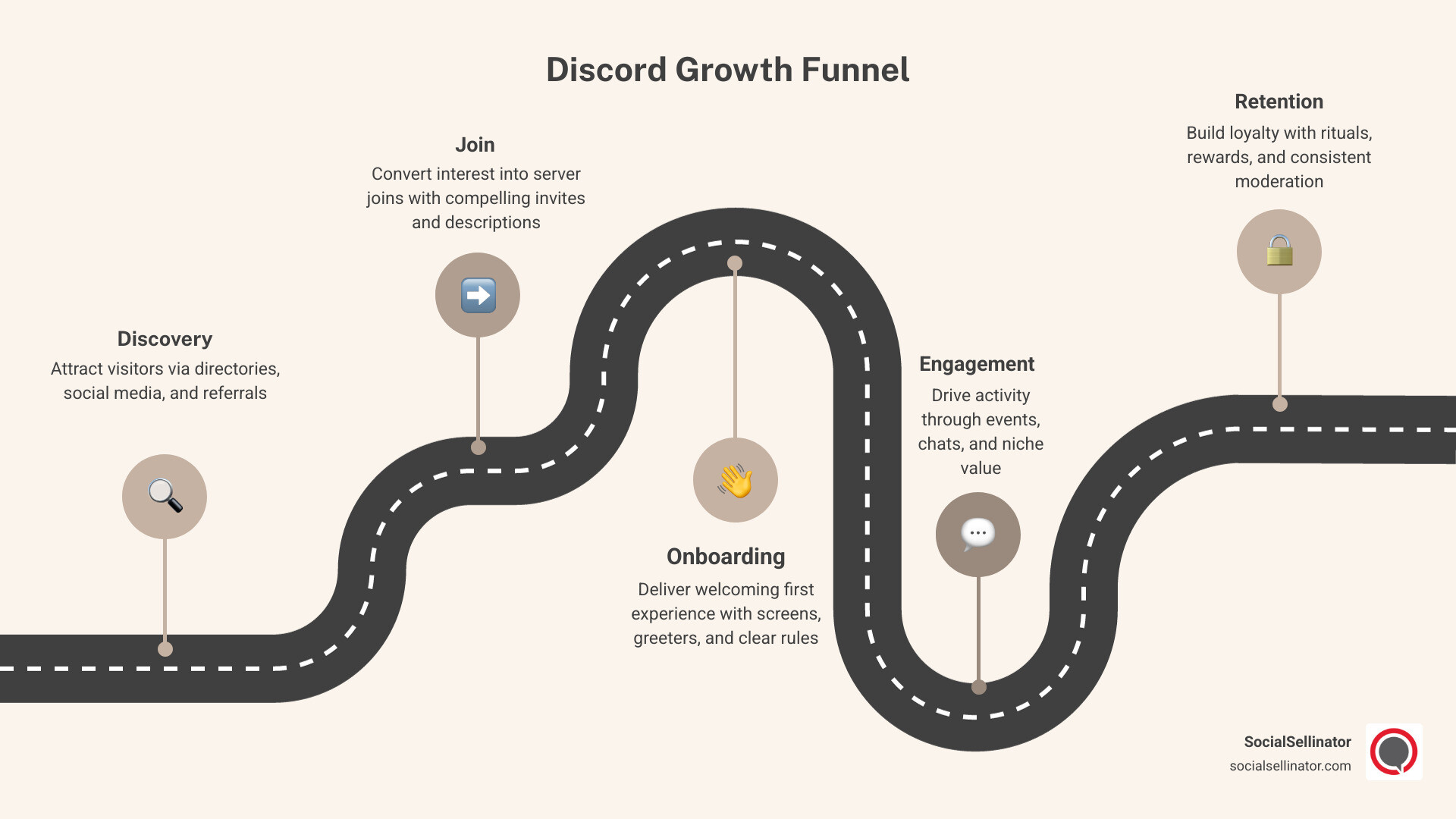
Alt text: Discord community growth funnel from discovery to onboarding, retention, and engagement
Image metadata: In-line image, infographic style, topic: member acquisition and retention funnel
Step 1: Decide If You Should Grow Discord Community Quickly at All
Not every idea deserves its own server. That sounds harsh, but it saves months of frustration. If the goal is to grow Discord community quickly, we need to be honest before we create anything: does this idea actually need a Discord server, or would it work better as a group chat, subreddit, newsletter, or social feed? Discord is a high-maintenance platform that requires real-time moderation and constant content flow. If you aren’t prepared for that level of commitment, your growth will stall before it even begins.
Fast growth usually comes from clear usefulness, not enthusiasm alone. You need to identify a “pain point” that your community solves. Are people looking for teammates? Are they looking for professional networking? Are they looking for a safe space to discuss a niche hobby? Without a clear “why,” your server will just be another notification that people eventually mute and forget.
Ask the 5 questions before you create anything
Before building channels or inviting friends, ask:
Are we genuinely interested in this topic long term? A server is not a weekend project. Early growth usually requires daily involvement for weeks. You will be the primary conversation starter for the first 100 members.
Is the topic specific enough? “Gaming” is too broad. “No-toxicity Valorant coaching for Silver and Gold players” is much better. Specificity wins because people instantly understand the value and the “vibe” of the community.
Are there already established communities for this exact need? If yes, we should ask whether joining or partnering makes more sense than starting from scratch. If you do start your own, you must offer something the existing giants do not—perhaps a more intimate setting or specialized resources.
Does this topic benefit from real-time conversation? Discord works best when people want ongoing chat, voice calls, live events, support, matchmaking, accountability, or community rituals. If the topic is purely informational, a newsletter might be better.
Are we building this for the community, not our ego? Servers grow faster when they feel member-first. If everything revolves around the owner badge and self-promotion, people notice. And not in a good way. A successful community is a democracy of interest, even if it’s a managed one.
How to validate demand before you try to grow discord community quickly
Validation matters because even the best setup cannot save a server nobody asked for. You should treat your community launch like a product launch. This involves market research and audience testing.
A simple way to test demand:
- Ask 5 to 10 people in the target audience if they would actually join and participate.
- Post an interest check in a relevant online community where allowed, asking for feedback on the concept.
- Create a simple waitlist or signup form to gauge how many people are willing to give their email for an invite.
- Share a one-sentence pitch and see whether people understand it immediately. If you have to explain it for five minutes, the concept is too complex.
- Aim for at least a small pool of 20-30 interested early members before the official launch to ensure the server isn’t empty on day one.
For local communities in cities like Austin, Boston, Charlotte, Chicago, Dallas, Denver, Kansas City, Los Angeles, New York, Portland, San Diego, San Francisco, San Jose, Silicon Valley, and Washington, D.C., validation can be even easier. You can test interest through existing local social audiences, creator communities, meetup-style groups, or niche hobby circles. Localized communities often grow faster because the “real-world” connection adds a layer of trust and accountability that purely digital spaces lack.
Niche vs general servers: what actually grows faster
Hyper-specific servers almost always grow faster than generic hangouts. Why? Because people can tell in 10 seconds whether they belong there. In a world of infinite digital noise, clarity is a superpower. A vague server like “fun community” competes with thousands of others. That means generic communities are not just hard to grow, they are easy to ignore.
Better examples of high-growth niches:
- A local gaming and events community for Chicago players focusing on fighting games.
- A creator feedback hub for Los Angeles short-form video editors working in the beauty niche.
- A startup founder accountability server for San Francisco and San Jose tech entrepreneurs.
- A fantasy book club for Boston readers focusing on 19th-century gothic literature.
- A niche esports training server for one specific title and one specific skill bracket.
One server can reach massive size without heavy advertising if the topic fit is strong enough. The pattern is consistent: narrow identity first, promotion second. For brands and businesses, this is also where broader digital marketing strategy matters. If your positioning is vague, your community growth will be vague too. Clear audience targeting, strong messaging, and focused content—the same fundamentals used in SEO, PPC, and social media marketing—also make Discord growth much easier. SocialSellinator specializes in this type of precision targeting, ensuring that every marketing effort reaches the exact right person at the exact right time.
Step 2: Build a Server That Feels Professional on Day One
If new members join and feel confused, growth stops. A polished setup improves trust, activation, and retention. It also makes promotion easier because we can confidently send people somewhere that feels active and safe. Think of your server as a storefront; if the windows are dirty and the shelves are empty, nobody is going to stay and shop.
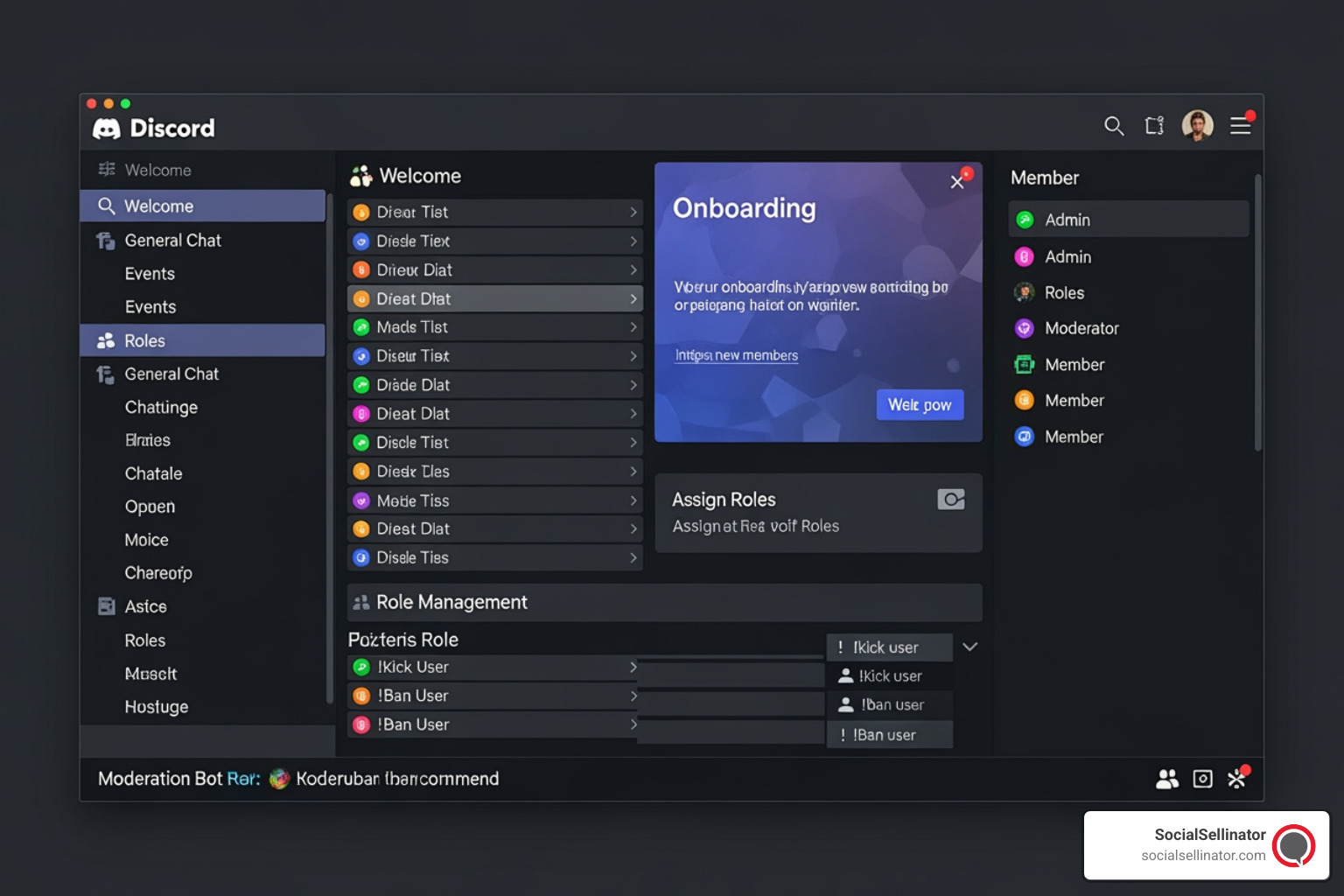
Alt text: Discord server channel architecture showing roles, permissions, onboarding, and moderation setup
Image metadata: In-line image, high-quality diagram, topic: server setup and moderation workflow
The fastest server structure to grow discord community quickly
Most new servers make one of two mistakes: they either have too many channels, so everything feels dead, or too few channels, so everything becomes chaos. A practical sweet spot for most new communities is 8 to 14 active channels. This provides enough variety to keep things interesting without spreading the conversation too thin.
A clean starter structure should include:
#rules: Clear, concise, and non-negotiable.#welcomeor#start-here: The first thing people see. It should contain a 2-sentence mission statement.#announcements: For important updates only. Keep this clean.#introductions: A place for new members to break the ice.#general: The main hub for daily chatter.#helpor#questions: A dedicated space for support.#events: A calendar of what’s coming up.#resourcesor#faq: Static information that adds value.- 1 to 3 topic-specific channels: For example,
#strategy-talkor#gear-reviews. - 1 to 2 voice channels: One for active hanging out and one for “AFK” or quiet study.
Put the most important channels first. The goal is simple: a new member should understand what to do in under a minute. Best practices include keeping rules short and readable, making the first call-to-action (CTA) obvious, and archiving dead channels instead of letting them collect dust. If a channel hasn’t had a message in 48 hours, it might be time to merge it with another.
Roles, permissions, and staff structure that scale cleanly
Permissions should follow the least-privilege rule: give people only the access they need. Start with a simple role system that can grow as you do. Avoid the temptation to create 50 different roles for every minor achievement; this creates “role bloat” and makes your member list look messy.
Start with this basic hierarchy:
- Admin: Full control, usually the founders.
- Moderator: Daily enforcement and member support.
- Event Host: Trusted members who can start stages or voice events.
- Member: The standard role for verified users.
- Optional interest roles: Used for pinging specific groups (e.g., @PC-Gamers).
A useful scaling guideline is to have around 1 moderator per 1,000 members. This isn’t a hard law, but it’s a solid planning benchmark. Other smart role tips include avoiding giving new joins automatic roles if it weakens your verification setup, keeping hoisted roles limited to essential staff, and using reaction or self-select roles for interests, regions, or notifications. This allows members to customize their own experience without cluttering the server for everyone else.
Bot stack: moderation, referrals, loyalty, and onboarding
Bots help, but too many bots make a server feel like a vending machine with trust issues. A lean stack usually works best. You want bots that enhance the human experience, not replace it. For example, a moderation tool for spam, filters, and logs is essential for keeping the environment safe. AutoMod and verification settings should be your first line of defense.
A welcome or onboarding bot can help automate the initial greeting, but it should be followed by a human message whenever possible. An analytics or activity-tracking bot is vital for measuring growth and identifying which channels are performing well. Optional referral tracking bots can help when they reward real advocacy, and loyalty or rewards bots can help when they recognize useful participation. However, both become harmful if they encourage empty chatting just to grind points. Use bots to support the community, not replace the core social interaction.
Security and anti-raid settings most owners skip
Security is growth infrastructure. If a raid or spam wave hits early, your best new members may leave before they ever say hello. Important protections include raising verification levels appropriately, using CAPTCHA or basic verification if needed, and reviewing invite permissions. You should also enable and monitor audit logs to see who is making changes to the server.
Restrict dangerous permissions like mass mentions (@everyone and @here) to only the highest-level staff. Limit bot permissions to the bare minimum required for them to function. Do not auto-assign roles that bypass verification controls unless absolutely necessary. Security should still stay balanced with usability. Too much friction hurts conversion, while too little protection invites abuse. The best setup protects the server without making legitimate members feel like joining is a chore.
For organizations using Discord as part of a bigger digital marketing or community strategy, this setup work matters even more. A polished server reflects brand quality the same way a strong landing page, SEO-friendly content hub, or well-structured PPC destination page does. SocialSellinator understands that every touchpoint in the customer journey—including a Discord server—must be optimized for the best possible user experience.
Step 3: Promote Without Spamming or Breaking Trust
Promotion should feel like matching the right people with the right community—not throwing invites around like confetti. The big rule: never send unsolicited invites in DMs or random servers. That is bad etiquette, it’s ineffective, and it can violate platform rules, leading to your account or server being banned. Instead, focus on “pull” marketing rather than “push” marketing.
Free ways to grow discord community quickly without violating rules
Free promotion still works well when it is targeted and value-driven. Good options include Discord directory listings with keyword-rich descriptions that help people find you through search. You should also include social bio links on all your profiles and make relevant posts on your existing social channels. Niche subreddits where promotion is allowed can be a goldmine, as can forums, group chats, or communities tied to your topic.
Content marketing that naturally points people to the server is one of the most effective long-term strategies. If you write a helpful blog post or create a useful video, mention that more in-depth discussion happens in your Discord. We also recommend making your invite copy value-driven. Instead of “Join our server,” say what people get:
- “Join our weekly ranked scrims every Friday night.”
- “Get peer feedback on your short-form video edits from professional creators.”
- “Access local startup networking and office-hours chats with Silicon Valley founders.”
- “Join our book discussions every Thursday at 7 PM EST.”
- “Find beginner-friendly help without the toxicity found in larger hubs.”
What matters most is relevance. A small number of highly matched joins beats a flood of random clicks every time. Quality over quantity is the mantra for sustainable growth.
Paid tactics that bring better members, not just bigger numbers
Paid promotion can help, but only after your onboarding and retention work is solid. If people join and leave immediately, paid traffic just helps you fail faster. Better paid options include sponsored posts in niche communities where allowed, creator shoutouts from relevant micro-influencers who share your target audience, and premium placements on listing platforms.
Paid social campaigns supporting a landing page can also be effective, as can community-focused PPC campaigns tied to a specific offer or event. Paid promotion works best when attached to something concrete, such as a launch week, a free workshop, a tournament, an AMA, a challenge, or a local event. This gives people a reason to join now rather than “someday.”
That is where strong digital marketing strategy matters. If we are already building cross-platform visibility through SEO, PPC, and social media, Discord becomes one part of a broader acquisition funnel instead of a lonely invite link floating around the internet. SocialSellinator helps clients integrate these various channels into a cohesive strategy that drives high-quality traffic to their most important community hubs.
Partnerships with streamers, esports teams, and adjacent communities
Partnerships can accelerate growth when there is true audience overlap. A strong partnership is a win-win where both communities get value. Strong examples include a streamer hosting a Q&A in your server, a local esports team helping promote tournament signups, a creator community collaborating on a showcase event, or two adjacent niche servers co-hosting a workshop.
Weak examples to avoid include random link swaps with unrelated servers, mass “partnership outreach” messages that feel like spam, and shoutout trades with communities that have no overlap. The best partnership question is simple: Would their audience naturally care about what happens in our server next week? If the answer is yes, you have something useful. If no, it is probably just noise with better branding.
How social media content turns discovery into joins
Short-form content is one of the best discovery tools in 2026. People do not join Discord servers because you tell them to; they join because they see proof that the community is alive and providing value. Content ideas that convert include clips from live events, funny moments from voice chat, quick tips from your niche, community wins, and member spotlights.
Event recaps and screenshots of active, high-value discussions can also be very persuasive. Simple “here’s what happens in our server each week” videos can demystify the experience for newcomers. This is where a broader social media system helps. If we already know how to build consistent visibility, publish useful content, and drive action across platforms, we can turn social reach into qualified Discord joins instead of vanity impressions. SocialSellinator’s expertise in social media management ensures that your content isn’t just seen, but that it drives the specific actions you need for growth.
Step 4: Retain Members So Growth Doesn’t Turn Into Ghost Members
Retention is where most Discord growth plans quietly fall apart. Research across multiple sources points to the same problem: many servers lose 70% to 90% of new joins before they ever send a message. That means the issue usually is not top-of-funnel traffic; it is what happens after the click. If you can’t keep the people you get, you’re just pouring water into a leaky bucket.
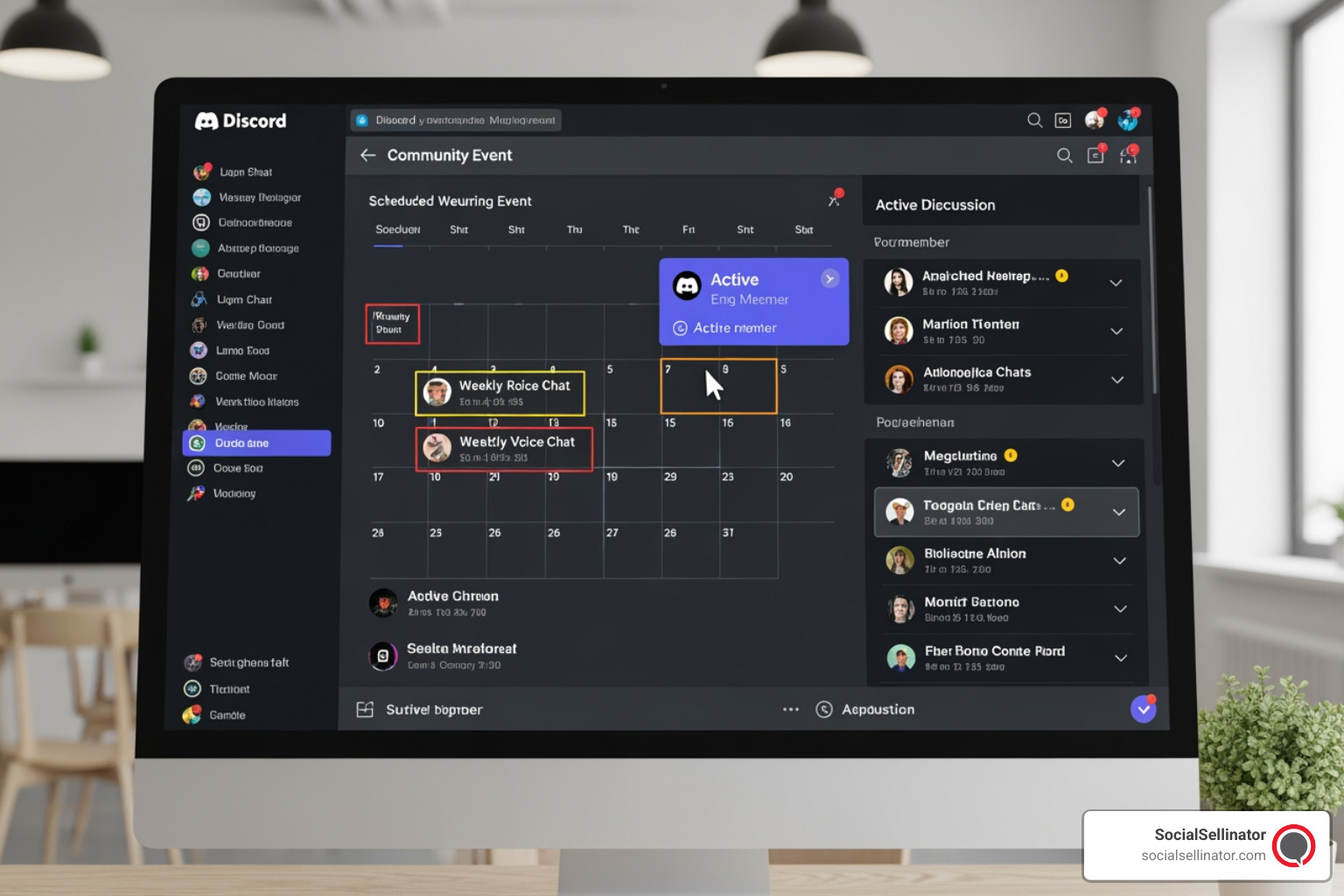
Alt text: Discord community event calendar with active chat member badges and recurring engagement
Image metadata: In-line image, high-quality graphic, topic: community engagement and event scheduling
The first 5 minutes that decide whether new members stay
The first five minutes determine whether a new member becomes active, lurks forever, or leaves. This is the “onboarding window.” During this time, they need to understand what the server is for, see visible activity, know exactly where to post first, and feel welcomed by a real person if possible. They should be able to access meaningful content in under three clicks.
A strong onboarding flow includes short, punchy welcome copy, one clear first action (like “Introduce yourself here”), a simple channel layout that isn’t overwhelming, and a friendly staff presence. Optional prompts like “What brought you here?” or “What is your biggest goal this month?” can help spark that first vital interaction. One research-backed benchmark is especially useful: aim for at least 30% of new joiners to send a first message within 24 hours. If you are below that, fix your onboarding before spending more effort on promotion.
Events, giveaways, tournaments, and incentives that actually work
Events create rhythm. Rhythm creates habits. Habits create community. The best events are not always huge productions. In fact, smaller recurring rituals often outperform occasional giant events because they build consistent engagement. Good options include weekly game nights, monthly AMAs (Ask Me Anything), review or critique sessions, office hours, challenges, tournaments, and new member mixers.
Giveaways can help, but only when they support the community instead of attracting prize hunters. If you give away a generic Amazon gift card, you’ll get people who don’t care about your niche. If you give away something specific to your community—like a specialized tool, a coaching session, or a unique role—you’ll attract the right people. Gate these rewards around relevant participation, not just random reactions.
Healthy incentives include referral rewards for bringing in qualified members, badges for contribution, spotlight features for active members, and access to useful resources. Low-quality incentives create low-quality behavior. If people are only there for a freebie, they usually leave when the freebies stop. You want to reward contribution, not just presence.
What to avoid: XP systems, dead channels, and low-value bots
Some popular tactics look like growth but produce mostly noise. Be careful with XP systems that reward message spam; they often lead to “level grinding” where people post nonsense just to see a number go up. Game bots unrelated to your purpose can also distract from the core mission of the server. Endless meme dumps in serious communities can drive away high-value members who are looking for real discussion.
Empty channels no one uses are a major red flag for new members. If a channel is dead, delete it or merge it. Automated “revive chat” clutter and excessive pings are also quick ways to get your server muted. A good rule is to reward contribution, not volume. Useful activity might mean helping others, starting thoughtful conversations, joining events, sharing resources, or welcoming new members. This is far more valuable than 400 one-word messages and a shiny level badge.
How many moderators you need as your community grows
You do not need a giant staff team early on, but you do need enough coverage to keep the space safe and responsive. As the server grows, build in layers. Founders and admins should handle strategy and difficult cases, while moderators handle daily chat and enforcement. Event hosts or community leads can drive activity without needing full moderation powers.
A practical staffing benchmark is about 1 mod per 1,000 members, adjusted for activity level, age group, and timezone spread. You should also set up a staff handbook, escalation rules, and internal notes to ensure consistency. The best staff are not just rule enforcers; they are visible participants who model the culture you want to see. They set the tone for every interaction in the server.
Step 5: Measure What Healthy Growth Looks Like
If we only track member count, we can fool ourselves fast. A server with 2,000 members and 40 people online may be weaker than a server with 500 members and 150 active users. Healthy growth is about participation, retention, and fit. You need to look at the data to understand the true health of your community. This is the same approach SocialSellinator takes with digital marketing—focusing on the metrics that actually drive business results, not just vanity numbers.
The metrics that matter more than raw member count
Focus on these key performance indicators (KPIs):
- New joins per week: Is your promotion working?
- Join-to-first-message rate: Is your onboarding effective?
- Day 7 and Day 30 retention: Are people finding a reason to stay?
- Daily and Weekly Active Users (DAU/WAU): How many people are actually using the server?
- Active chatters: How many people are contributing vs. just lurking?
- Messages per active member: Is the conversation deep or superficial?
- Referral rate: Are your members bringing in their friends?
- Source of joins: Which promotion channel is most effective?
One useful engagement benchmark: around 0.5 to 2 messages per member per day can be a healthy range depending on the server type. Member count is a lagging metric, while activation and retention are leading metrics. If people join and actually participate, growth compounds. If they leave or go silent, your promotion efforts are just a leaky bucket.
Simple review cadence to improve growth every week
Run a weekly review of your server’s performance. It does not need to be fancy, but it must be consistent. Check which channels were active and which were dead. Look at where your new joins came from and how many of them spoke within the first 24 hours. Identify which event had the best turnout and which social media posts drove the most invites.
Then, make one or two small changes each week based on that data. You might rewrite the welcome message, archive a couple of dead channels, test a different event time, or improve your server description. You could also ask your greeters to personally welcome every newcomer or adjust your verification settings if you notice too many people dropping off before they speak. Continuous improvement is the key to long-term success.
When to double down, pivot, or pause promotion
Knowing when to change your strategy is just as important as having one. Double down when new members are activating well, events are filling up, and existing members are starting to invite their own friends. This is the time to increase your promotion efforts or even explore paid options.
Pivot when your growth sources are bringing in the wrong audience, or if your niche feels too vague. If new people join but do not engage, your “hook” might be wrong. Pause promotion when your staff cannot handle the moderation load, or if you notice toxicity increasing. If retention is falling hard, more traffic is not the answer. Sometimes the fastest way to grow is to stop promoting for a week and fix the internal experience. A healthy community is a stable one, and stability must come before scale.
Frequently Asked Questions About How to Grow Discord Community Quickly
Should you create a Discord server or join an existing one?
Create a new server if you have a clear niche, real demand, and a reason why Discord is the best format for your goals. If you have a unique perspective or a specific problem to solve that isn’t being addressed elsewhere, start your own. However, join or partner with an existing server if the need is already well served and your value is additive rather than distinct. If ownership matters more to you than usefulness, that is usually a warning sign that you’re building for the wrong reasons.
Are referral bots, loyalty bots, and moderation bots worth it?
Yes, but only if they solve real problems. Moderation bots are almost always worth it from day one to prevent spam and raids. Referral bots can be helpful if the rewards encourage high-quality, qualified invites rather than just mass-pinging. Loyalty bots can help if they recognize and reward meaningful participation, but they shouldn’t be the only reason people are talking. Keep your bot stack lean and focused on enhancing the user experience.
How fast can a new Discord server realistically grow in 2026?
With a strong niche, smart promotion, and good retention, noticeable traction can happen in 4 to 12 weeks. The first 50 members are the hardest because they create the initial culture. The first 100 prove there is real demand. Around 1,000 members, growth can start compounding if your onboarding and engagement are healthy. “Quickly” does not mean overnight; it means building a server that earns momentum faster because the fundamentals are right.
How do I handle toxicity as my server grows?
Toxicity is the enemy of growth. As you scale, you must have clear rules and a moderation team that isn’t afraid to enforce them. Use automated tools to filter out common slurs and spam, but rely on human moderators to handle nuanced situations. A “zero tolerance” policy for harassment is often necessary to keep the environment welcoming for everyone. Remember, one toxic member can drive away ten high-value members.
Can I use Discord for B2B networking?
Absolutely. Discord is increasingly being used for professional networking, especially in tech, creative, and marketing fields. The key is to maintain a professional yet accessible tone. Focus on providing value through resources, office hours, and high-level discussion. For B2B companies, a Discord server can be a powerful way to build brand loyalty and provide real-time support to clients and partners.
Conclusion
If we want to grow Discord community quickly, the formula is not complicated—but it does require discipline and a commitment to quality. By choosing a specific niche, building a professional structure, promoting through the right channels, and focusing heavily on member retention, you can create a thriving digital hub that stands the test of time.
We need to remember that a community is a living thing. It requires constant attention, a clear sense of purpose, and a welcoming atmosphere. Whether you are a creator, a brand, or a local organization, Discord offers a unique opportunity to connect with your audience on a deeper level than traditional social media allows.
For brands, creators, local organizations, and online communities, Discord works best when it is part of a bigger digital ecosystem. Social media brings discovery. SEO supports long-term visibility. PPC can amplify launches and events. Content marketing builds trust before people ever click an invite. SocialSellinator supports businesses with digital marketing services including SEO, PPC, social media management, and content creation to help build measurable growth across channels.
Headquartered in San Jose, in the heart of Silicon Valley and the San Francisco bay Area, SocialSellinator proudly provides top-tier digital marketing, SEO, PPC, social media management, and content creation services to B2B and B2C SMB companies. While serving businesses across the U.S., SocialSellinator specializes in supporting clients in key cities, including Austin, Boston, Charlotte, Chicago, Dallas, Denver, Kansas City, Los Angeles, New York, Portland, San Diego, San Francisco, and Washington, D.C.